

Bulrush in Ponds: Benefits and Identification
Bulrush in Ponds: Benefits and Identification
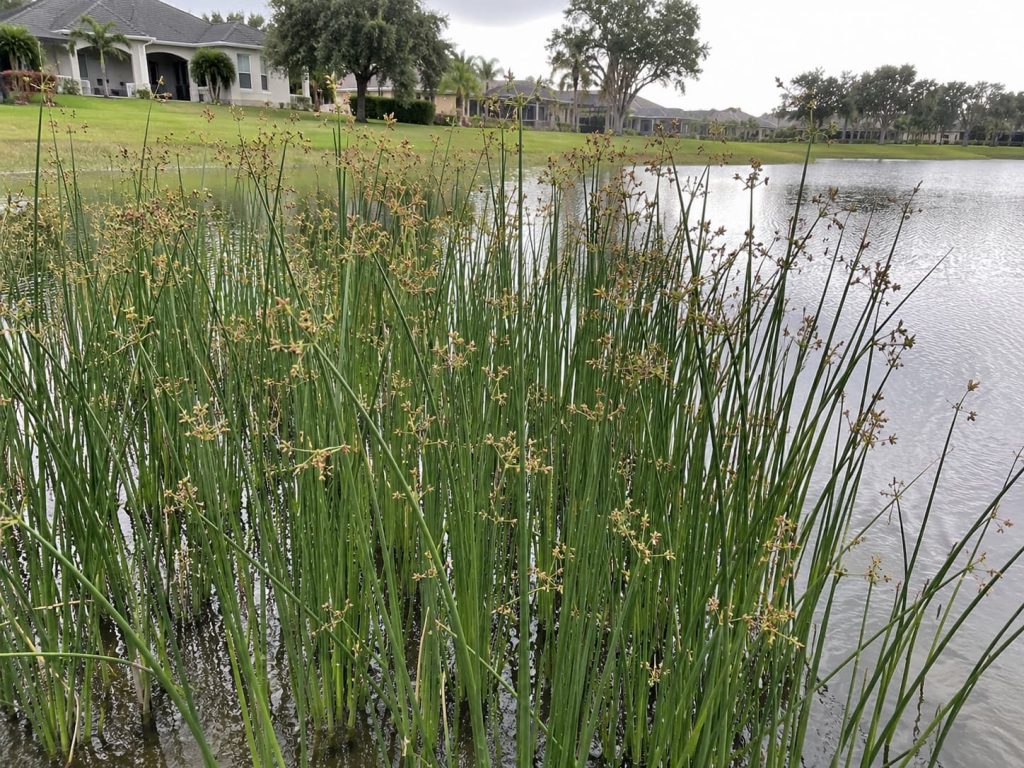
Table of Contents
Those tall, round green stems standing in clusters at the edge of a Florida pond are most likely bulrush, one of the state’s most useful and underappreciated native wetland plants. Bulrush rarely gets the attention that showier flowering plants do, but it quietly filters pollutants, buffers shorelines against waves, and shelters wildlife, making it a workhorse of healthy ponds and restoration projects alike.
This guide explains the benefits of bulrush for ponds, how to identify it, how it differs from the commonly confused cattail, where it grows, and how to keep its vigorous spread in balance.
Bulrush is a native Florida emergent plant with tall, round, soft green stems that grows in clusters along pond and lake edges. It benefits ponds by filtering nutrients and pollutants from runoff, stabilizing shorelines, buffering wave energy, and providing food and cover for waterfowl and other wildlife. It spreads readily by underground rhizomes.
Key Takeaways
- Bulrush is a Florida native sedge found nearly throughout the state along pond, lake, marsh, and stream edges.
- It filters water, with stems that absorb nutrients and pollutants entering the pond through runoff.
- It protects shorelines, buffering wind and wave action and stabilizing banks with dense rhizomes.
- It supports wildlife, providing seeds for ducks and other birds, food for muskrats, and nesting cover.
- Bulrush differs from cattail: bulrush has round, leafless stems, while cattail has flat leaves and a brown, cigar-shaped seed head.
What Is Bulrush?
Bulrush is a native emergent aquatic sedge, most commonly softstem bulrush (Schoenoplectus tabernaemontani) and giant or southern bulrush (Schoenoplectus californicus) in Florida. It grows as dense colonies of tall, round, soft green stems in shallow water and saturated soil, topped by drooping clusters of small brown flowers. Stems can reach 4 to 10 feet tall.
Understanding what bulrush is starts with recognizing that it is a sedge, not a grass or a broadleaf plant, with an unusual near-leafless growth form.
According to the UF/IFAS Center for Aquatic and Invasive Plants directory, softstem bulrush grows as large colonies of stems in marshes, streams, and ponds nearly throughout Florida, with rounded, light green, spongy stems up to about an inch wide at the base that taper upward, topped by hanging clusters of brown spikelets, and no true leaf blades, just sheaths at the base. Like other bulrushes, it is food for wild birds.
A few defining traits:
- Round, soft stems. The stems are cylindrical and spongy, giving softstem bulrush its name.
- Essentially leafless. Instead of leaf blades, bulrush has sheaths at the stem base, so the green stems do the work of the leaves.
- Drooping brown flowers. Small brown spikelet clusters hang near the stem tips.
- Colony-forming. It spreads by rhizomes into dense stands.
Florida has several native bulrush species, but they share this general form and the same ecological value.

What Are the Benefits of Bulrush for a Pond?
Bulrush benefits a pond by filtering nutrients and pollutants from runoff through its stems, stabilizing shorelines and buffering wave energy with dense root systems, and providing food and cover for waterfowl, birds, and other wildlife. It is widely used in wetland restoration and erosion control for exactly these reasons.
These benefits make bulrush a foundational plant for both natural and managed waterbodies.
Water filtration. Bulrush stems can absorb nutrients and pollutants that enter a pond through runoff, helping to filter the water. By taking up these inputs, bulrush competes with algae for the nutrients that fuel blooms, complementing broader water quality management.
Shoreline stabilization and wave buffering. Bulrush forms a buffer against wind and wave action, and its dense rhizome system holds bank soil in place. This wave-buffering role even allows other, more delicate aquatic plants to establish in the calmer water behind it. It is a natural fit for shoreline restoration and erosion control.
Wildlife habitat and food. The seeds are eaten by ducks and other wetland birds, muskrats feed on the foliage and rhizomes, and dense stands provide nesting cover for water birds and shelter for fish and aquatic invertebrates. This supports the food web that pond wildlife management sustains.
Restoration value. Because it establishes quickly, spreads vigorously, and does all of the above, bulrush is a staple of wetland reconstruction and habitat enhancement projects.
For communities with permit-required littoral coverage, bulrush is a dependable component of a compliant littoral zone planting, often installed alongside pickerelweed, arrowhead, and other natives.
Plant Bulrush In Your Pond
Bulrush are native beneficial littoral plants, which can help improve water quality in your Florida pond.
How Do You Identify Bulrush?

Identify bulrush by its tall, round, soft green stems that grow in dense clusters directly from the base, with no obvious leaves, just sheaths at the bottom. Near the stem tips, look for drooping clusters of small brown flower spikelets. Stems commonly reach 4 to 10 feet in shallow water or saturated soil.
The round, nearly leafless stem is the single most distinctive feature and the key to telling bulrush apart from other pond plants.
Key identification features:
- Stems: Round or slightly triangular, soft and spongy, light to dark green, rising directly from the base.
- Leaves: Essentially none, just sheaths wrapping the stem base, so the stems appear bare.
- Flowers: Small brown spikelet clusters, often drooping, near the top of the stem.
- Height: Commonly 4 to 10 feet depending on species and conditions.
- Habit: Dense, colony-forming stands in shallow water and wet soil.
If a pond-edge plant is a cluster of tall, round, leafless green stems, it is almost certainly a bulrush. If it has flat, sword-like leaves and a brown cigar-shaped seed head, it is a cattail, a distinction the next section covers.
Bulrush vs Cattail: What Is the Difference?
The main difference is the stems and seed heads. Bulrush has round, soft, nearly leafless green stems with small drooping brown flower clusters. Cattail has flat, sword-shaped leaves and a distinctive brown, cigar-shaped seed head on a stiff stalk. Both are emergent wetland plants, but they look quite different once you know what to check.
These two are constantly confused because both grow as tall stands at the water’s edge, but telling them apart is straightforward.
Feature | Bulrush | Cattail |
|---|---|---|
Stems | Round, soft, spongy | Stiff, with flat leaves |
Leaves | Essentially none, just sheaths | Long, flat, sword-shaped |
Seed head | Small drooping brown clusters | Brown cigar-shaped spike |
Overall look | Cluster of bare green stems | Flat leaves with a brown “cattail” |
Preferred water | Shallow, fluctuating levels | Deeper, more stable water |
Native in Florida | Yes | Yes (some cattails aggressive) |
As wetland plant guides note, bulrush produces slender, round stems from a basal clump with narrow or absent leaves and inconspicuous flower clusters, while cattail has flat leaves and the unmistakable brown cigar-shaped seed head. They also occupy slightly different niches: bulrush tolerates shallow, fluctuating water, while cattail tends to dominate deeper, more stable water.
This distinction matters for management. Cattail, especially where it grows aggressively, is often treated as a nuisance to control, while bulrush is usually a desirable native to encourage. Correct identification ensures you manage each appropriately.

Where Does Bulrush Grow in Florida?
Bulrush grows nearly throughout Florida in shallow freshwater and saturated soil along the edges of ponds, lakes, marshes, and streams. It prefers full sun and tolerates fluctuating water levels, growing in wet soil to about a foot or more of standing water. Some bulrush species also tolerate brackish conditions.
Its adaptability to varying water depth makes bulrush especially useful in stormwater ponds, where levels rise and fall.
Conditions bulrush prefers:
- Water depth: Saturated soil to roughly a foot of water, with tolerance for deeper water and fluctuation.
- Light: Full sun for best growth.
- Water type: Primarily freshwater, though some species tolerate a range of salinity, unlike many pond plants.
- Soil: Wet, mucky, or saturated substrate.
That tolerance for fluctuating water and, in some species, salinity gives bulrush an edge in challenging sites where more sensitive plants struggle, which is part of why it is a restoration favorite.
Can Bulrush Become Too Aggressive?
Bulrush can spread vigorously. It naturalizes by creeping rhizomes and self-seeding, sometimes aggressively, forming dense colonies along shorelines and in shallow water. In a managed pond this vigor is usually beneficial for erosion control and habitat, but it may occasionally need thinning to maintain open water and access.
As with most beneficial natives, its strength is also something to manage in an amenity setting.
Bulrush spreads sometimes aggressively to form dense colonies on shorelines or in shallow water. In restoration and erosion-control contexts this is exactly the goal. In a manicured community pond, it means planning for occasional maintenance.
Practical implications:
- Expect dense colonies to form and expand over a few seasons.
- Periodic thinning may be needed to keep open water, sightlines, and access.
- This is routine maintenance, not a control problem, since bulrush is a beneficial native rather than an invasive.
- Water-level management can influence its spread, since prolonged deep flooding can reduce bulrush stands.
Unlike genuinely invasive plants, bulrush belongs in the Florida ecosystem and supports native wildlife, so managing it is about maintaining balance rather than eliminating it.
Schedule a Site Visit With Pond Guru
Bulrush is a quiet achiever among pond plants: it filters runoff, absorbs wave energy, holds the bank, and feeds wildlife, all while asking little in return. It works best as part of a diverse native littoral planting matched to your pond’s depth, water movement, and shoreline conditions.
Pond Guru works with HOA boards, property managers, and homeowners across Florida to design and install native littoral plantings, restore shorelines, control nuisance vegetation, and manage water quality in community lakes and ponds.
Because plant selection depends on site conditions and any permit requirements, the process starts with an evaluation. To find out what your shoreline can support, schedule a site visit with Pond Guru and a specialist will assess conditions and recommend a planting plan.

Frequently Asked Questions
Bulrush benefits a pond by filtering nutrients and pollutants from runoff through its stems, stabilizing shorelines and buffering wave energy, and providing food and cover for waterfowl, birds, and other wildlife. It is widely used in wetland restoration and erosion control, making it one of the most useful native pond plants.
Yes. Bulrush is a native sedge found nearly throughout Florida along the shallow edges of ponds, lakes, marshes, and streams. Common Florida species include softstem bulrush and giant or southern bulrush. It is a beneficial native, not an invasive, and supports water quality, shorelines, and wildlife.
Bulrush has round, soft, nearly leafless green stems with small drooping brown flower clusters. Cattail has flat, sword-shaped leaves and a distinctive brown, cigar-shaped seed head. Bulrush tolerates shallow, fluctuating water, while cattail prefers deeper, stable water. Both are emergent plants but look quite different once identified.
Yes, significantly. Bulrush forms a dense rhizome root system that holds shoreline soil in place, and its stands buffer wind and wave action that would otherwise erode the bank. This wave-buffering even allows more delicate plants to establish behind it, making bulrush a frontline plant for erosion control and shoreline restoration.
Bulrush can spread vigorously, naturalizing by creeping rhizomes and self-seeding to form dense colonies. In a managed amenity pond it may need occasional thinning to maintain open water and access. This is routine maintenance rather than an invasive problem, since bulrush is a beneficial Florida native that supports the ecosystem.
Ready to Schedule a Visit ?
Have questions about your pond or lake? Our experts are ready to help you take the next step.
Latest Article
Popular Post

Why Keeping Culverts Clear of Debris Matters for Stormwater Systems
Table of Contents A culvert is one of those…
Table of Contents
Those tall, round green stems standing in clusters at the edge of a Florida pond are most likely bulrush, one of the state’s most useful and underappreciated native wetland plants. Bulrush rarely gets the attention that showier flowering plants do, but it quietly filters pollutants, buffers shorelines against waves, and shelters wildlife, making it a workhorse of healthy ponds and restoration projects alike.
This guide explains the benefits of bulrush for ponds, how to identify it, how it differs from the commonly confused cattail, where it grows, and how to keep its vigorous spread in balance.
Bulrush is a native Florida emergent plant with tall, round, soft green stems that grows in clusters along pond and lake edges. It benefits ponds by filtering nutrients and pollutants from runoff, stabilizing shorelines, buffering wave energy, and providing food and cover for waterfowl and other wildlife. It spreads readily by underground rhizomes.
Key Takeaways
- Bulrush is a Florida native sedge found nearly throughout the state along pond, lake, marsh, and stream edges.
- It filters water, with stems that absorb nutrients and pollutants entering the pond through runoff.
- It protects shorelines, buffering wind and wave action and stabilizing banks with dense rhizomes.
- It supports wildlife, providing seeds for ducks and other birds, food for muskrats, and nesting cover.
- Bulrush differs from cattail: bulrush has round, leafless stems, while cattail has flat leaves and a brown, cigar-shaped seed head.
What Is Bulrush?
Bulrush is a native emergent aquatic sedge, most commonly softstem bulrush (Schoenoplectus tabernaemontani) and giant or southern bulrush (Schoenoplectus californicus) in Florida. It grows as dense colonies of tall, round, soft green stems in shallow water and saturated soil, topped by drooping clusters of small brown flowers. Stems can reach 4 to 10 feet tall.
Understanding what bulrush is starts with recognizing that it is a sedge, not a grass or a broadleaf plant, with an unusual near-leafless growth form.
According to the UF/IFAS Center for Aquatic and Invasive Plants directory, softstem bulrush grows as large colonies of stems in marshes, streams, and ponds nearly throughout Florida, with rounded, light green, spongy stems up to about an inch wide at the base that taper upward, topped by hanging clusters of brown spikelets, and no true leaf blades, just sheaths at the base. Like other bulrushes, it is food for wild birds.
A few defining traits:
- Round, soft stems. The stems are cylindrical and spongy, giving softstem bulrush its name.
- Essentially leafless. Instead of leaf blades, bulrush has sheaths at the stem base, so the green stems do the work of the leaves.
- Drooping brown flowers. Small brown spikelet clusters hang near the stem tips.
- Colony-forming. It spreads by rhizomes into dense stands.
Florida has several native bulrush species, but they share this general form and the same ecological value.
What Are the Benefits of Bulrush for a Pond?
Bulrush benefits a pond by filtering nutrients and pollutants from runoff through its stems, stabilizing shorelines and buffering wave energy with dense root systems, and providing food and cover for waterfowl, birds, and other wildlife. It is widely used in wetland restoration and erosion control for exactly these reasons.
These benefits make bulrush a foundational plant for both natural and managed waterbodies.
Water filtration. Bulrush stems can absorb nutrients and pollutants that enter a pond through runoff, helping to filter the water. By taking up these inputs, bulrush competes with algae for the nutrients that fuel blooms, complementing broader water quality management.
Shoreline stabilization and wave buffering. Bulrush forms a buffer against wind and wave action, and its dense rhizome system holds bank soil in place. This wave-buffering role even allows other, more delicate aquatic plants to establish in the calmer water behind it. It is a natural fit for shoreline restoration and erosion control.
Wildlife habitat and food. The seeds are eaten by ducks and other wetland birds, muskrats feed on the foliage and rhizomes, and dense stands provide nesting cover for water birds and shelter for fish and aquatic invertebrates. This supports the food web that pond wildlife management sustains.
Restoration value. Because it establishes quickly, spreads vigorously, and does all of the above, bulrush is a staple of wetland reconstruction and habitat enhancement projects.
For communities with permit-required littoral coverage, bulrush is a dependable component of a compliant littoral zone planting, often installed alongside pickerelweed, arrowhead, and other natives.
Plant Bulrush In Your Pond
Bulrush are native beneficial littoral plants, which can help improve water quality in your Florida pond.
How Do You Identify Bulrush?

Identify bulrush by its tall, round, soft green stems that grow in dense clusters directly from the base, with no obvious leaves, just sheaths at the bottom. Near the stem tips, look for drooping clusters of small brown flower spikelets. Stems commonly reach 4 to 10 feet in shallow water or saturated soil.
The round, nearly leafless stem is the single most distinctive feature and the key to telling bulrush apart from other pond plants.
Key identification features:
- Stems: Round or slightly triangular, soft and spongy, light to dark green, rising directly from the base.
- Leaves: Essentially none, just sheaths wrapping the stem base, so the stems appear bare.
- Flowers: Small brown spikelet clusters, often drooping, near the top of the stem.
- Height: Commonly 4 to 10 feet depending on species and conditions.
- Habit: Dense, colony-forming stands in shallow water and wet soil.
If a pond-edge plant is a cluster of tall, round, leafless green stems, it is almost certainly a bulrush. If it has flat, sword-like leaves and a brown cigar-shaped seed head, it is a cattail, a distinction the next section covers.
Bulrush vs Cattail: What Is the Difference?
The main difference is the stems and seed heads. Bulrush has round, soft, nearly leafless green stems with small drooping brown flower clusters. Cattail has flat, sword-shaped leaves and a distinctive brown, cigar-shaped seed head on a stiff stalk. Both are emergent wetland plants, but they look quite different once you know what to check.
These two are constantly confused because both grow as tall stands at the water’s edge, but telling them apart is straightforward.
Stems: Bulrush stems are round, soft, and spongy. Cattail is stiff with flat leaves.
Leaves: Bulrush has essentially none, just sheaths. Cattail has long, flat, sword-shaped leaves.
Seed head: Bulrush has small drooping brown clusters. Cattail has a brown cigar-shaped spike.
Overall look: Bulrush is a cluster of bare green stems. Cattail is flat leaves with a brown “cattail.”
Preferred water: Bulrush likes shallow, fluctuating levels. Cattail prefers deeper, more stable water.
Native in Florida: Both are native, though some cattails grow aggressively.
As wetland plant guides note, bulrush produces slender, round stems from a basal clump with narrow or absent leaves and inconspicuous flower clusters, while cattail has flat leaves and the unmistakable brown cigar-shaped seed head. They also occupy slightly different niches: bulrush tolerates shallow, fluctuating water, while cattail tends to dominate deeper, more stable water.
This distinction matters for management. Cattail, especially where it grows aggressively, is often treated as a nuisance to control, while bulrush is usually a desirable native to encourage. Correct identification ensures you manage each appropriately.
Where Does Bulrush Grow in Florida?
Bulrush grows nearly throughout Florida in shallow freshwater and saturated soil along the edges of ponds, lakes, marshes, and streams. It prefers full sun and tolerates fluctuating water levels, growing in wet soil to about a foot or more of standing water. Some bulrush species also tolerate brackish conditions.
Its adaptability to varying water depth makes bulrush especially useful in stormwater ponds, where levels rise and fall.
Conditions bulrush prefers:
- Water depth: Saturated soil to roughly a foot of water, with tolerance for deeper water and fluctuation.
- Light: Full sun for best growth.
- Water type: Primarily freshwater, though some species tolerate a range of salinity, unlike many pond plants.
- Soil: Wet, mucky, or saturated substrate.
That tolerance for fluctuating water and, in some species, salinity gives bulrush an edge in challenging sites where more sensitive plants struggle, which is part of why it is a restoration favorite.
Can Bulrush Become Too Aggressive?
Bulrush can spread vigorously. It naturalizes by creeping rhizomes and self-seeding, sometimes aggressively, forming dense colonies along shorelines and in shallow water. In a managed pond this vigor is usually beneficial for erosion control and habitat, but it may occasionally need thinning to maintain open water and access.
As with most beneficial natives, its strength is also something to manage in an amenity setting.
Bulrush spreads sometimes aggressively to form dense colonies on shorelines or in shallow water. In restoration and erosion-control contexts this is exactly the goal. In a manicured community pond, it means planning for occasional maintenance.
Practical implications:
- Expect dense colonies to form and expand over a few seasons.
- Periodic thinning may be needed to keep open water, sightlines, and access.
- This is routine maintenance, not a control problem, since bulrush is a beneficial native rather than an invasive.
- Water-level management can influence its spread, since prolonged deep flooding can reduce bulrush stands.
Unlike genuinely invasive plants, bulrush belongs in the Florida ecosystem and supports native wildlife, so managing it is about maintaining balance rather than eliminating it.
Schedule a Site Visit With Pond Guru

Bulrush is a quiet achiever among pond plants: it filters runoff, absorbs wave energy, holds the bank, and feeds wildlife, all while asking little in return. It works best as part of a diverse native littoral planting matched to your pond’s depth, water movement, and shoreline conditions.
Pond Guru works with HOA boards, property managers, and homeowners across Florida to design and install native littoral plantings, restore shorelines, control nuisance vegetation, and manage water quality in community lakes and ponds.
Because plant selection depends on site conditions and any permit requirements, the process starts with an evaluation. To find out what your shoreline can support, schedule a site visit with Pond Guru and a specialist will assess conditions and recommend a planting plan.
Frequently Asked Questions
Bulrush benefits a pond by filtering nutrients and pollutants from runoff through its stems, stabilizing shorelines and buffering wave energy, and providing food and cover for waterfowl, birds, and other wildlife. It is widely used in wetland restoration and erosion control, making it one of the most useful native pond plants.
Yes. Bulrush is a native sedge found nearly throughout Florida along the shallow edges of ponds, lakes, marshes, and streams. Common Florida species include softstem bulrush and giant or southern bulrush. It is a beneficial native, not an invasive, and supports water quality, shorelines, and wildlife.
Bulrush has round, soft, nearly leafless green stems with small drooping brown flower clusters. Cattail has flat, sword-shaped leaves and a distinctive brown, cigar-shaped seed head. Bulrush tolerates shallow, fluctuating water, while cattail prefers deeper, stable water. Both are emergent plants but look quite different once identified.
Yes, significantly. Bulrush forms a dense rhizome root system that holds shoreline soil in place, and its stands buffer wind and wave action that would otherwise erode the bank. This wave-buffering even allows more delicate plants to establish behind it, making bulrush a frontline plant for erosion control and shoreline restoration.
Bulrush can spread vigorously, naturalizing by creeping rhizomes and self-seeding to form dense colonies. In a managed amenity pond it may need occasional thinning to maintain open water and access. This is routine maintenance rather than an invasive problem, since bulrush is a beneficial Florida native that supports the ecosystem.
Ready to Schedule a Visit ?
Have questions about your pond or lake? Our experts are ready to help you take the next step.
Latest Article
Popular Post
Why Keeping Culverts Clear of Debris Matters for Stormwater Systems
Table of Contents A culvert is one of those…