

Littoral Shelf Planting & Shoreline Restoration for Florida HOA Lakes
Littoral Shelf Planting & Shoreline Restoration for Florida HOA Lakes
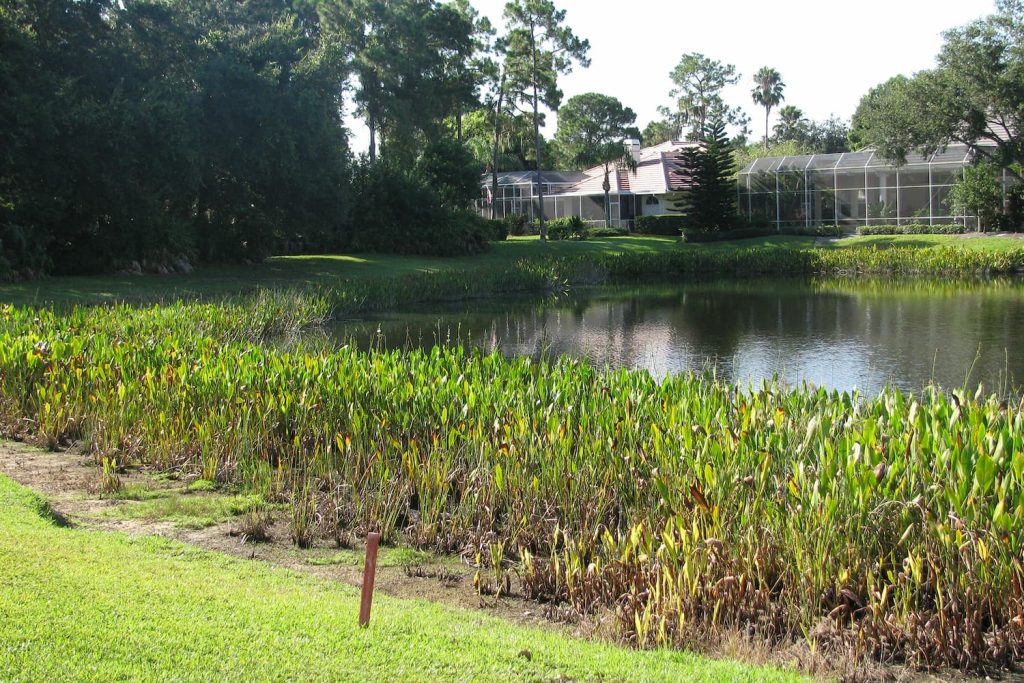
Table of Contents
If your HOA community is built around a lake or stormwater pond, the strip of vegetation along its edge is doing more work than most residents realize. That planted band, called the littoral zone, filters runoff, holds the bank together, and is often required by the permit your community operates under.
This guide explains what littoral planting in Florida involves, how it supports shoreline restoration and lake bank stabilization, which native plants work best, and how it ties into permit compliance for HOA lakes.
Littoral shelf planting is the practice of installing native aquatic plants along the shallow shelf at a lake’s edge. In Florida, it stabilizes shorelines, filters nutrients from stormwater runoff, provides wildlife habitat, and often satisfies water management district permit requirements for HOA and stormwater ponds.
Key Takeaways
- The littoral zone is the shallow, vegetated edge of a lake where land meets water and aquatic plants grow.
- Littoral planting stabilizes banks and reduces erosion by anchoring soil with dense root systems.
- It improves water quality through nutrient uptake, pulling nitrogen and phosphorus out of stormwater runoff.
- Coverage is often required by permit. Florida water management districts and many counties require a planted littoral zone on stormwater ponds, with coverage thresholds that vary by jurisdiction.
- Native species work best, including pickerelweed, bulrush, and spike rush, planted in the right depth zones.
What Is the Littoral Zone of a Lake?
The littoral zone is the shallow, near-shore area of a lake or pond where sunlight reaches the bottom and rooted aquatic plants can grow. It stretches from the upper bank down into shallow water. In stormwater ponds, the planted portion is often called the littoral shelf, and it is the biological engine for filtering pollutants and stabilizing the shoreline.
Understanding the littoral zone is the foundation for everything else in this guide. It is the transition area between the dry upland and the deeper open water, and it is where the most ecological activity in a pond takes place.
According to UF/IFAS Extension, wetland plants grow in three different littoral zones, the upper, middle, and lower, each defined by water depth. Matching plants to the correct zone is what makes a planting succeed.
In a typical Florida stormwater pond, the littoral shelf is the gently sloped band engineered along the perimeter specifically to hold these plants. It is shallow by design, which lets sunlight drive plant growth.
What Is Littoral Planting and Why Does It Matter for Florida HOA Lakes?
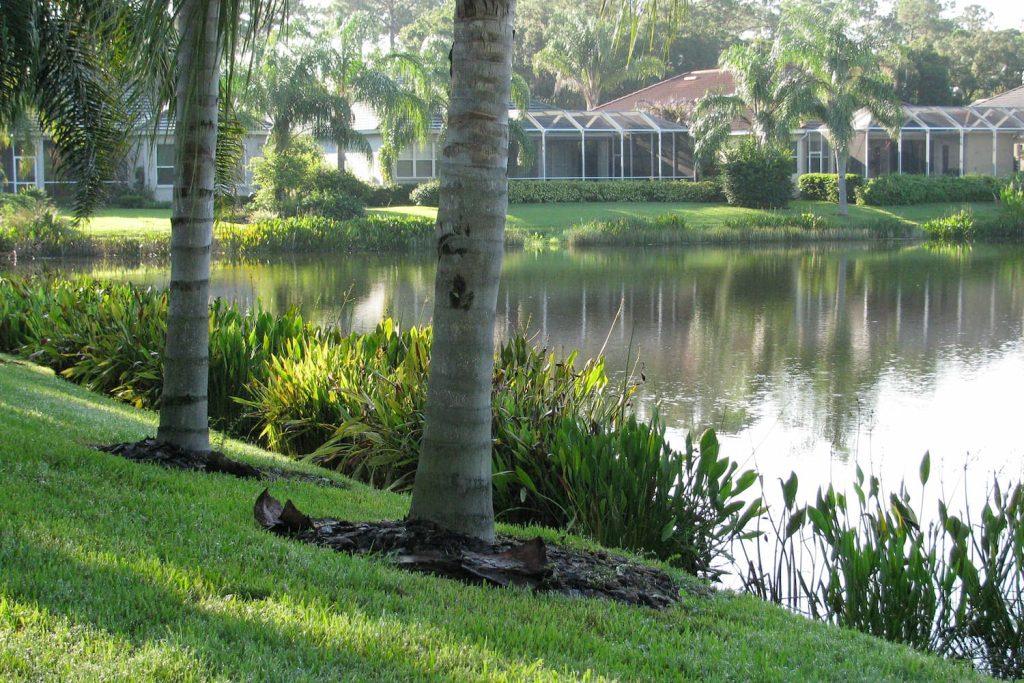
Littoral planting is the installation of native aquatic and wetland vegetation along a lake’s shallow shelf. For Florida HOA lakes, it matters because it stabilizes eroding banks, filters nutrient pollution from runoff, discourages nuisance algae, supports wildlife, and helps communities meet the permit conditions attached to their stormwater systems.
The value of littoral planting in Florida comes down to four jobs the plants perform at once: erosion control, water quality treatment, habitat creation, and regulatory compliance.
The scale of the issue is significant. A University of Florida Water Institute research summary notes there are over 76,000 stormwater ponds in Florida, engineered to control flooding and reduce nutrient runoff, yet many underperform at the nutrient-removal job. Strategic plantings are one tool researchers have studied to improve that performance.
For an HOA, a well-planted shoreline is also a budget question. Healthy littoral vegetation slows the bank erosion that leads to expensive repairs, and it reduces the nutrient load that fuels costly algae blooms.
How Does Littoral Planting Help With Shoreline Restoration?
Littoral planting supports shoreline restoration by replacing bare, eroding banks with deep-rooted native vegetation that holds soil in place. The root systems bind sediment, the stems absorb wave and rain energy, and the plant cover slows runoff before it can carve away the bank. Over time, this rebuilds a stable, self-reinforcing shoreline.
Shoreline restoration through planting addresses the root cause of bank loss rather than just patching the symptom. Bare shorelines erode because nothing holds the soil when water moves against it.
The mechanics are straightforward. Plant roots create a living mesh that grips the soil. Above the waterline, foliage absorbs the impact of rain and wave action. The combined effect reduces the undercutting that topples bank edges and, in severe cases, threatens nearby structures.
The UF/IFAS Sarasota County Extension has documented how mismanaged stormwater ponds, where littoral zones are cleared of plants, often suffer bank erosion so severe that trees fall and water threatens the integrity of nearby homes and condos. Planting is a frontline defense against that outcome.
For shorelines that have already failed, planting is frequently paired with engineered solutions. Pond Guru’s shoreline restoration services combine bank repair with native littoral planting to restore both stability and function.
How Do Littoral Shelf Plants Improve Water Quality?
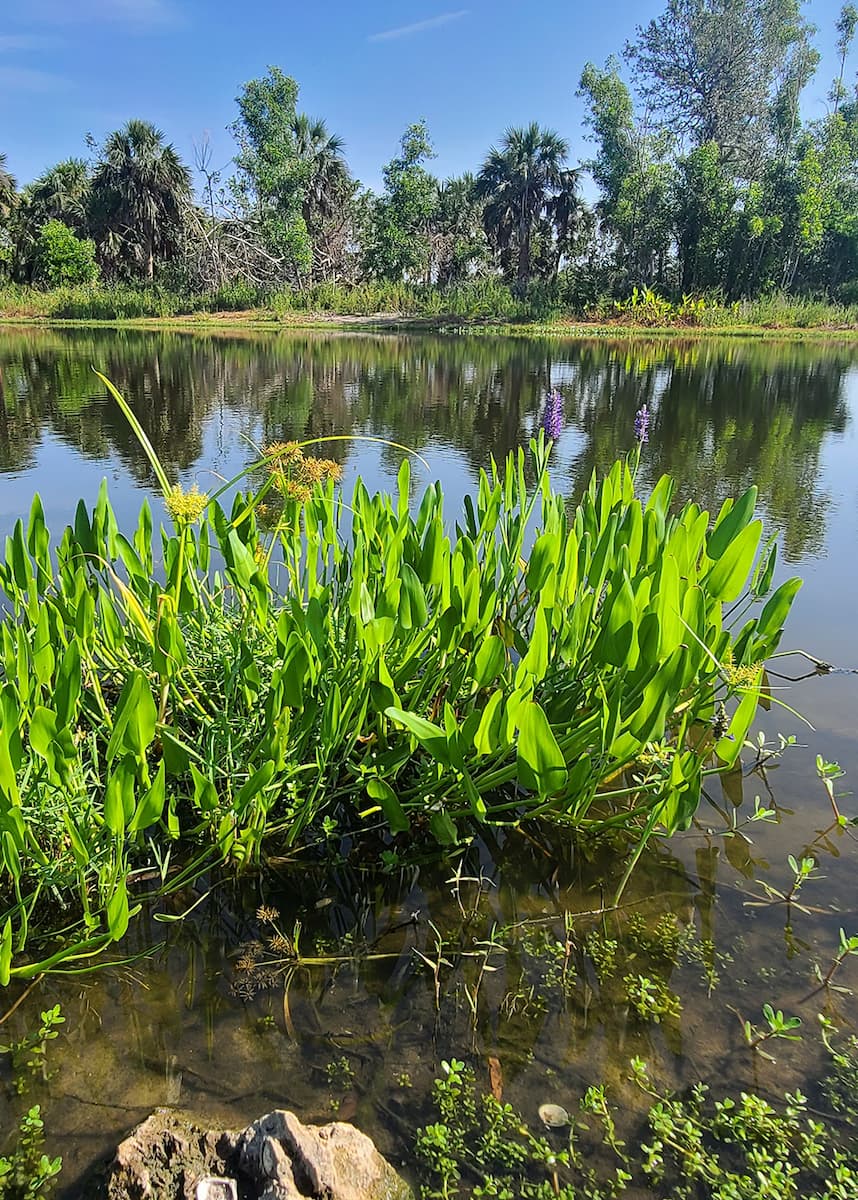
Littoral shelf plants improve water quality through nutrient uptake. Their roots absorb nitrogen and phosphorus from stormwater runoff before those nutrients can feed algae blooms. The plants also trap sediment, slow incoming water so pollutants settle out, and shade the shallows, which together produce clearer, healthier, more balanced water.
The water-treatment role of littoral shelf plants is the reason regulators care about them. Stormwater carries fertilizer, grass clippings, and other nutrient sources straight into community ponds, and plants intercept that load.
Research backs the effect. The UF Water Institute summary reported that, within planted ponds, water sampled at planted littoral shelves contained 28 percent less ortho-phosphate than water at non-planted shelves, evidence that vegetation is actively removing nutrients at the shoreline.
This nutrient uptake is a slow, continuous process. Unlike a chemical treatment that knocks down a bloom after it appears, a planted littoral zone reduces the fuel supply day after day, helping prevent blooms from forming in the first place.
What Are the Best Native Pond Plants for Florida Littoral Zones?
The best native pond plants for Florida littoral zones include pickerelweed, bulrush, spike rush, duck potato, soft rush, and golden canna. These hardy, Florida-native species tolerate fluctuating water levels, establish strong root systems for bank stabilization, absorb excess nutrients, and provide habitat. Plant selection should match each species to its proper water-depth zone.
Choosing the right native pond plants for Florida is about matching species to depth, function, and appearance. UF/IFAS recommends selecting natives adapted to the specific conditions of the pond to improve survival and long-term sustainability.
A few workhorse species for Florida littoral shelves:
- Pickerelweed (Pontederia cordata): A popular emergent with violet-blue flower spikes. It thrives in shallow water, supports pollinators, and is a staple of HOA littoral plantings for its looks and hardiness.
- Bulrush (Schoenoplectus or Scirpus species): Tall, rush-like stems with deep roots that excel at bank stabilization and nutrient uptake. Bulrush handles fluctuating water levels well.
- Spike rush (Eleocharis species): A fine-textured, grass-like plant that forms dense mats, providing excellent erosion control and habitat for small aquatic life along the water’s edge.
- Duck potato (Sagittaria species), soft rush, and golden canna round out a diverse planting palette.
Diversity is not just aesthetic. The UF/IFAS Sarasota County Extension notes that some county codes require littoral plantings to include at least three native herbaceous species, with no single species making up more than half of the vegetation cover, a rule that builds resilience into the planting.
Improve Your Shoreline With Littoral Plants
Pond Guru can help plant, nurture, and maintain beneficial littoral vegetation for your pond or lake.
What Are the Littoral Zone Requirements for Florida Stormwater Ponds?
Florida stormwater ponds are typically required to include a planted littoral zone as a condition of their environmental resource permit. The exact coverage threshold varies by water management district and county. Many jurisdictions set a minimum percentage of the pond’s surface area, often around 30 percent, and require native species and limited slope steepness.
Understanding the SFWMD requirement and similar rules starts with one fact: the littoral zone is usually not optional. It is written into the permit.
Here is what the verified standards actually say, and why the specifics matter:
- The Southwest Florida Water Management District bases the littoral requirement on the ratio of vegetated littoral zone to the pond’s surface area at the control elevation, and specifies the littoral zone be no deeper than 3.5 feet below the design overflow elevation.
- The South Florida Water Management District requires wet detention side slopes no steeper than 4:1 out to a depth of two feet below control elevation, with plantings consisting of aquatic plants native to Florida.
- At the county level, the UF/IFAS Sarasota County Extension reports that Sarasota County requires qualifying stormwater ponds to have littoral zones covering at least 30 percent of the surface area.
Because the 35% coverage figure circulates widely in the industry but is not a single uniform statewide rule, the practical takeaway is this: your community’s specific obligation lives in your own permit and local code. The numbers differ between the five water management districts and between counties.
This is also where professional help earns its keep. A provider experienced in littoral zone management can read your permit, confirm the exact coverage and species requirements that apply to your pond, and design a planting that meets them.
How Do Vegetative Buffers Support Lake Bank Stabilization?
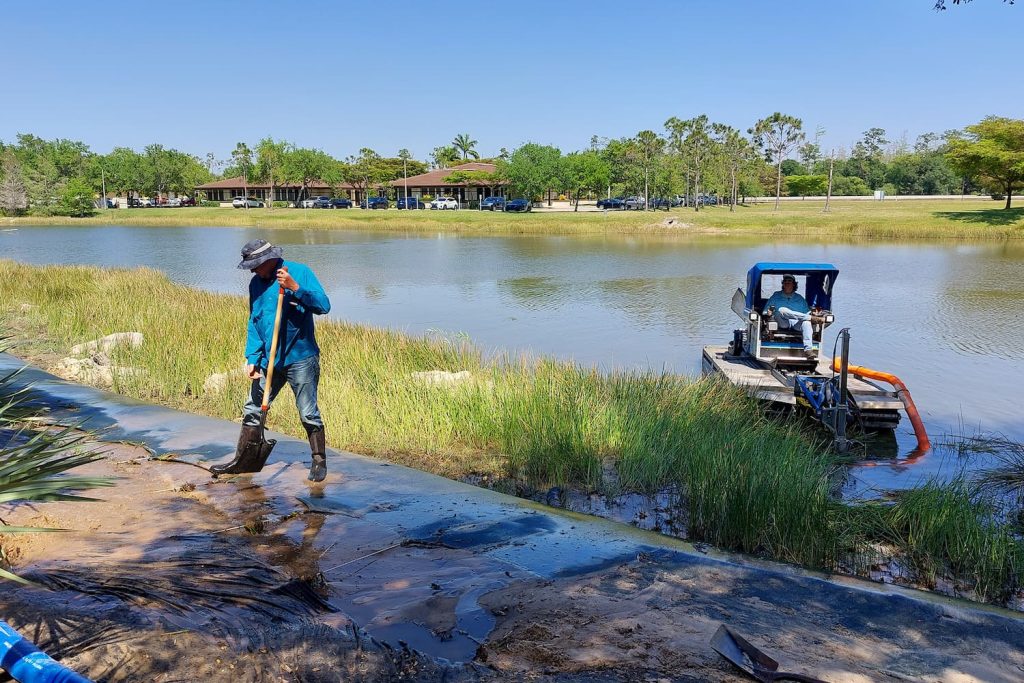
Vegetative buffers are bands of unmowed native plants along the upland edge of a lake that work together with littoral plantings for lake bank stabilization. The buffer intercepts runoff, fertilizer, and grass clippings before they reach the water, while its roots reinforce the top of the bank. Together, buffer and littoral zone form a continuous protective transition.
A vegetative buffer complements the littoral shelf by extending protection above the waterline. While littoral plants work at and below the water’s edge, the buffer guards the dry slope just above it.
The UF/IFAS Hillsborough resource describes how a plant buffer functions as a protective barrier, preventing fertilizer runoff and grass clippings from entering the pond. Stopping those inputs at the bank is far easier than removing the algae they would otherwise feed.
For lake bank stabilization, the buffer-plus-littoral combination is more durable than either alone. Mowing to the water’s edge, by contrast, leaves the bank exposed and accelerates erosion. Pond Guru’s vegetation buffer services and broader erosion control program are built around this layered approach.
How Is a Littoral Shelf Planted and Established?
A littoral shelf is planted by first assessing water depth and slope, selecting native species suited to each depth zone, then installing plants on the shelf during the right season, usually the warmer growing months. Plants are spaced to spread and fill in, sometimes protected from foraging wildlife, and monitored until established, with replanting as needed.
The process of establishing a littoral shelf is methodical, because survival depends on getting depth, timing, and protection right.
A typical sequence:
- Site assessment: Measure water depth, bank slope, soil, and light, and review the governing permit.
- Plant selection and zoning: Match species to the upper, middle, and lower littoral zones based on how wet each area stays.
- Installation: Plant during the active growing season so roots establish before stress periods.
- Protection: Where ducks, turtles, or fish graze heavily on new plants, temporary exclosures can protect young plantings.
- Monitoring: Track survival and coverage, manage invasive species, and replant gaps.
The UF/IFAS Littoral Zone Scorecard offers a useful benchmark for the goal: a littoral zone is considered optimal when fully covered with plants, and sub-optimal when at least 65 percent covered. That gives boards a clear target to maintain over time.
Establishment is not instant. A new planting needs a season or more to root in and fill out, which is why ongoing management matters as much as the initial install.
Get an Estimate for Littoral Planting From Pond Guru
Littoral shelf planting and shoreline restoration combine ecology, engineering, and regulatory knowledge. Done well, the result is a stable bank, cleaner water, a permit-compliant pond, and a shoreline that looks intentional rather than neglected.
Pond Guru works with HOA boards, property managers, and homeowners across Florida to design and install native littoral plantings, restore eroding shorelines, and establish vegetative buffers suited to each property’s permit and conditions.
Because every pond’s depth, slope, and permit obligations differ, the process begins with an on-site evaluation. A specialist can assess your shoreline, identify the coverage and species your permit requires, and recommend a plan.
To get started, contact Pond Guru for a littoral planting estimate and site visit. The team will evaluate your lake’s shoreline conditions and design a restoration plan built around your community’s needs.
Frequently Asked Questions
Littoral planting is the installation of native aquatic and wetland plants along the shallow shelf at a lake or pond's edge. In Florida, it stabilizes shorelines, filters nutrients from stormwater runoff, provides wildlife habitat, and often satisfies the littoral zone requirements attached to a stormwater pond's permit.
The littoral zone filters pollutants, holds the bank together, and supports wildlife. For HOA lakes, it reduces erosion that leads to costly bank repairs, lowers the nutrient load that fuels algae blooms, and helps the community stay compliant with water management district and county permit conditions.
Hardy Florida natives work best, including pickerelweed, bulrush, spike rush, duck potato, soft rush, and golden canna. These species tolerate changing water levels, build strong roots for bank stabilization, and absorb excess nutrients. Each should be planted in the water depth zone it is adapted to.
Often, yes. Most Florida stormwater ponds must include a planted littoral zone as a permit condition. The required coverage percentage and species rules vary by water management district and county, so the specific obligation depends on your pond's environmental resource permit and local code.
It depends on the jurisdiction. Coverage thresholds vary among Florida's water management districts and counties; some counties set a minimum near 30 percent of surface area, while districts may use a permit-specific ratio. Your community's exact requirement is defined in its own permit documents.
A new littoral planting generally needs at least one growing season to root in and fill out, and often longer to reach full coverage. Success depends on correct plant-to-depth matching, planting in the warm season, protection from grazing wildlife, and ongoing monitoring with replanting as needed.
Ready to Schedule a Visit ?
Have questions about your pond or lake? Our experts are ready to help you take the next step.
Latest Article
Popular Post

Why Keeping Culverts Clear of Debris Matters for Stormwater Systems
Table of Contents A culvert is one of those…
Table of Contents
If your HOA community is built around a lake or stormwater pond, the strip of vegetation along its edge is doing more work than most residents realize. That planted band, called the littoral zone, filters runoff, holds the bank together, and is often required by the permit your community operates under.
This guide explains what littoral planting in Florida involves, how it supports shoreline restoration and lake bank stabilization, which native plants work best, and how it ties into permit compliance for HOA lakes.
Littoral shelf planting is the practice of installing native aquatic plants along the shallow shelf at a lake’s edge. In Florida, it stabilizes shorelines, filters nutrients from stormwater runoff, provides wildlife habitat, and often satisfies water management district permit requirements for HOA and stormwater ponds.
Key Takeaways
- The littoral zone is the shallow, vegetated edge of a lake where land meets water and aquatic plants grow.
- Littoral planting stabilizes banks and reduces erosion by anchoring soil with dense root systems.
- It improves water quality through nutrient uptake, pulling nitrogen and phosphorus out of stormwater runoff.
- Coverage is often required by permit. Florida water management districts and many counties require a planted littoral zone on stormwater ponds, with coverage thresholds that vary by jurisdiction.
- Native species work best, including pickerelweed, bulrush, and spike rush, planted in the right depth zones.
What Is the Littoral Zone of a Lake?
The littoral zone is the shallow, near-shore area of a lake or pond where sunlight reaches the bottom and rooted aquatic plants can grow. It stretches from the upper bank down into shallow water. In stormwater ponds, the planted portion is often called the littoral shelf, and it is the biological engine for filtering pollutants and stabilizing the shoreline.
Understanding the littoral zone is the foundation for everything else in this guide. It is the transition area between the dry upland and the deeper open water, and it is where the most ecological activity in a pond takes place.
According to UF/IFAS Extension, wetland plants grow in three different littoral zones, the upper, middle, and lower, each defined by water depth. Matching plants to the correct zone is what makes a planting succeed.
In a typical Florida stormwater pond, the littoral shelf is the gently sloped band engineered along the perimeter specifically to hold these plants. It is shallow by design, which lets sunlight drive plant growth.
What Is Littoral Planting and Why Does It Matter for Florida HOA Lakes?
Littoral planting is the installation of native aquatic and wetland vegetation along a lake’s shallow shelf. For Florida HOA lakes, it matters because it stabilizes eroding banks, filters nutrient pollution from runoff, discourages nuisance algae, supports wildlife, and helps communities meet the permit conditions attached to their stormwater systems.
The value of littoral planting in Florida comes down to four jobs the plants perform at once: erosion control, water quality treatment, habitat creation, and regulatory compliance.
The scale of the issue is significant. A University of Florida Water Institute research summary notes there are over 76,000 stormwater ponds in Florida, engineered to control flooding and reduce nutrient runoff, yet many underperform at the nutrient-removal job. Strategic plantings are one tool researchers have studied to improve that performance.
For an HOA, a well-planted shoreline is also a budget question. Healthy littoral vegetation slows the bank erosion that leads to expensive repairs, and it reduces the nutrient load that fuels costly algae blooms.
How Does Littoral Planting Help With Shoreline Restoration?
Littoral planting supports shoreline restoration by replacing bare, eroding banks with deep-rooted native vegetation that holds soil in place. The root systems bind sediment, the stems absorb wave and rain energy, and the plant cover slows runoff before it can carve away the bank. Over time, this rebuilds a stable, self-reinforcing shoreline.
Shoreline restoration through planting addresses the root cause of bank loss rather than just patching the symptom. Bare shorelines erode because nothing holds the soil when water moves against it.
The mechanics are straightforward. Plant roots create a living mesh that grips the soil. Above the waterline, foliage absorbs the impact of rain and wave action. The combined effect reduces the undercutting that topples bank edges and, in severe cases, threatens nearby structures.
The UF/IFAS Sarasota County Extension has documented how mismanaged stormwater ponds, where littoral zones are cleared of plants, often suffer bank erosion so severe that trees fall and water threatens the integrity of nearby homes and condos. Planting is a frontline defense against that outcome.
For shorelines that have already failed, planting is frequently paired with engineered solutions. Pond Guru’s shoreline restoration services combine bank repair with native littoral planting to restore both stability and function.
How Do Littoral Shelf Plants Improve Water Quality?
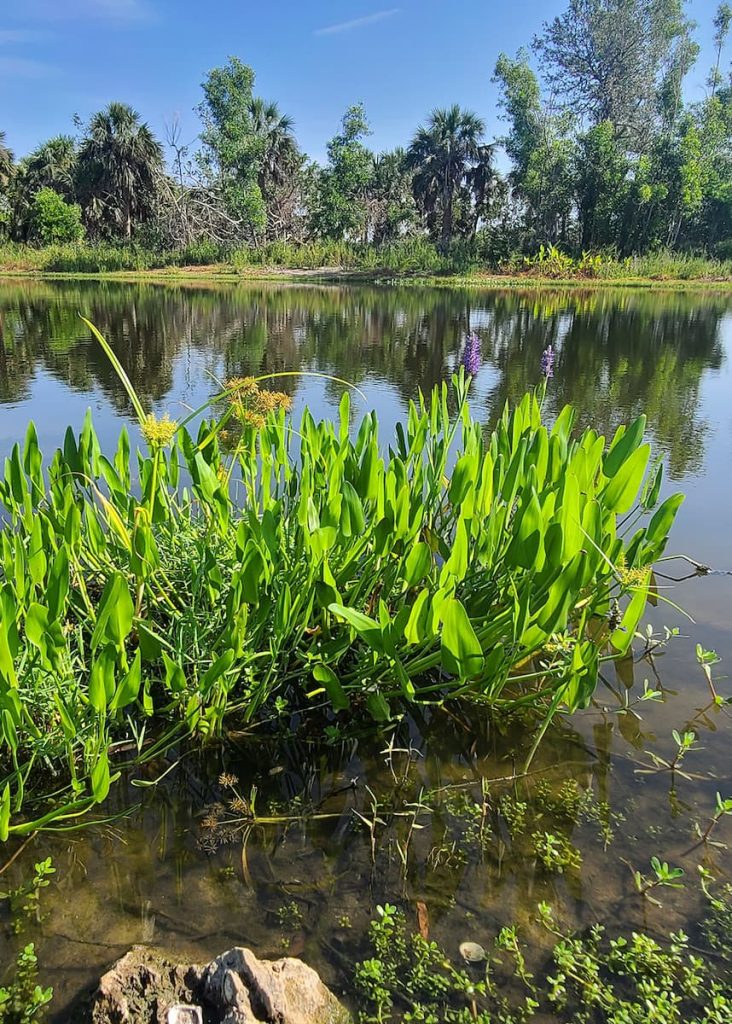
Littoral shelf plants improve water quality through nutrient uptake. Their roots absorb nitrogen and phosphorus from stormwater runoff before those nutrients can feed algae blooms. The plants also trap sediment, slow incoming water so pollutants settle out, and shade the shallows, which together produce clearer, healthier, more balanced water.
The water-treatment role of littoral shelf plants is the reason regulators care about them. Stormwater carries fertilizer, grass clippings, and other nutrient sources straight into community ponds, and plants intercept that load.
Research backs the effect. The UF Water Institute summary reported that, within planted ponds, water sampled at planted littoral shelves contained 28 percent less ortho-phosphate than water at non-planted shelves, evidence that vegetation is actively removing nutrients at the shoreline.
This nutrient uptake is a slow, continuous process. Unlike a chemical treatment that knocks down a bloom after it appears, a planted littoral zone reduces the fuel supply day after day, helping prevent blooms from forming in the first place.
What Are the Best Native Pond Plants for Florida Littoral Zones?
The best native pond plants for Florida littoral zones include pickerelweed, bulrush, spike rush, duck potato, soft rush, and golden canna. These hardy, Florida-native species tolerate fluctuating water levels, establish strong root systems for bank stabilization, absorb excess nutrients, and provide habitat. Plant selection should match each species to its proper water-depth zone.
Choosing the right native pond plants for Florida is about matching species to depth, function, and appearance. UF/IFAS recommends selecting natives adapted to the specific conditions of the pond to improve survival and long-term sustainability.
A few workhorse species for Florida littoral shelves:
- Pickerelweed (Pontederia cordata): A popular emergent with violet-blue flower spikes. It thrives in shallow water, supports pollinators, and is a staple of HOA littoral plantings for its looks and hardiness.
- Bulrush (Schoenoplectus or Scirpus species): Tall, rush-like stems with deep roots that excel at bank stabilization and nutrient uptake. Bulrush handles fluctuating water levels well.
- Spike rush (Eleocharis species): A fine-textured, grass-like plant that forms dense mats, providing excellent erosion control and habitat for small aquatic life along the water’s edge.
- Duck potato (Sagittaria species), soft rush, and golden canna round out a diverse planting palette.
Diversity is not just aesthetic. The UF/IFAS Sarasota County Extension notes that some county codes require littoral plantings to include at least three native herbaceous species, with no single species making up more than half of the vegetation cover, a rule that builds resilience into the planting.
Improve Your Shoreline With Littoral Plants
Pond Guru can help plant, nurture, and maintain beneficial littoral vegetation for your pond or lake.
What Are the Littoral Zone Requirements for Florida Stormwater Ponds?
Florida stormwater ponds are typically required to include a planted littoral zone as a condition of their environmental resource permit. The exact coverage threshold varies by water management district and county. Many jurisdictions set a minimum percentage of the pond’s surface area, often around 30 percent, and require native species and limited slope steepness.
Understanding the SFWMD requirement and similar rules starts with one fact: the littoral zone is usually not optional. It is written into the permit.
Here is what the verified standards actually say, and why the specifics matter:
- The Southwest Florida Water Management District bases the littoral requirement on the ratio of vegetated littoral zone to the pond’s surface area at the control elevation, and specifies the littoral zone be no deeper than 3.5 feet below the design overflow elevation.
- The South Florida Water Management District requires wet detention side slopes no steeper than 4:1 out to a depth of two feet below control elevation, with plantings consisting of aquatic plants native to Florida.
- At the county level, the UF/IFAS Sarasota County Extension reports that Sarasota County requires qualifying stormwater ponds to have littoral zones covering at least 30 percent of the surface area.
Because the 35% coverage figure circulates widely in the industry but is not a single uniform statewide rule, the practical takeaway is this: your community’s specific obligation lives in your own permit and local code. The numbers differ between the five water management districts and between counties.
This is also where professional help earns its keep. A provider experienced in littoral zone management can read your permit, confirm the exact coverage and species requirements that apply to your pond, and design a planting that meets them.
How Do Vegetative Buffers Support Lake Bank Stabilization?
Vegetative buffers are bands of unmowed native plants along the upland edge of a lake that work together with littoral plantings for lake bank stabilization. The buffer intercepts runoff, fertilizer, and grass clippings before they reach the water, while its roots reinforce the top of the bank. Together, buffer and littoral zone form a continuous protective transition.
A vegetative buffer complements the littoral shelf by extending protection above the waterline. While littoral plants work at and below the water’s edge, the buffer guards the dry slope just above it.
The UF/IFAS Hillsborough resource describes how a plant buffer functions as a protective barrier, preventing fertilizer runoff and grass clippings from entering the pond. Stopping those inputs at the bank is far easier than removing the algae they would otherwise feed.
For lake bank stabilization, the buffer-plus-littoral combination is more durable than either alone. Mowing to the water’s edge, by contrast, leaves the bank exposed and accelerates erosion. Pond Guru’s vegetation buffer services and broader erosion control program are built around this layered approach.
How Is a Littoral Shelf Planted and Established?
A littoral shelf is planted by first assessing water depth and slope, selecting native species suited to each depth zone, then installing plants on the shelf during the right season, usually the warmer growing months. Plants are spaced to spread and fill in, sometimes protected from foraging wildlife, and monitored until established, with replanting as needed.
The process of establishing a littoral shelf is methodical, because survival depends on getting depth, timing, and protection right.
A typical sequence:
- Site assessment: Measure water depth, bank slope, soil, and light, and review the governing permit.
- Plant selection and zoning: Match species to the upper, middle, and lower littoral zones based on how wet each area stays.
- Installation: Plant during the active growing season so roots establish before stress periods.
- Protection: Where ducks, turtles, or fish graze heavily on new plants, temporary exclosures can protect young plantings.
- Monitoring: Track survival and coverage, manage invasive species, and replant gaps.
The UF/IFAS Littoral Zone Scorecard offers a useful benchmark for the goal: a littoral zone is considered optimal when fully covered with plants, and sub-optimal when at least 65 percent covered. That gives boards a clear target to maintain over time.
Establishment is not instant. A new planting needs a season or more to root in and fill out, which is why ongoing management matters as much as the initial install.
Get an Estimate for Littoral Planting From Pond Guru
Littoral shelf planting and shoreline restoration combine ecology, engineering, and regulatory knowledge. Done well, the result is a stable bank, cleaner water, a permit-compliant pond, and a shoreline that looks intentional rather than neglected.
Pond Guru works with HOA boards, property managers, and homeowners across Florida to design and install native littoral plantings, restore eroding shorelines, and establish vegetative buffers suited to each property’s permit and conditions.
Because every pond’s depth, slope, and permit obligations differ, the process begins with an on-site evaluation. A specialist can assess your shoreline, identify the coverage and species your permit requires, and recommend a plan.
To get started, contact Pond Guru for a littoral planting estimate and site visit. The team will evaluate your lake’s shoreline conditions and design a restoration plan built around your community’s needs.
Frequently Asked Questions
Littoral planting is the installation of native aquatic and wetland plants along the shallow shelf at a lake or pond's edge. In Florida, it stabilizes shorelines, filters nutrients from stormwater runoff, provides wildlife habitat, and often satisfies the littoral zone requirements attached to a stormwater pond's permit.
The littoral zone filters pollutants, holds the bank together, and supports wildlife. For HOA lakes, it reduces erosion that leads to costly bank repairs, lowers the nutrient load that fuels algae blooms, and helps the community stay compliant with water management district and county permit conditions.
Hardy Florida natives work best, including pickerelweed, bulrush, spike rush, duck potato, soft rush, and golden canna. These species tolerate changing water levels, build strong roots for bank stabilization, and absorb excess nutrients. Each should be planted in the water depth zone it is adapted to.
Often, yes. Most Florida stormwater ponds must include a planted littoral zone as a permit condition. The required coverage percentage and species rules vary by water management district and county, so the specific obligation depends on your pond's environmental resource permit and local code.
It depends on the jurisdiction. Coverage thresholds vary among Florida's water management districts and counties; some counties set a minimum near 30 percent of surface area, while districts may use a permit-specific ratio. Your community's exact requirement is defined in its own permit documents.
A new littoral planting generally needs at least one growing season to root in and fill out, and often longer to reach full coverage. Success depends on correct plant-to-depth matching, planting in the warm season, protection from grazing wildlife, and ongoing monitoring with replanting as needed.
Ready to Schedule a Visit ?
Have questions about your pond or lake? Our experts are ready to help you take the next step.
Latest Article
Popular Post
Why Keeping Culverts Clear of Debris Matters for Stormwater Systems
Table of Contents A culvert is one of those…