

Is Common Water Hyacinth an Invasive Species in Florida?
Is Common Water Hyacinth an Invasive Species in Florida?
Short answer: yes.
Common water hyacinth is one of the most aggressive invasive species Florida has ever dealt with. If you manage a community pond, golf course water hazard, or private lakefront, there is a good chance you have already seen it. A thick green carpet of glossy leaves topped with lavender flowers spreading across the water seemingly overnight.
Below is what this plant actually is, why it is such a serious problem in Florida, and what your real options are when it shows up in water you are responsible for.
Quick fact: A healthy water hyacinth population can double in size every 6 to 15 days in Florida conditions. A small patch in May can become a full surface mat by August.
What Is the Common Water Hyacinth (Eichhornia crassipes)?
The common water hyacinth, known scientifically as water hyacinth eichhornia or Eichhornia crassipes (now also classified as Pontederia crassipes), is a free-floating aquatic plant native to the Amazon basin in South America.
Despite the shared name, it has no botanical relationship to the fragrant garden hyacinth most homeowners picture.
Here is what to look for if you suspect it in your pond:
- Leaves: glossy, oval-shaped leaves arranged in a rosette
- Stems: swollen, spongy stems (petioles) that act as natural floats
- Roots: feathery purple-black roots that dangle beneath the plant
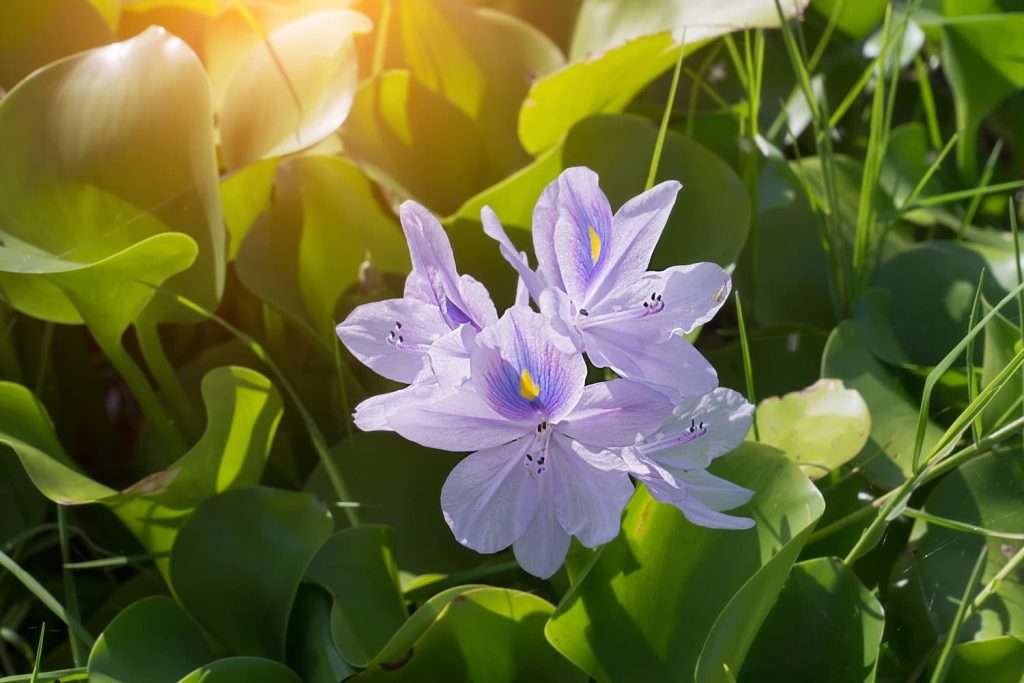
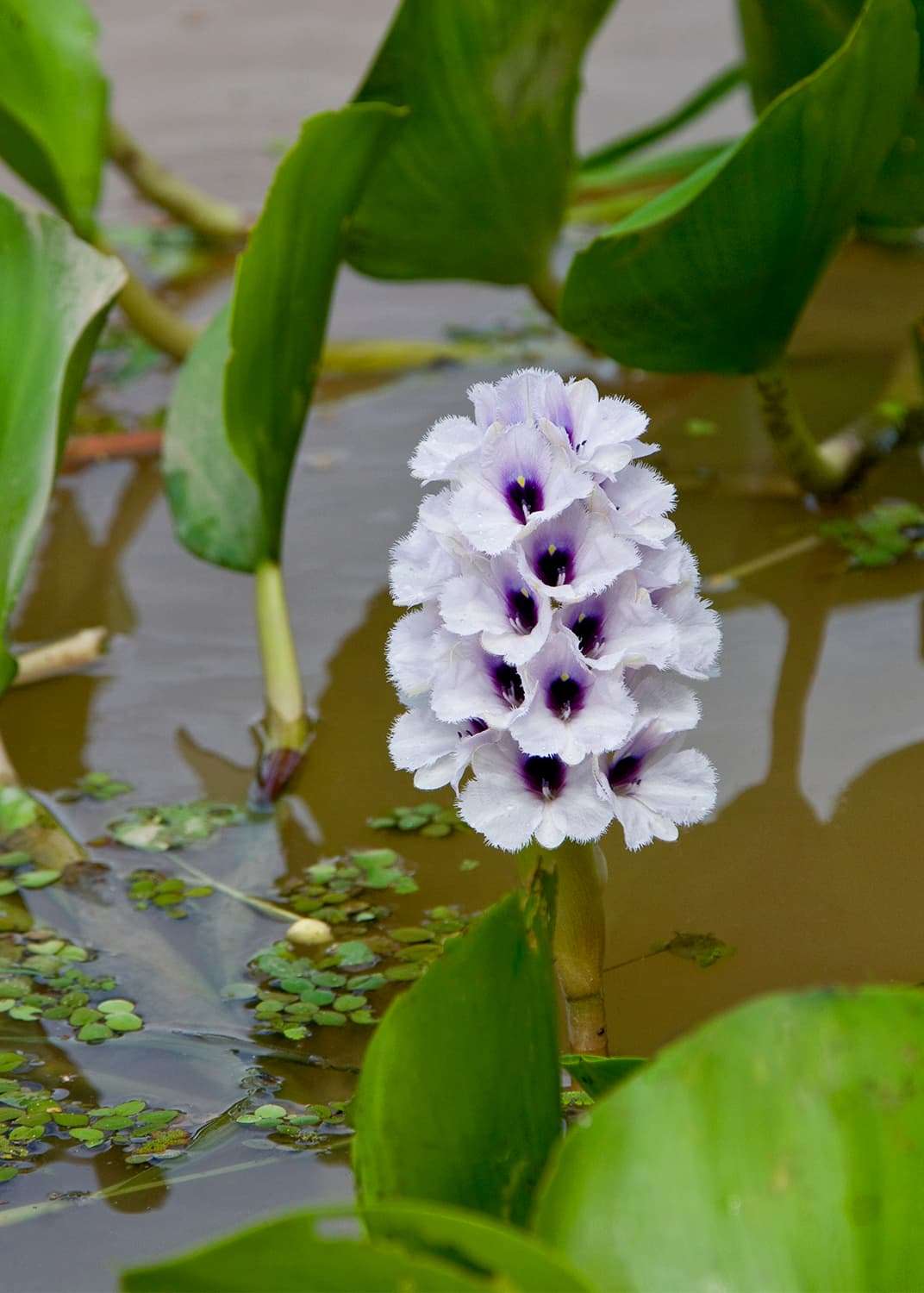
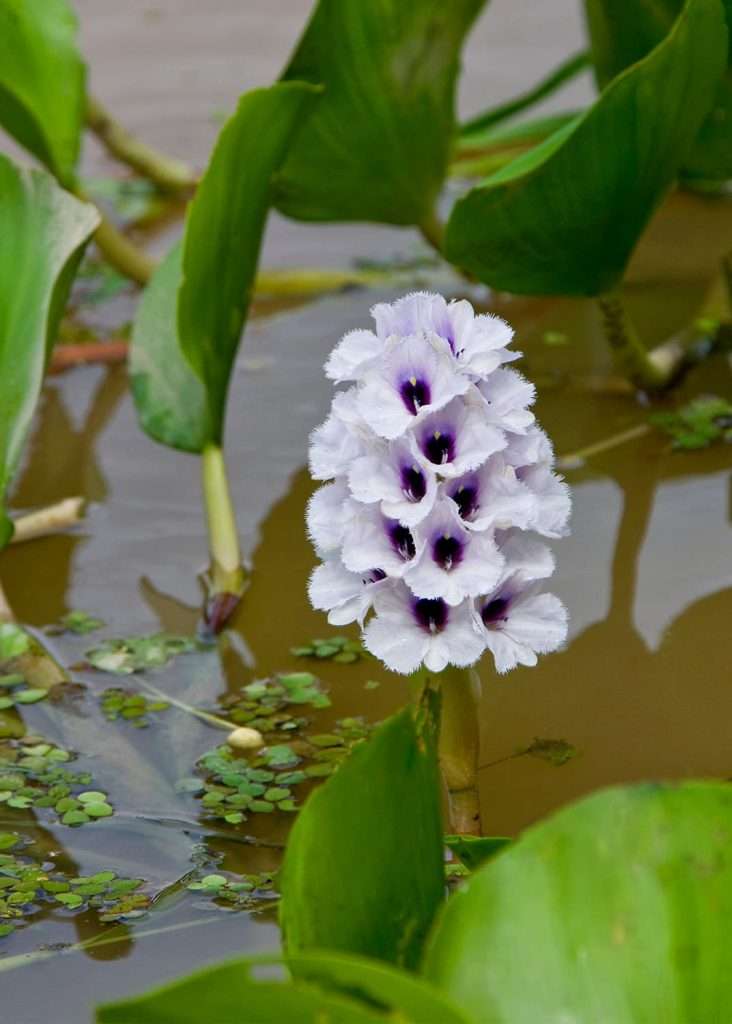
- Flower: a single spike with 6 to 8 pale lavender-blue petals, each marked with a yellow spot ringed in deeper purple
- Anchor: free-floating. The plant is not rooted to the pond bottom.
One plant looks pretty. A colony is a problem. A mat of floating hyacinth plants can cover an entire pond in a matter of weeks, which is exactly why the species is regulated as a noxious weed in Florida and in dozens of other states and countries. (See the University of Florida IFAS plant directory for a full species profile.)
How Floating Hyacinth Plants Arrived in Florida Waterways
Water hyacinth’s path into Florida is one of the most cited cautionary tales in invasive plant history.
In 1884, plants were handed out as ornamental souvenirs at the World’s Industrial and Cotton Centennial Exposition in New Orleans. A Florida visitor reportedly brought a few home and tossed them into the St. Johns River outside Jacksonville.
By 1896, barely a decade later, water hyacinth had clogged tens of millions of acres of Florida waterways. Steamboats could not move. Fish populations crashed in covered stretches. Congress eventually authorized the U.S. Army Corps of Engineers in 1899 to begin systematic removal, and that work has not truly stopped since.
Today, the Florida Fish and Wildlife Conservation Commission (FWC) and partner agencies spend tens of millions of dollars every year managing invasive aquatic plants, with water hyacinth and hydrilla consistently at the top of the list.
Why Water Hyacinth Is Invasive (and Why That Matters in Florida)
A few traits combine to make water hyacinth invasive at a scale most plants simply cannot match:
- It reproduces two ways, by seed and by stolons (horizontal stems that generate daughter plants).
- It can double in size every 6 to 15 days under ideal Florida conditions.
- Its seeds remain viable in pond sediment for up to 20 years, waiting for the right moment.
- Florida hands it a perfect environment: no winter cold snap, year-round sunlight, nutrient-rich stormwater runoff, and almost no natural predators.
- It is regulated: Class II Prohibited Aquatic Plant under the Florida Administrative Code, so possession, transport, and cultivation without a permit are illegal.
In plain terms: if it is growing in your pond, you are legally expected to manage it. The full regulation is published as Florida Administrative Code Rule 5B-64.011.
Pink Hyacinth Flower vs. Water Hyacinth: Don't Confuse the Two
This is one of the most common search-engine mix-ups. Here is the clear answer.
When most people search for the pink hyacinth flower, they are picturing Hyacinthus orientalis, the fragrant spring bulb sold at every garden center. That plant is a land-grown bulb in the asparagus family and has no relationship to water hyacinth.
A few quick points on basic hyacinth plant care for the garden variety, since these questions come up alongside water hyacinth searches all the time:
How long do hyacinths bloom?
Garden hyacinths typically bloom for about 2 to 3 weeks in early to mid-spring, depending on temperature and variety.
Do hyacinths bloom more than once?
Yes, in a sense. The same bulb can re-bloom in later years if planted outdoors in a climate with a real winter chill period. Indoor “forced” bulbs usually only put on one strong show before needing to be moved outside to recover, and the second-year bloom is often weaker.
Are hyacinths poisonous?
Garden hyacinth bulbs contain calcium oxalate crystals and alkaloids that can cause skin irritation, stomach upset, and serious toxicity in dogs and cats if ingested. (See the ASPCA toxic plants database for the full pet-safety profile.)
Water hyacinth itself is not considered highly toxic (it is even eaten in parts of Asia), but it absorbs heavy metals and pollutants from the water it grows in, so consuming wild plants is not recommended.
Bottom line: If a flowering mat is covering your pond, it is not a garden bulb gone wild. It is water hyacinth, and the management approach is completely different.
Is Water Hyacinth for a Pond Ever a Good Idea?
A quick online search will turn up plenty of advice promoting water hyacinth for pond owners. The claims usually focus on three benefits:
- it absorbs nitrates and excess nutrients
- it shades out unsightly algae
- it provides shelter and spawning cover for fish
All of that is technically true in the right setting.
A small, fully contained backyard koi pond, far from any natural waterway, in a climate with cold enough winters to kill the plant back, can sometimes benefit from limited use.
In Florida? Almost never worth the risk:
- no winter cold snap to slow growth
- easy escape paths via stormwater, wind, flooding, or birds
- state law restricts possession without a permit
- cleanup costs almost always exceed any short-term aesthetic benefit
If someone has told you water hyacinth is a “natural solution” for your community pond or golf course water feature, treat the suggestion with serious caution.
Manage Invasive Water Hyacinth
Even plants with pretty flowers can be highly invasive and dangerous to Florida waterways.
The Damage Invasive Aquatic Plants Cause Florida Properties
When a pond is taken over by invasive aquatic plants like water hyacinth, the problems compound fast. Here is what tends to go wrong, in roughly the order you will notice it:
- Dissolved oxygen drops. the surface mat blocks sunlight and prevents the water from exchanging gases with the air.
- The food web breaks. submerged native plants and beneficial algae die back.
- Fish kills become common, especially after summer storms collapse oxygen levels overnight.
- Mosquitoes thrive. the calm, shaded water beneath the mat is ideal for species that can transmit West Nile and Eastern equine encephalitis virus.
- Infrastructure fails. aerators and fountains clog, pump intakes stall, and shorelines erode unevenly.
- Golf operations stall. irrigation systems pull in plant fragments and shut down at peak demand.
- HOA property values fall. waterfront values measurably drop when ponds turn green and stagnant.
Cost rule of thumb: It is dramatically cheaper to control common water hyacinth at 5 percent coverage than at 50 percent. The longer it sits, the more expensive remediation becomes.
Water Hyacinth Removal from Pond: Methods That Actually Work
There is no single silver bullet for water hyacinth removal from pond systems. Effective aquatic weed removal usually combines several methods, matched to the size of the waterbody, the severity of infestation, and what else lives in the pond.
Mechanical Harvesting
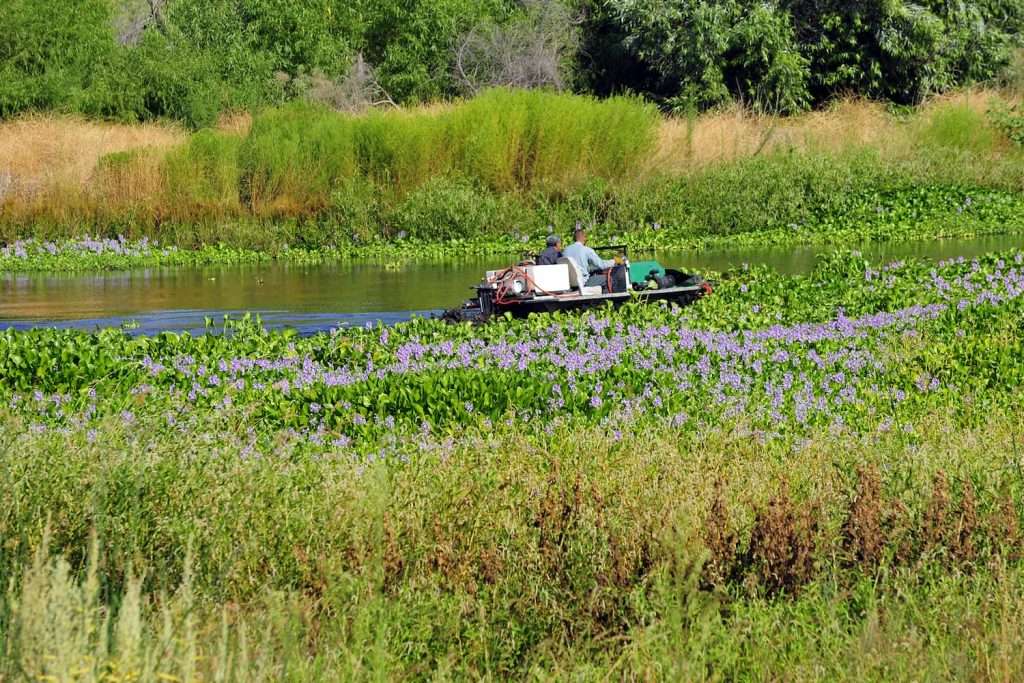
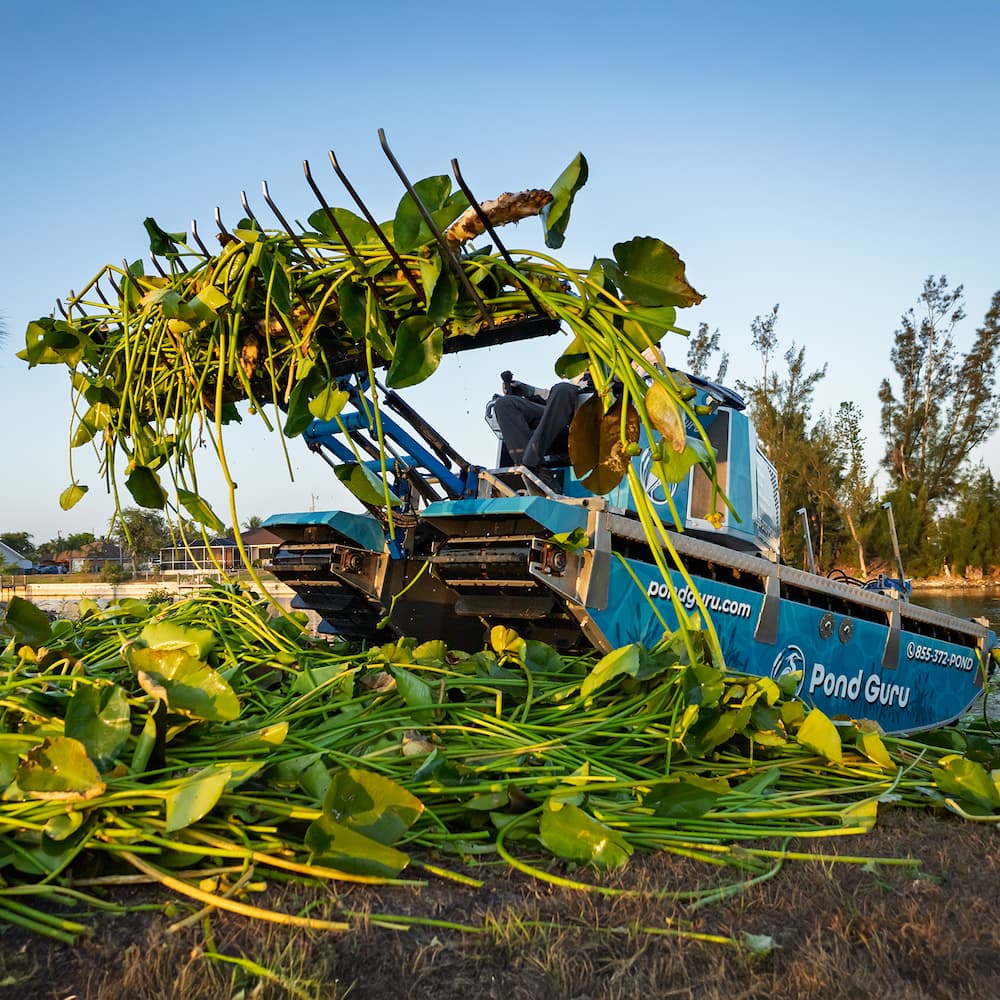
Specialized equipment cuts and lifts plants out of the water for haul-away and composting. Best for large, heavily infested ponds where chemical-only treatment would create a massive decomposition load.
- Effective and immediately visible
- Expensive at scale
- Often leaves fragments behind that can regrow
Licensed Aquatic Herbicide Applications
The workhorse of long-term control when applied correctly by a licensed aquatic applicator.
- Common products: diquat, aquatic-labeled glyphosate, and 2,4-D
- Selective enough to spare desirable native species when applied properly
- Timing matters. Best on actively growing plants in warm water
- Must be coordinated with fish, wildlife, and weather conditions
Florida applicator licensing is administered by the Florida Department of Agriculture and Consumer Services.
Biological Control
Two species of weevil (Neochetina eichhorniae and N. bruchi), introduced from South America under careful regulatory review, feed on water hyacinth and suppress regrowth over time. Useful as a supplement to mechanical and chemical work, not a stand-alone solution. The USGS Nonindigenous Aquatic Species fact sheet covers the established control history in detail.
Manual Removal
Raking, netting, and hand-pulling are realistic only for very small ornamental ponds caught extremely early. Once floating hyacinth plants cover even 10 percent of the surface, manual removal cannot outrun the plant’s doubling rate.
Why a Professional Lake Management Company Outperforms DIY
A few honest reasons DIY rarely works in Florida:
- Legal compliance. Herbicide use in or near standing water requires a licensed aquatic applicator and, depending on the waterbody, FWC notification or permitting.
- Plant ID is tricky. Water hyacinth is regularly confused with water lettuce (Pistia stratiotes), frogbit, and other floating species. Each responds differently to treatment.
- The seed bank wins long term. One-shot treatments fail because the seed bank is still in the sediment. Sustained results come from scheduled inspections and follow-up applications.
- Mistakes are expensive. Misapplication can kill fish, damage neighboring landscaping, and trigger enforcement action.
A professional lake management company brings the equipment, the permits, the diagnostic experience, and (just as important) a real maintenance plan.
How Pond Guru Approaches Aquatic Weed Removal
Pond Guru is a Florida-based lake management company built around one idea: ponds and lakes are living ecosystems, not landscaping. Our approach to water hyacinth and other invasive aquatic plants reflects that.
Every site starts the same way:
- Full inventory. We identify every plant species present, invasive and native.
- Water quality readings. We measure dissolved oxygen, pH, and nutrient load.
- Site usage. We document how the pond is actually being used: recreation, irrigation, drainage, aesthetics.
- Written plan. Then we recommend, in writing, exactly what we would do and why.
From there, treatment is matched to the situation and can include:
- licensed aquatic herbicide applications
- mechanical removal for heavy mats
- shoreline restoration where erosion has already set in
- fountain and aeration installation to keep oxygen levels healthy
- seasonal maintenance visits to catch regrowth before it spreads
Our crews are trained, licensed, and insured specifically for aquatic work, not a side service added on to a landscaping operation.
Our goal: Not a one-time clean pond. A pond that stays clean.
Schedule Your Site Visit with Pond Guru
Spotted floating hyacinth plants? Suspect water hyacinth? Or just not sure what is growing in the water you are responsible for?
The next step is a site visit. Here is what to expect:
- a specialist walks the waterbody with you
- we identify every plant present, invasive and beneficial
- you get a clear written plan with realistic timing and pricing
- no obligation, and most assessments can be scheduled within the week
Schedule your site visit today:
- call (855) 372-7663
- submit a contact form
- email info@pondguru.com
Frequently Asked Questions
Yes. It is listed as a Class II Prohibited Aquatic Plant under Florida Administrative Code 5B-64.011 and may not be possessed, transported, or cultivated without a special permit from the Florida Department of Agriculture and Consumer Services.
Under typical Florida conditions, a healthy population can roughly double every 6 to 15 days during the warm season. A small patch can become a full surface mat in a single summer.
Often yes, especially if seeds remain in the sediment or fragments are left behind. That is why ongoing aquatic weed removal, inspection, and scheduled maintenance are part of any effective long-term management plan.
Only aquatic-labeled herbicides applied by a licensed applicator should be used in or near water in Florida. DIY herbicide use on retention ponds, lakes, or shared community waterbodies is both risky and, in many situations, illegal.
The plant itself is not considered highly toxic, but the dense mats are a real hazard to animals or children who fall in and cannot get out. The standing water beneath them breeds disease-carrying mosquitoes.
Ready to Schedule a Visit ?
Have questions about your pond or lake? Our experts are ready to help you take the next step.
Latest Article
Popular Post

Pennywort: From Lawn Weed to Pond Invader
Table of Contents Most Floridians know pennywort as dollarweed,…
Short answer: yes.
Common water hyacinth is one of the most aggressive invasive species Florida has ever dealt with. If you manage a community pond, golf course water hazard, or private lakefront, there is a good chance you have already seen it. A thick green carpet of glossy leaves topped with lavender flowers spreading across the water seemingly overnight.
Below is what this plant actually is, why it is such a serious problem in Florida, and what your real options are when it shows up in water you are responsible for.
Quick fact: A healthy water hyacinth population can double in size every 6 to 15 days in Florida conditions. A small patch in May can become a full surface mat by August.
What Is the Common Water Hyacinth (Eichhornia crassipes)?
The common water hyacinth, known scientifically as water hyacinth eichhornia or Eichhornia crassipes (now also classified as Pontederia crassipes), is a free-floating aquatic plant native to the Amazon basin in South America.
Despite the shared name, it has no botanical relationship to the fragrant garden hyacinth most homeowners picture.
Here is what to look for if you suspect it in your pond:
- Leaves: glossy, oval-shaped leaves arranged in a rosette
- Stems: swollen, spongy stems (petioles) that act as natural floats
- Roots: feathery purple-black roots that dangle beneath the plant
- Flower: a single spike with 6 to 8 pale lavender-blue petals, each marked with a yellow spot ringed in deeper purple
- Anchor: free-floating. The plant is not rooted to the pond bottom.
One plant looks pretty. A colony is a problem. A mat of floating hyacinth plants can cover an entire pond in a matter of weeks, which is exactly why the species is regulated as a noxious weed in Florida and in dozens of other states and countries. (See the University of Florida IFAS plant directory for a full species profile.)
How Floating Hyacinth Plants Arrived in Florida Waterways
Water hyacinth’s path into Florida is one of the most cited cautionary tales in invasive plant history.
In 1884, plants were handed out as ornamental souvenirs at the World’s Industrial and Cotton Centennial Exposition in New Orleans. A Florida visitor reportedly brought a few home and tossed them into the St. Johns River outside Jacksonville.
By 1896, barely a decade later, water hyacinth had clogged tens of millions of acres of Florida waterways. Steamboats could not move. Fish populations crashed in covered stretches. Congress eventually authorized the U.S. Army Corps of Engineers in 1899 to begin systematic removal, and that work has not truly stopped since.
Today, the Florida Fish and Wildlife Conservation Commission (FWC) and partner agencies spend tens of millions of dollars every year managing invasive aquatic plants, with water hyacinth and hydrilla consistently at the top of the list.
Why Water Hyacinth Is Invasive (and Why That Matters in Florida)
A few traits combine to make water hyacinth invasive at a scale most plants simply cannot match:
- It reproduces two ways, by seed and by stolons (horizontal stems that generate daughter plants).
- It can double in size every 6 to 15 days under ideal Florida conditions.
- Its seeds remain viable in pond sediment for up to 20 years, waiting for the right moment.
- Florida hands it a perfect environment: no winter cold snap, year-round sunlight, nutrient-rich stormwater runoff, and almost no natural predators.
- It is regulated: Class II Prohibited Aquatic Plant under the Florida Administrative Code, so possession, transport, and cultivation without a permit are illegal.
In plain terms: if it is growing in your pond, you are legally expected to manage it. The full regulation is published as Florida Administrative Code Rule 5B-64.011.
Pink Hyacinth Flower vs. Water Hyacinth: Don't Confuse the Two
This is one of the most common search-engine mix-ups. Here is the clear answer.
When most people search for the pink hyacinth flower, they are picturing Hyacinthus orientalis, the fragrant spring bulb sold at every garden center. That plant is a land-grown bulb in the asparagus family and has no relationship to water hyacinth.
A few quick points on basic hyacinth plant care for the garden variety, since these questions come up alongside water hyacinth searches all the time:
How long do hyacinths bloom?
Garden hyacinths typically bloom for about 2 to 3 weeks in early to mid-spring, depending on temperature and variety.
Do hyacinths bloom more than once?
Yes, in a sense. The same bulb can re-bloom in later years if planted outdoors in a climate with a real winter chill period. Indoor “forced” bulbs usually only put on one strong show before needing to be moved outside to recover, and the second-year bloom is often weaker.
Are hyacinths poisonous?
Garden hyacinth bulbs contain calcium oxalate crystals and alkaloids that can cause skin irritation, stomach upset, and serious toxicity in dogs and cats if ingested. (See the ASPCA toxic plants database for the full pet-safety profile.)
Water hyacinth itself is not considered highly toxic (it is even eaten in parts of Asia), but it absorbs heavy metals and pollutants from the water it grows in, so consuming wild plants is not recommended.
Bottom line: If a flowering mat is covering your pond, it is not a garden bulb gone wild. It is water hyacinth, and the management approach is completely different.
Is Water Hyacinth for a Pond Ever a Good Idea?
A quick online search will turn up plenty of advice promoting water hyacinth for pond owners. The claims usually focus on three benefits:
- it absorbs nitrates and excess nutrients
- it shades out unsightly algae
- it provides shelter and spawning cover for fish
All of that is technically true in the right setting.
A small, fully contained backyard koi pond, far from any natural waterway, in a climate with cold enough winters to kill the plant back, can sometimes benefit from limited use.
In Florida? Almost never worth the risk:
- no winter cold snap to slow growth
- easy escape paths via stormwater, wind, flooding, or birds
- state law restricts possession without a permit
- cleanup costs almost always exceed any short-term aesthetic benefit
If someone has told you water hyacinth is a “natural solution” for your community pond or golf course water feature, treat the suggestion with serious caution.
Manage Invasive Water Hyacinth
Even plants with pretty flowers can be highly invasive and dangerous to Florida waterways.
The Damage Invasive Aquatic Plants Cause Florida Properties
When a pond is taken over by invasive aquatic plants like water hyacinth, the problems compound fast. Here is what tends to go wrong, in roughly the order you will notice it:
- Dissolved oxygen drops. the surface mat blocks sunlight and prevents the water from exchanging gases with the air.
- The food web breaks. submerged native plants and beneficial algae die back.
- Fish kills become common, especially after summer storms collapse oxygen levels overnight.
- Mosquitoes thrive. the calm, shaded water beneath the mat is ideal for species that can transmit West Nile and Eastern equine encephalitis virus.
- Infrastructure fails. aerators and fountains clog, pump intakes stall, and shorelines erode unevenly.
- Golf operations stall. irrigation systems pull in plant fragments and shut down at peak demand.
- HOA property values fall. waterfront values measurably drop when ponds turn green and stagnant.
Cost rule of thumb: It is dramatically cheaper to control common water hyacinth at 5 percent coverage than at 50 percent. The longer it sits, the more expensive remediation becomes.
Water Hyacinth Removal from Pond: Methods That Actually Work
There is no single silver bullet for water hyacinth removal from pond systems. Effective aquatic weed removal usually combines several methods, matched to the size of the waterbody, the severity of infestation, and what else lives in the pond.
Mechanical Harvesting
Specialized equipment cuts and lifts plants out of the water for haul-away and composting. Best for large, heavily infested ponds where chemical-only treatment would create a massive decomposition load.
- Effective and immediately visible
- Expensive at scale
- Often leaves fragments behind that can regrow
Licensed Aquatic Herbicide Applications
The workhorse of long-term control when applied correctly by a licensed aquatic applicator.
- Common products: diquat, aquatic-labeled glyphosate, and 2,4-D
- Selective enough to spare desirable native species when applied properly
- Timing matters. Best on actively growing plants in warm water
- Must be coordinated with fish, wildlife, and weather conditions
Florida applicator licensing is administered by the Florida Department of Agriculture and Consumer Services.
Biological Control
Two species of weevil (Neochetina eichhorniae and N. bruchi), introduced from South America under careful regulatory review, feed on water hyacinth and suppress regrowth over time. Useful as a supplement to mechanical and chemical work, not a stand-alone solution. The USGS Nonindigenous Aquatic Species fact sheet covers the established control history in detail.
Manual Removal
Raking, netting, and hand-pulling are realistic only for very small ornamental ponds caught extremely early. Once floating hyacinth plants cover even 10 percent of the surface, manual removal cannot outrun the plant’s doubling rate.
Why a Professional Lake Management Company Outperforms DIY
A few honest reasons DIY rarely works in Florida:
- Legal compliance. Herbicide use in or near standing water requires a licensed aquatic applicator and, depending on the waterbody, FWC notification or permitting.
- Plant ID is tricky. Water hyacinth is regularly confused with water lettuce (Pistia stratiotes), frogbit, and other floating species. Each responds differently to treatment.
- The seed bank wins long term. One-shot treatments fail because the seed bank is still in the sediment. Sustained results come from scheduled inspections and follow-up applications.
- Mistakes are expensive. Misapplication can kill fish, damage neighboring landscaping, and trigger enforcement action.
A professional lake management company brings the equipment, the permits, the diagnostic experience, and (just as important) a real maintenance plan.
How Pond Guru Approaches Aquatic Weed Removal
Pond Guru is a Florida-based lake management company built around one idea: ponds and lakes are living ecosystems, not landscaping. Our approach to water hyacinth and other invasive aquatic plants reflects that.
Every site starts the same way:
- Full inventory. We identify every plant species present, invasive and native.
- Water quality readings. We measure dissolved oxygen, pH, and nutrient load.
- Site usage. We document how the pond is actually being used: recreation, irrigation, drainage, aesthetics.
- Written plan. Then we recommend, in writing, exactly what we would do and why.
From there, treatment is matched to the situation and can include:
- licensed aquatic herbicide applications
- mechanical removal for heavy mats
- shoreline restoration where erosion has already set in
- fountain and aeration installation to keep oxygen levels healthy
- seasonal maintenance visits to catch regrowth before it spreads
Our crews are trained, licensed, and insured specifically for aquatic work, not a side service added on to a landscaping operation.
Our goal: Not a one-time clean pond. A pond that stays clean.
Schedule Your Site Visit with Pond Guru
Spotted floating hyacinth plants? Suspect water hyacinth? Or just not sure what is growing in the water you are responsible for?
The next step is a site visit. Here is what to expect:
- a specialist walks the waterbody with you
- we identify every plant present, invasive and beneficial
- you get a clear written plan with realistic timing and pricing
- no obligation, and most assessments can be scheduled within the week
Schedule your site visit today:
- call (855) 372-7663
- submit a contact form
- email info@pondguru.com
Frequently Asked Questions
Yes. It is listed as a Class II Prohibited Aquatic Plant under Florida Administrative Code 5B-64.011 and may not be possessed, transported, or cultivated without a special permit from the Florida Department of Agriculture and Consumer Services.
Under typical Florida conditions, a healthy population can roughly double every 6 to 15 days during the warm season. A small patch can become a full surface mat in a single summer.
Often yes, especially if seeds remain in the sediment or fragments are left behind. That is why ongoing aquatic weed removal, inspection, and scheduled maintenance are part of any effective long-term management plan.
Only aquatic-labeled herbicides applied by a licensed applicator should be used in or near water in Florida. DIY herbicide use on retention ponds, lakes, or shared community waterbodies is both risky and, in many situations, illegal.
The plant itself is not considered highly toxic, but the dense mats are a real hazard to animals or children who fall in and cannot get out. The standing water beneath them breeds disease-carrying mosquitoes.
Ready to Schedule a Visit ?
Have questions about your pond or lake? Our experts are ready to help you take the next step.
Latest Article
Popular Post
Pennywort: From Lawn Weed to Pond Invader
Table of Contents Most Floridians know pennywort as dollarweed,…