

Filamentous Algae vs. Chara: How to Tell the Difference
Filamentous Algae vs. Chara: How to Tell the Difference
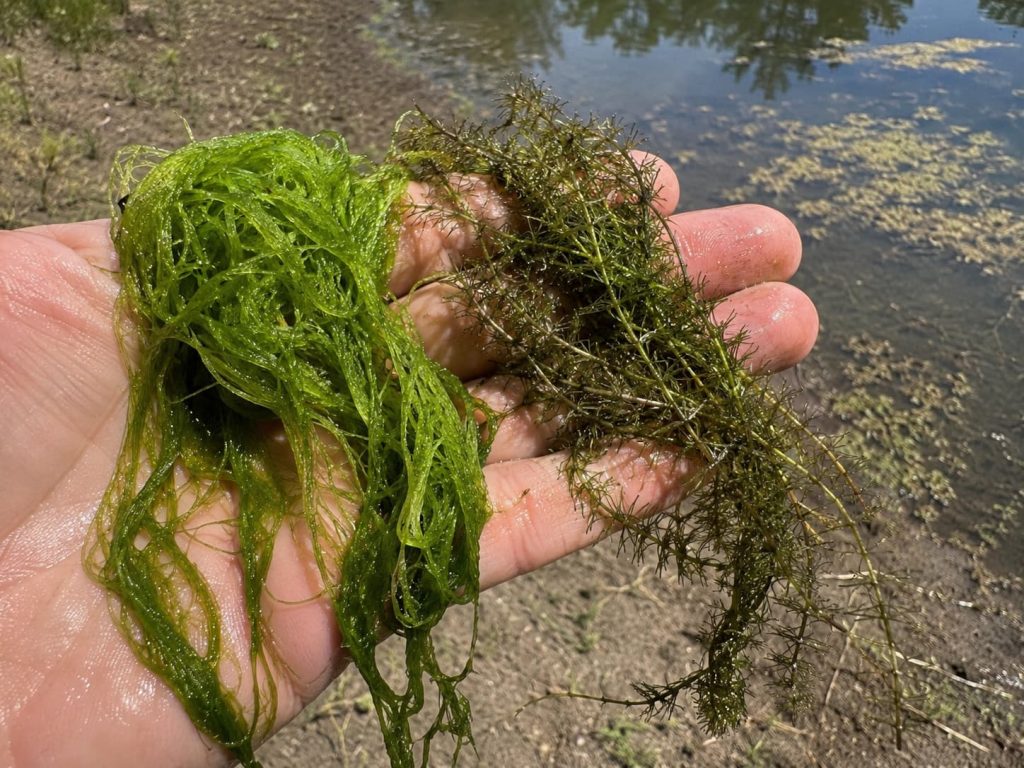
Table of Contents
Two of the most common growths in a pond look similar from the shoreline, get confused constantly, and call for very different responses. One is filamentous algae, the slimy green threads that mat on the surface. The other is chara, a gritty, plant-like growth that stays on the bottom. Telling them apart is easy once you know the two tests that give it away instantly.
This guide explains the difference between filamentous algae and chara, the simple smell-and-feel checks that identify each in seconds, what each one means for your pond’s health, and how each is managed. Getting the identification right saves money and prevents the wrong treatment.
Filamentous algae is slimy, forms hair-like threads, and floats to the surface in mats. Chara, also called muskgrass, is a bottom-growing macroalgae with a gritty, crunchy texture and a strong musky or garlic-like smell. The quickest tests: chara smells and feels gritty, while filamentous algae feels like wet wool and does not smell like garlic.
Key Takeaways
- The smell test is the fastest. Chara has a distinctive garlic or musky odor. Filamentous algae does not.
- The feel test confirms it. Chara is gritty and crunchy from calcium deposits; filamentous algae is slimy, like wet wool.
- Chara stays on the bottom. It rarely reaches the surface, while filamentous algae floats up into mats.
- Chara is beneficial in moderation, improving clarity and providing fish habitat. It is technically an algae, not a plant.
- Both share the same cause when they overgrow: excess nutrients, so lasting control means nutrient management.
What Is Filamentous Algae?
Filamentous algae is a group of simple algae whose cells link together into long, hair-like threads or filaments. It typically starts growing on the pond bottom and on rocks, then floats to the surface as it grows, forming green mats often called pond scum or string algae. It feels slimy and stringy, like wet wool.
This is the algae most people picture when they think of a green, mucky pond.
As pond management resources describe it, filamentous algae are colonies of microscopic plants that link together to form long visible chains or threads, and the intertwining filaments form a mat that resembles wet wool. It usually begins growing underwater in spring, then floats to the surface by mid-summer as it traps gases produced by photosynthesis.
Key traits of filamentous algae:
- Texture: Slimy, slippery, stringy. Strands stretch between your fingers.
- Location: Starts on the bottom and rocks, then floats up into surface mats.
- Appearance: Bright green threads early, turning darker or yellowish as it ages.
- Common names: String algae, hair algae, pond scum, pond moss.
Filamentous algae is a nuisance mainly because of its appearance and its tendency to cover the surface, interfering with swimming, fishing, and the look of the pond.

What Is Chara?
Chara, commonly called muskgrass, is a type of macroalgae that grows on the bottom of ponds and lakes. Despite looking like a rooted plant with stems and leaves, it is actually an algae, with no true roots, stems, or leaves. It is known for a gritty, crunchy texture and a strong musky or garlic-like smell.
Chara fools people because it looks like a vascular plant, but it is genuinely an alga, just a large and complex one.
According to Texas A&M AgriLife’s AquaPlant, chara has a grainy or crunchy texture due to calcium deposits, has cylindrical whorled branches with 6 to 16 branchlets around each node but no true leaves, and lacks roots, attaching to the bottom via structures called holdfasts. It grows in shallow and deep water, prefers hard or alkaline water, and is consumed by many species of ducks while providing habitat for invertebrates and small fish.
Key traits of chara:
- Texture: Gritty, crunchy, brittle, from calcium deposits on the surface.
- Smell: A strong musky or garlic-like odor, the source of the name muskgrass.
- Location: Grows on the bottom, forming cushiony beds, rarely reaching the surface.
- Appearance: Grayish-green, plant-like, with whorled branches, often with a chalky coating.
How Do You Tell Filamentous Algae and Chara Apart?
The two fastest tests are smell and feel. Crush a sample and smell it: a strong garlic or musky odor means chara, while little smell points to filamentous algae. Then feel it: gritty and crunchy is chara, slimy like wet wool is filamentous algae. Location helps too, as chara stays on the bottom while filamentous algae floats up.
These two tests are nearly foolproof and take seconds, which is why they are the field standard.
Feature | Filamentous algae | Chara (muskgrass) |
|---|---|---|
Smell | Little or earthy | Strong garlic or musky |
Texture | Slimy, like wet wool | Gritty, crunchy, brittle |
Location | Floats to surface in mats | Stays on the bottom |
Appearance | Fine hair-like threads | Plant-like with whorled branches |
Structure | Simple strands | Complex, resembles a plant |
Feel when grabbed | Slippery, stretches | Rough, crumbly, calcified |
As Mississippi State University Extension notes, chara is easily distinguished from other growths by its rough texture and strong musty or garlic-like odor. Multiple pond specialists agree the smell is the single most reliable field identifier, since no other common pond growth has that distinctive garlic scent.
The practical rule: if it smells like garlic and feels gritty, it is chara. If it feels slimy and stringy and floats on top, it is filamentous algae.
Is Chara Good or Bad for a Pond?

Chara is generally beneficial in moderate amounts. It stabilizes bottom sediment, improves water clarity, absorbs nutrients, and provides excellent habitat and food for fish and waterfowl. It can become a nuisance if it grows densely enough to fill shallow areas or interfere with recreation, but it is not harmful the way toxic blue-green algae can be.
Chara has a better reputation among pond managers than most algae, and understanding why helps you decide whether to leave it alone.
Sources widely describe chara as valuable. It benefits water quality and clarity, acts as a good sediment stabilizer, and is considered valuable fish habitat. It is sometimes called the filter algae because it helps remove nutrients and add dissolved oxygen. Many duck species eat it, and it shelters the invertebrates and small fish that feed a healthy pond.
The nuances worth knowing:
- In moderation, chara is a positive sign, often indicating clear, good-quality water.
- It can overgrow, forming dense beds that fill shallow zones and interfere with fishing or swimming, especially in nutrient-rich ponds.
- Its presence often reflects hard, alkaline water, since it prefers calcium-rich conditions.
- It is frequently an early colonizer, appearing in new ponds or newly wet areas, spread by waterfowl.
So unlike filamentous algae, which is mostly an aesthetic nuisance, chara is often something to appreciate rather than eliminate, unless it genuinely takes over.
What Causes Filamentous Algae and Chara to Overgrow?
Both filamentous algae and chara overgrow for the same underlying reason: excess nutrients, mainly phosphorus and nitrogen, combined with sunlight reaching the pond bottom. These nutrients come from fertilizer runoff, organic matter, and sediment. Because both feed on the same nutrients, controlling the nutrient supply is the key to controlling either one.
This shared cause is the most important thing to understand, because it determines the real solution.
Whether the growth is slimy filamentous algae or gritty chara, an overabundance is usually a symptom of a nutrient-rich pond. The common sources will be familiar:
- Fertilizer runoff from surrounding lawns and landscaping.
- Organic matter like leaves, grass clippings, and accumulated muck.
- Sediment buildup that shallows the pond and lets light reach the bottom.
- Runoff carrying nutrients from surrounding surfaces.
This is why treating the visible growth without addressing nutrients tends to fail. You can remove or kill the algae, but if the nutrient supply remains, it returns. Lasting management pairs any direct control with nutrient reduction, which is where pond water quality testing identifies the sources feeding the growth.
Control Weeds Like Chara In Your Lake
Chara can quickly take over your lake if left unchecked. Work with Pond Guru to manage it correctly.
How Do You Control Filamentous Algae and Chara?
Both are controlled through similar methods: nutrient management, aeration, and, when needed, professional algaecide treatment. Filamentous algae can also be physically raked from the surface, while chara is often best left alone unless overgrown. Because chara is calcified, it can require specific treatment approaches, so correct identification matters before treating.
The right approach depends on which growth you have and how severe it is, which is exactly why identification comes first.
For filamentous algae:
- Physical removal. Raking surface mats provides immediate relief for smaller areas.
- Aeration and nutrient control. Reduces the conditions that fuel regrowth.
- Professional treatment. For heavy mats, applied carefully to avoid oxygen crashes from too much algae dying at once.
For chara:
- Often leave it alone. In moderate amounts it is beneficial, so treatment is only warranted if it genuinely interferes with the pond’s use.
- Grass carp. Chara is a highly preferred food for grass carp, making them an effective biological control.
- Treatment when overgrown. Because chara’s calcified coating can affect how treatments work, professional identification and application matter.
A key caution applies to both: killing a large volume of algae at once can deplete oxygen as it decomposes, harming fish. This is why professional lake and pond management treats in stages and pairs control with aeration, and why addressing the nutrient cause through littoral and shoreline management is what prevents the problem from returning.
Schedule a Site Visit With Pond Guru
Filamentous algae and chara look similar but mean different things, and knowing which one you have changes whether you should treat it, leave it, or address something deeper in the water. The smell and feel tests get you started, but a professional can confirm the identification and, more importantly, find the nutrient sources behind any overgrowth.
Pond Guru works with HOA boards, property managers, and homeowners across Florida to identify pond growths accurately, treat nuisance algae safely, test water quality, and address the nutrient sources behind recurring problems.
Because every pond is different, the process starts with an on-site evaluation. To find out what is growing in your water and how to manage it, schedule a site visit with Pond Guru and a specialist will assess conditions and recommend a plan.

Frequently Asked Questions
Filamentous algae is slimy, forms hair-like threads, and floats to the surface in mats. Chara, or muskgrass, is a bottom-growing macroalgae with a gritty, crunchy texture and a strong garlic or musky smell. The fastest way to tell them apart is by smell and feel: chara smells like garlic and feels gritty.
Chara is an algae, specifically a macroalgae, even though it looks like a rooted plant with stems and leaves. It has no true roots, stems, or leaves, attaching to the bottom with structures called holdfasts. Its plant-like appearance is why it is so often mistaken for a vascular aquatic plant.
A strong garlic or musky smell from pond growth almost always indicates chara, also called muskgrass. The odor comes from compounds the algae produces and is its most reliable identifying feature. No other common pond growth has this distinctive scent, so the garlic smell is essentially a positive identification.
Usually yes, in moderation. Chara stabilizes sediment, improves water clarity, absorbs nutrients, and provides excellent habitat and food for fish and waterfowl. It is not toxic like blue-green algae. It only becomes a problem if it grows so densely that it fills shallow areas or interferes with fishing and swimming.
Both respond to nutrient management and aeration. Filamentous algae can be raked from the surface, while chara is often best left alone unless overgrown and is readily eaten by grass carp. For heavy growth, professional treatment paired with aeration avoids oxygen crashes. Addressing the nutrient cause prevents regrowth.
Ready to Schedule a Visit ?
Have questions about your pond or lake? Our experts are ready to help you take the next step.
Latest Article
Popular Post

Why Keeping Culverts Clear of Debris Matters for Stormwater Systems
Table of Contents A culvert is one of those…
Table of Contents
Two of the most common growths in a pond look similar from the shoreline, get confused constantly, and call for very different responses. One is filamentous algae, the slimy green threads that mat on the surface. The other is chara, a gritty, plant-like growth that stays on the bottom. Telling them apart is easy once you know the two tests that give it away instantly.
This guide explains the difference between filamentous algae and chara, the simple smell-and-feel checks that identify each in seconds, what each one means for your pond’s health, and how each is managed. Getting the identification right saves money and prevents the wrong treatment.
Filamentous algae is slimy, forms hair-like threads, and floats to the surface in mats. Chara, also called muskgrass, is a bottom-growing macroalgae with a gritty, crunchy texture and a strong musky or garlic-like smell. The quickest tests: chara smells and feels gritty, while filamentous algae feels like wet wool and does not smell like garlic.
Key Takeaways
- The smell test is the fastest. Chara has a distinctive garlic or musky odor. Filamentous algae does not.
- The feel test confirms it. Chara is gritty and crunchy from calcium deposits; filamentous algae is slimy, like wet wool.
- Chara stays on the bottom. It rarely reaches the surface, while filamentous algae floats up into mats.
- Chara is beneficial in moderation, improving clarity and providing fish habitat. It is technically an algae, not a plant.
- Both share the same cause when they overgrow: excess nutrients, so lasting control means nutrient management.
What Is Filamentous Algae?
Filamentous algae is a group of simple algae whose cells link together into long, hair-like threads or filaments. It typically starts growing on the pond bottom and on rocks, then floats to the surface as it grows, forming green mats often called pond scum or string algae. It feels slimy and stringy, like wet wool.
This is the algae most people picture when they think of a green, mucky pond.
As pond management resources describe it, filamentous algae are colonies of microscopic plants that link together to form long visible chains or threads, and the intertwining filaments form a mat that resembles wet wool. It usually begins growing underwater in spring, then floats to the surface by mid-summer as it traps gases produced by photosynthesis.
Key traits of filamentous algae:
- Texture: Slimy, slippery, stringy. Strands stretch between your fingers.
- Location: Starts on the bottom and rocks, then floats up into surface mats.
- Appearance: Bright green threads early, turning darker or yellowish as it ages.
- Common names: String algae, hair algae, pond scum, pond moss.
Filamentous algae is a nuisance mainly because of its appearance and its tendency to cover the surface, interfering with swimming, fishing, and the look of the pond.
What Is Chara?
Chara, commonly called muskgrass, is a type of macroalgae that grows on the bottom of ponds and lakes. Despite looking like a rooted plant with stems and leaves, it is actually an algae, with no true roots, stems, or leaves. It is known for a gritty, crunchy texture and a strong musky or garlic-like smell.
Chara fools people because it looks like a vascular plant, but it is genuinely an alga, just a large and complex one.
According to Texas A&M AgriLife’s AquaPlant, chara has a grainy or crunchy texture due to calcium deposits, has cylindrical whorled branches with 6 to 16 branchlets around each node but no true leaves, and lacks roots, attaching to the bottom via structures called holdfasts. It grows in shallow and deep water, prefers hard or alkaline water, and is consumed by many species of ducks while providing habitat for invertebrates and small fish.
Key traits of chara:
- Texture: Gritty, crunchy, brittle, from calcium deposits on the surface.
- Smell: A strong musky or garlic-like odor, the source of the name muskgrass.
- Location: Grows on the bottom, forming cushiony beds, rarely reaching the surface.
- Appearance: Grayish-green, plant-like, with whorled branches, often with a chalky coating.
How Do You Tell Filamentous Algae and Chara Apart?
The two fastest tests are smell and feel. Crush a sample and smell it: a strong garlic or musky odor means chara, while little smell points to filamentous algae. Then feel it: gritty and crunchy is chara, slimy like wet wool is filamentous algae. Location helps too, as chara stays on the bottom while filamentous algae floats up.
These two tests are nearly foolproof and take seconds, which is why they are the field standard.
Smell: Filamentous algae has little or an earthy smell. Chara has a strong garlic or musky smell.
Texture: Filamentous algae is slimy, like wet wool. Chara is gritty, crunchy, and brittle.
Location: Filamentous algae floats to the surface in mats. Chara stays on the bottom.
Appearance: Filamentous algae is fine hair-like threads. Chara is plant-like with whorled branches.
Structure: Filamentous algae is simple strands. Chara is complex and resembles a plant.
Feel when grabbed: Filamentous algae is slippery and stretches. Chara is rough, crumbly, and calcified.
As Mississippi State University Extension notes, chara is easily distinguished from other growths by its rough texture and strong musty or garlic-like odor. Multiple pond specialists agree the smell is the single most reliable field identifier, since no other common pond growth has that distinctive garlic scent.
The practical rule: if it smells like garlic and feels gritty, it is chara. If it feels slimy and stringy and floats on top, it is filamentous algae.
Is Chara Good or Bad for a Pond?

Chara is generally beneficial in moderate amounts. It stabilizes bottom sediment, improves water clarity, absorbs nutrients, and provides excellent habitat and food for fish and waterfowl. It can become a nuisance if it grows densely enough to fill shallow areas or interfere with recreation, but it is not harmful the way toxic blue-green algae can be.
Chara has a better reputation among pond managers than most algae, and understanding why helps you decide whether to leave it alone.
Sources widely describe chara as valuable. It benefits water quality and clarity, acts as a good sediment stabilizer, and is considered valuable fish habitat. It is sometimes called the filter algae because it helps remove nutrients and add dissolved oxygen. Many duck species eat it, and it shelters the invertebrates and small fish that feed a healthy pond.
The nuances worth knowing:
- In moderation, chara is a positive sign, often indicating clear, good-quality water.
- It can overgrow, forming dense beds that fill shallow zones and interfere with fishing or swimming, especially in nutrient-rich ponds.
- Its presence often reflects hard, alkaline water, since it prefers calcium-rich conditions.
- It is frequently an early colonizer, appearing in new ponds or newly wet areas, spread by waterfowl.
So unlike filamentous algae, which is mostly an aesthetic nuisance, chara is often something to appreciate rather than eliminate, unless it genuinely takes over.
What Causes Filamentous Algae and Chara to Overgrow?
Both filamentous algae and chara overgrow for the same underlying reason: excess nutrients, mainly phosphorus and nitrogen, combined with sunlight reaching the pond bottom. These nutrients come from fertilizer runoff, organic matter, and sediment. Because both feed on the same nutrients, controlling the nutrient supply is the key to controlling either one.
This shared cause is the most important thing to understand, because it determines the real solution.
Whether the growth is slimy filamentous algae or gritty chara, an overabundance is usually a symptom of a nutrient-rich pond. The common sources will be familiar:
- Fertilizer runoff from surrounding lawns and landscaping.
- Organic matter like leaves, grass clippings, and accumulated muck.
- Sediment buildup that shallows the pond and lets light reach the bottom.
- Runoff carrying nutrients from surrounding surfaces.
This is why treating the visible growth without addressing nutrients tends to fail. You can remove or kill the algae, but if the nutrient supply remains, it returns. Lasting management pairs any direct control with nutrient reduction, which is where pond water quality testing identifies the sources feeding the growth.
Control Weeds Like Chara In Your Lake
Chara can quickly take over your lake if left unchecked. Work with Pond Guru to manage it correctly.
How Do You Control Filamentous Algae and Chara?
Both are controlled through similar methods: nutrient management, aeration, and, when needed, professional algaecide treatment. Filamentous algae can also be physically raked from the surface, while chara is often best left alone unless overgrown. Because chara is calcified, it can require specific treatment approaches, so correct identification matters before treating.
The right approach depends on which growth you have and how severe it is, which is exactly why identification comes first.
For filamentous algae:
- Physical removal. Raking surface mats provides immediate relief for smaller areas.
- Aeration and nutrient control. Reduces the conditions that fuel regrowth.
- Professional treatment. For heavy mats, applied carefully to avoid oxygen crashes from too much algae dying at once.
For chara:
- Often leave it alone. In moderate amounts it is beneficial, so treatment is only warranted if it genuinely interferes with the pond’s use.
- Grass carp. Chara is a highly preferred food for grass carp, making them an effective biological control.
- Treatment when overgrown. Because chara’s calcified coating can affect how treatments work, professional identification and application matter.
A key caution applies to both: killing a large volume of algae at once can deplete oxygen as it decomposes, harming fish. This is why professional lake and pond management treats in stages and pairs control with aeration, and why addressing the nutrient cause through littoral and shoreline management is what prevents the problem from returning.
Schedule a Site Visit With Pond Guru

Filamentous algae and chara look similar but mean different things, and knowing which one you have changes whether you should treat it, leave it, or address something deeper in the water. The smell and feel tests get you started, but a professional can confirm the identification and, more importantly, find the nutrient sources behind any overgrowth.
Pond Guru works with HOA boards, property managers, and homeowners across Florida to identify pond growths accurately, treat nuisance algae safely, test water quality, and address the nutrient sources behind recurring problems.
Because every pond is different, the process starts with an on-site evaluation. To find out what is growing in your water and how to manage it, schedule a site visit with Pond Guru and a specialist will assess conditions and recommend a plan.
Frequently Asked Questions
Filamentous algae is slimy, forms hair-like threads, and floats to the surface in mats. Chara, or muskgrass, is a bottom-growing macroalgae with a gritty, crunchy texture and a strong garlic or musky smell. The fastest way to tell them apart is by smell and feel: chara smells like garlic and feels gritty.
Chara is an algae, specifically a macroalgae, even though it looks like a rooted plant with stems and leaves. It has no true roots, stems, or leaves, attaching to the bottom with structures called holdfasts. Its plant-like appearance is why it is so often mistaken for a vascular aquatic plant.
A strong garlic or musky smell from pond growth almost always indicates chara, also called muskgrass. The odor comes from compounds the algae produces and is its most reliable identifying feature. No other common pond growth has this distinctive scent, so the garlic smell is essentially a positive identification.
Usually yes, in moderation. Chara stabilizes sediment, improves water clarity, absorbs nutrients, and provides excellent habitat and food for fish and waterfowl. It is not toxic like blue-green algae. It only becomes a problem if it grows so densely that it fills shallow areas or interferes with fishing and swimming.
Both respond to nutrient management and aeration. Filamentous algae can be raked from the surface, while chara is often best left alone unless overgrown and is readily eaten by grass carp. For heavy growth, professional treatment paired with aeration avoids oxygen crashes. Addressing the nutrient cause prevents regrowth.
Ready to Schedule a Visit ?
Have questions about your pond or lake? Our experts are ready to help you take the next step.
Latest Article
Popular Post
Why Keeping Culverts Clear of Debris Matters for Stormwater Systems
Table of Contents A culvert is one of those…