

Hydro Raking: Muck Removal Without Dredging
Hydro Raking: Muck Removal Without Dredging

Table of Contents
When a pond fills with muck, rooted weeds, and years of accumulated debris, dredging is not the only option. Hydro raking is a less invasive, often less expensive method that uses a floating machine to physically pull material off the bottom, restoring depth and clearing vegetation without the scale of a full dredging project. For many ponds, it is the right-sized tool for a muck problem that has not yet reached the point of requiring dredging.
This guide explains what hydro raking is, how it works, what it removes, how it compares to dredging, and when it is the right choice.
Hydro raking is a mechanical muck and vegetation removal method that uses a barge-mounted hydraulic rake, essentially a floating excavator with a rake attachment, to pull rooted plants, muck, leaf litter, and debris from a pond bottom. It restores depth and clears vegetation without the full excavation of dredging, making it a less invasive alternative.
Key Takeaways
- Hydro raking uses a floating rake to pull muck, roots, and debris from the pond bottom.
- It is less invasive than dredging, operating from the water without draining the pond.
- It targets organic material, including rooted vegetation, leaf litter, and soft muck.
- It is often more economical than full dredging for the right scale of problem.
- It has limits, removing less material and depth than dredging, so severe sediment buildup may still require dredging.
What Is Hydro Raking?
Hydro raking is a mechanical pond and lake cleanup method that uses a barge-mounted hydraulic rake to remove material from the bottom. The machine is essentially a small floating excavator fitted with a rake attachment, which reaches down, pulls up rooted vegetation, muck, and debris, and deposits it for removal. It works from the water rather than requiring the pond to be drained.
Understanding hydro raking starts with picturing the equipment: a rake on a floating excavator.
As lake management specialists including Pond Guru describe, a hydro rake is a floating barge with a hydraulic arm and a rake head that removes rooted aquatic plants and accumulated organic material from the bottom. Key features:
- The equipment. A barge-mounted hydraulic rake, like a floating backhoe with a rake instead of a bucket.
- The action. It reaches to the bottom, rakes up rooted plants, muck, and debris, and lifts the material out.
- The operation. It works from the water surface, so the pond does not need to be drained.
- The material. Removed material is collected and hauled away or placed as appropriate.
Hydro raking occupies a useful middle ground between hand removal and full dredging. It removes far more than manual methods, yet it is less involved than dredging an entire pond. This makes it a practical tool for ponds with a muck and vegetation problem that is significant but not extreme, and it is part of the broader family of muck removal solutions.

How Does Hydro Raking Work?
Hydro raking works by maneuvering a floating barge across the pond while its hydraulic arm lowers a rake to the bottom, pulls up rooted vegetation, muck, and debris, and lifts the material out of the water. The collected material is moved to shore for dewatering and disposal. The pond stays full throughout the process.
The process is methodical, working the pond area by area from the water.
How a hydro raking project typically unfolds:
- The barge is launched. The floating rake is put into the pond and positioned over the target areas.
- The rake works the bottom. The hydraulic arm lowers the rake, which pulls up rooted plants, muck, and debris in repeated passes.
- Material is collected. The raked material is lifted out and moved to a staging area on shore.
- Dewatering and disposal. The material is allowed to drain and is then hauled away or placed as appropriate.
- The pond stays full. Because the rake works from the surface, there is no need to drain the pond.
A key advantage of this approach is that it physically removes the material, including the roots of aquatic plants, rather than just cutting the tops or killing them chemically. Removing the roots and the muck they grow in provides longer-lasting results than surface treatment. Because the material and the nutrients it holds leave the pond, hydro raking also reduces the nutrient load that fuels future growth.
Hydro-Raking The Right Option
Pond Guru utilizes mechanical hydro raking techniques to remove submersed vegetation and muck from your lake bed.
What Does Hydro Raking Remove?
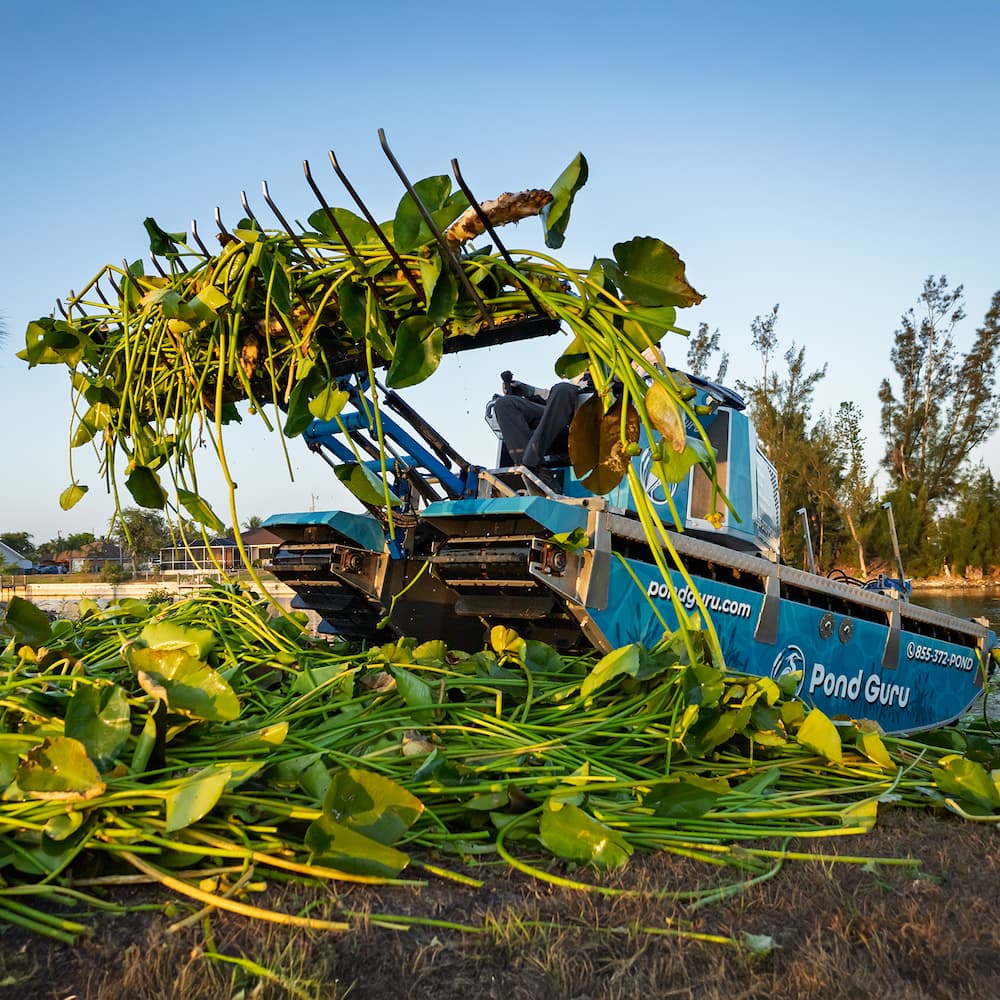
Hydro raking removes rooted aquatic vegetation, soft organic muck, leaf litter, and accumulated bottom debris. It is especially effective at pulling up rooted plants along with their root systems and clearing the organic material that builds up from years of decaying leaves and vegetation. It targets organic accumulation rather than deep mineral sediment.
Knowing what hydro raking handles well, and what it does not, clarifies when it is the right tool.
What hydro raking removes effectively:
- Rooted aquatic plants. It pulls up submerged and rooted vegetation along with the roots, which discourages quick regrowth.
- Organic muck. The soft, mucky layer of decomposed organic matter that accumulates on the bottom.
- Leaf litter and debris. Accumulated leaves, sticks, and other organic debris, especially in wooded settings.
- Floating and loose material. Debris and loosened vegetation that can be raked and collected.
What it is less suited for:
- Deep mineral sediment. For removing large volumes of deep, compacted sediment and restoring substantial depth, full dredging is the more complete tool.
- Very large volumes. Severe, pond-wide sediment accumulation may exceed what raking can practically handle.
This focus on organic material is the heart of hydro raking’s value. Many pond problems come from the organic muck and rooted vegetation that build up over years, and removing those directly addresses the issue, often connecting to the same goals as dredging at a smaller scale.
How Does Hydro Raking Compare to Dredging?
Hydro raking and dredging both remove bottom material, but hydro raking is less invasive and typically less expensive, targeting rooted vegetation and organic muck, while dredging removes larger volumes of sediment and restores more depth. Hydro raking suits moderate organic buildup; dredging suits severe sediment accumulation that has significantly shallowed a pond.
Choosing between them comes down to the scale and type of the problem.
Feature | Hydro raking | Dredging |
|---|---|---|
Material removed | Rooted plants, organic muck, debris | Large volumes of sediment |
Invasiveness | Lower, works from the water | Higher, larger operation |
Pond drainage | Not required | Sometimes required |
Depth restored | Moderate | Substantial |
Relative cost | Lower | Higher |
Best for | Moderate organic buildup and vegetation | Severe sediment, major depth loss |
Hydro raking is the lighter-touch option. It removes rooted vegetation and organic muck effectively, works from the water without draining the pond, and generally costs less than a full dredging project. For a pond with a manageable muck and weed problem, it can restore condition and depth without the scale and expense of dredging.
Dredging is the more complete tool for severe cases. When a pond has filled in with large volumes of sediment and lost significant depth, dredging removes far more material and restores more capacity than raking can. The two are not competitors so much as different-sized tools, and hydro raking can even extend the time before dredging becomes necessary. A professional assessment determines which fits a given pond, and for a fuller look at the heavier option, see the lake dredging process and cost.

When Should You Choose Hydro Raking?
Choose hydro raking when a pond has a moderate buildup of rooted vegetation, organic muck, and debris that manual removal cannot handle but that does not yet require full dredging. It is a good fit for clearing rooted weeds, removing leaf litter and muck, and restoring some depth, at lower cost and disruption than dredging.
Matching the method to the problem is what makes hydro raking worthwhile.
Hydro raking is often the right choice when:
- Rooted vegetation is the problem. It pulls up rooted weeds and their roots, providing longer-lasting control than cutting or chemical treatment alone.
- Organic muck has accumulated. It removes the soft muck layer from decaying leaves and vegetation without a full dredging project.
- The buildup is moderate. The problem is significant but has not filled the pond with deep sediment, so a lighter tool fits.
- Draining is undesirable. Because it works from the water, it avoids the need to drain the pond.
- Budget matters. It typically costs less than dredging, making it attractive for the right scale of problem.
The decision ultimately rests on the scale and type of accumulation. For moderate organic and vegetation buildup, hydro raking is efficient and cost-effective. For severe sediment that has drastically shallowed a pond, dredging remains the answer. And in both cases, pairing removal with ongoing management, aeration and nutrient control, slows the buildup from returning. A professional evaluation through muck removal services identifies the right approach.
Schedule a Site Visit With Pond Guru
Hydro raking fills an important gap in pond care: it removes the rooted weeds, muck, and debris that manual methods cannot, without the scale and cost of full dredging. For a pond with a moderate buildup problem, it restores condition and depth efficiently, and it can postpone the day dredging becomes necessary.
Pond Guru works with HOA boards, property managers, and homeowners across Florida to remove muck and vegetation, assess whether hydro raking or dredging fits a waterbody, and keep ponds from filling in through ongoing management.
Because the right method depends on how much and what kind of material has accumulated, the process starts with an on-site evaluation. To find out whether hydro raking fits your pond, schedule a site visit with Pond Guru and a specialist will assess conditions and recommend a plan.

Frequently Asked Questions
Hydro raking is a mechanical pond cleanup method that uses a barge-mounted hydraulic rake, essentially a floating excavator with a rake attachment, to pull rooted aquatic plants, organic muck, leaf litter, and debris from the bottom. It works from the water without draining the pond, offering a less invasive alternative to full dredging for moderate buildup.
Hydro raking removes rooted aquatic vegetation along with its roots, soft organic muck, leaf litter, and accumulated bottom debris. It is especially effective at pulling up rooted plants and clearing the organic material that builds up from years of decaying vegetation. It targets organic accumulation rather than deep, compacted mineral sediment.
Neither is universally better; they suit different problems. Hydro raking is less invasive and typically less expensive, ideal for moderate rooted vegetation and organic muck. Dredging removes far larger volumes of sediment and restores more depth, making it the tool for severe accumulation. Hydro raking can also delay the need for dredging on some ponds.
No. Hydro raking works from the water surface, with the barge-mounted rake reaching down to the bottom, so the pond stays full throughout the process. This is one of its advantages over some other methods, since avoiding drainage reduces disruption to the pond, its wildlife, and the surrounding area.
Cost depends on the pond's size, the amount and type of material, site access, and disposal, but hydro raking is generally less expensive than full dredging for a comparable area, since it is a lighter operation that does not require draining. Because it is so project-specific, it is best quoted after an on-site assessment.
Ready to Schedule a Visit ?
Have questions about your pond or lake? Our experts are ready to help you take the next step.
Latest Article
Popular Post

Hydro Raking: Muck Removal Without Dredging
Table of Contents When a pond fills with muck,…
Table of Contents
When a pond fills with muck, rooted weeds, and years of accumulated debris, dredging is not the only option. Hydro raking is a less invasive, often less expensive method that uses a floating machine to physically pull material off the bottom, restoring depth and clearing vegetation without the scale of a full dredging project. For many ponds, it is the right-sized tool for a muck problem that has not yet reached the point of requiring dredging.
This guide explains what hydro raking is, how it works, what it removes, how it compares to dredging, and when it is the right choice.
Hydro raking is a mechanical muck and vegetation removal method that uses a barge-mounted hydraulic rake, essentially a floating excavator with a rake attachment, to pull rooted plants, muck, leaf litter, and debris from a pond bottom. It restores depth and clears vegetation without the full excavation of dredging, making it a less invasive alternative.
Key Takeaways
- Hydro raking uses a floating rake to pull muck, roots, and debris from the pond bottom.
- It is less invasive than dredging, operating from the water without draining the pond.
- It targets organic material, including rooted vegetation, leaf litter, and soft muck.
- It is often more economical than full dredging for the right scale of problem.
- It has limits, removing less material and depth than dredging, so severe sediment buildup may still require dredging.
What Is Hydro Raking?
Hydro raking is a mechanical pond and lake cleanup method that uses a barge-mounted hydraulic rake to remove material from the bottom. The machine is essentially a small floating excavator fitted with a rake attachment, which reaches down, pulls up rooted vegetation, muck, and debris, and deposits it for removal. It works from the water rather than requiring the pond to be drained.
Understanding hydro raking starts with picturing the equipment: a rake on a floating excavator.
As lake management specialists including Pond Guru describe, a hydro rake is a floating barge with a hydraulic arm and a rake head that removes rooted aquatic plants and accumulated organic material from the bottom. Key features:
- The equipment. A barge-mounted hydraulic rake, like a floating backhoe with a rake instead of a bucket.
- The action. It reaches to the bottom, rakes up rooted plants, muck, and debris, and lifts the material out.
- The operation. It works from the water surface, so the pond does not need to be drained.
- The material. Removed material is collected and hauled away or placed as appropriate.
Hydro raking occupies a useful middle ground between hand removal and full dredging. It removes far more than manual methods, yet it is less involved than dredging an entire pond. This makes it a practical tool for ponds with a muck and vegetation problem that is significant but not extreme, and it is part of the broader family of muck removal solutions.
How Does Hydro Raking Work?
Hydro raking works by maneuvering a floating barge across the pond while its hydraulic arm lowers a rake to the bottom, pulls up rooted vegetation, muck, and debris, and lifts the material out of the water. The collected material is moved to shore for dewatering and disposal. The pond stays full throughout the process.
The process is methodical, working the pond area by area from the water.
How a hydro raking project typically unfolds:
- The barge is launched. The floating rake is put into the pond and positioned over the target areas.
- The rake works the bottom. The hydraulic arm lowers the rake, which pulls up rooted plants, muck, and debris in repeated passes.
- Material is collected. The raked material is lifted out and moved to a staging area on shore.
- Dewatering and disposal. The material is allowed to drain and is then hauled away or placed as appropriate.
- The pond stays full. Because the rake works from the surface, there is no need to drain the pond.
A key advantage of this approach is that it physically removes the material, including the roots of aquatic plants, rather than just cutting the tops or killing them chemically. Removing the roots and the muck they grow in provides longer-lasting results than surface treatment. Because the material and the nutrients it holds leave the pond, hydro raking also reduces the nutrient load that fuels future growth.
Hydro-Raking The Right Option
Pond Guru utilizes mechanical hydro raking techniques to remove submersed vegetation and muck from your lake bed.
What Does Hydro Raking Remove?
Hydro raking removes rooted aquatic vegetation, soft organic muck, leaf litter, and accumulated bottom debris. It is especially effective at pulling up rooted plants along with their root systems and clearing the organic material that builds up from years of decaying leaves and vegetation. It targets organic accumulation rather than deep mineral sediment.
Knowing what hydro raking handles well, and what it does not, clarifies when it is the right tool.
What hydro raking removes effectively:
- Rooted aquatic plants. It pulls up submerged and rooted vegetation along with the roots, which discourages quick regrowth.
- Organic muck. The soft, mucky layer of decomposed organic matter that accumulates on the bottom.
- Leaf litter and debris. Accumulated leaves, sticks, and other organic debris, especially in wooded settings.
- Floating and loose material. Debris and loosened vegetation that can be raked and collected.
What it is less suited for:
- Deep mineral sediment. For removing large volumes of deep, compacted sediment and restoring substantial depth, full dredging is the more complete tool.
- Very large volumes. Severe, pond-wide sediment accumulation may exceed what raking can practically handle.
This focus on organic material is the heart of hydro raking’s value. Many pond problems come from the organic muck and rooted vegetation that build up over years, and removing those directly addresses the issue, often connecting to the same goals as dredging at a smaller scale.
How Does Hydro Raking Compare to Dredging?
Hydro raking and dredging both remove bottom material, but hydro raking is less invasive and typically less expensive, targeting rooted vegetation and organic muck, while dredging removes larger volumes of sediment and restores more depth. Hydro raking suits moderate organic buildup; dredging suits severe sediment accumulation that has significantly shallowed a pond.
Choosing between them comes down to the scale and type of the problem.
Feature | Hydro raking | Dredging |
|---|---|---|
Material removed | Rooted plants, organic muck, debris | Large volumes of sediment |
Invasiveness | Lower, works from the water | Higher, larger operation |
Pond drainage | Not required | Sometimes required |
Depth restored | Moderate | Substantial |
Relative cost | Lower | Higher |
Best for | Moderate organic buildup and vegetation | Severe sediment, major depth loss |
Hydro raking is the lighter-touch option. It removes rooted vegetation and organic muck effectively, works from the water without draining the pond, and generally costs less than a full dredging project. For a pond with a manageable muck and weed problem, it can restore condition and depth without the scale and expense of dredging.
Dredging is the more complete tool for severe cases. When a pond has filled in with large volumes of sediment and lost significant depth, dredging removes far more material and restores more capacity than raking can. The two are not competitors so much as different-sized tools, and hydro raking can even extend the time before dredging becomes necessary. A professional assessment determines which fits a given pond, and for a fuller look at the heavier option, see the lake dredging process and cost.
When Should You Choose Hydro Raking?
Choose hydro raking when a pond has a moderate buildup of rooted vegetation, organic muck, and debris that manual removal cannot handle but that does not yet require full dredging. It is a good fit for clearing rooted weeds, removing leaf litter and muck, and restoring some depth, at lower cost and disruption than dredging.
Matching the method to the problem is what makes hydro raking worthwhile.
Hydro raking is often the right choice when:
- Rooted vegetation is the problem. It pulls up rooted weeds and their roots, providing longer-lasting control than cutting or chemical treatment alone.
- Organic muck has accumulated. It removes the soft muck layer from decaying leaves and vegetation without a full dredging project.
- The buildup is moderate. The problem is significant but has not filled the pond with deep sediment, so a lighter tool fits.
- Draining is undesirable. Because it works from the water, it avoids the need to drain the pond.
- Budget matters. It typically costs less than dredging, making it attractive for the right scale of problem.
The decision ultimately rests on the scale and type of accumulation. For moderate organic and vegetation buildup, hydro raking is efficient and cost-effective. For severe sediment that has drastically shallowed a pond, dredging remains the answer. And in both cases, pairing removal with ongoing management, aeration and nutrient control, slows the buildup from returning. A professional evaluation through muck removal services identifies the right approach.
Schedule a Site Visit With Pond Guru

Hydro raking fills an important gap in pond care: it removes the rooted weeds, muck, and debris that manual methods cannot, without the scale and cost of full dredging. For a pond with a moderate buildup problem, it restores condition and depth efficiently, and it can postpone the day dredging becomes necessary.
Pond Guru works with HOA boards, property managers, and homeowners across Florida to remove muck and vegetation, assess whether hydro raking or dredging fits a waterbody, and keep ponds from filling in through ongoing management.
Because the right method depends on how much and what kind of material has accumulated, the process starts with an on-site evaluation. To find out whether hydro raking fits your pond, schedule a site visit with Pond Guru and a specialist will assess conditions and recommend a plan.
Frequently Asked Questions
Hydro raking is a mechanical pond cleanup method that uses a barge-mounted hydraulic rake, essentially a floating excavator with a rake attachment, to pull rooted aquatic plants, organic muck, leaf litter, and debris from the bottom. It works from the water without draining the pond, offering a less invasive alternative to full dredging for moderate buildup.
Hydro raking removes rooted aquatic vegetation along with its roots, soft organic muck, leaf litter, and accumulated bottom debris. It is especially effective at pulling up rooted plants and clearing the organic material that builds up from years of decaying vegetation. It targets organic accumulation rather than deep, compacted mineral sediment.
Neither is universally better; they suit different problems. Hydro raking is less invasive and typically less expensive, ideal for moderate rooted vegetation and organic muck. Dredging removes far larger volumes of sediment and restores more depth, making it the tool for severe accumulation. Hydro raking can also delay the need for dredging on some ponds.
No. Hydro raking works from the water surface, with the barge-mounted rake reaching down to the bottom, so the pond stays full throughout the process. This is one of its advantages over some other methods, since avoiding drainage reduces disruption to the pond, its wildlife, and the surrounding area.
Cost depends on the pond's size, the amount and type of material, site access, and disposal, but hydro raking is generally less expensive than full dredging for a comparable area, since it is a lighter operation that does not require draining. Because it is so project-specific, it is best quoted after an on-site assessment.
Ready to Schedule a Visit ?
Have questions about your pond or lake? Our experts are ready to help you take the next step.
Latest Article
Popular Post
Hydro Raking: Muck Removal Without Dredging
Table of Contents When a pond fills with muck,…