

How to Identify a Water Moccasin? Florida Snake ID Guide
How to Identify a Water Moccasin? Florida Snake ID Guide
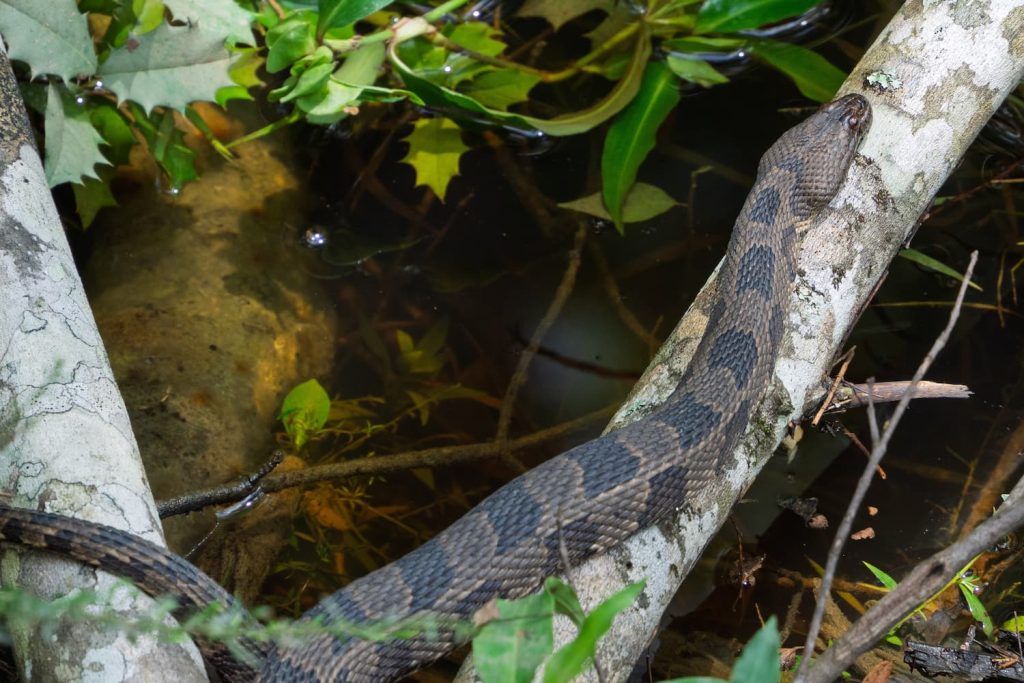
Table of Contents
If you live near a pond, lake, or canal in Florida, you have probably wondered whether that dark snake at the water’s edge is a dangerous water moccasin or a harmless lookalike. It is one of the most common, and most misunderstood, questions among waterfront property owners in the state.
This guide explains exactly how to identify a water moccasin, how to tell it apart from the harmless watersnakes it is constantly confused with, how dangerous a bite really is, and what you can do to keep your shoreline safer.
A water moccasin is a heavy-bodied venomous pit viper, typically 2 to 4 feet long, with a thick body, a broad blocky head wider than its neck, a dark facial stripe through the eye, vertical cat-like pupils, and a heat-sensing pit between each eye and nostril. It is found near fresh water throughout Florida.
Key Takeaways
- Water moccasin and cottonmouth are the same snake. Both names refer to the venomous pit viper Agkistrodon conanti (Florida cottonmouth).
- They are venomous, not poisonous. A bite is a medical emergency, but cottonmouths are not aggressive and bites are relatively uncommon.
- Most “water moccasins” people see are actually harmless watersnakes. Florida has eight nonvenomous Nerodia watersnake species that look similar and are far more abundant.
- Three reliable tells: a facial pit, vertical pupils, and a head so broad the eyes are hidden when viewed from directly above.
- Prevention is about habitat. Reducing cover, controlling rodents, and managing shoreline vegetation makes a pond less attractive to snakes.
What Is a Water Moccasin (Cottonmouth)?
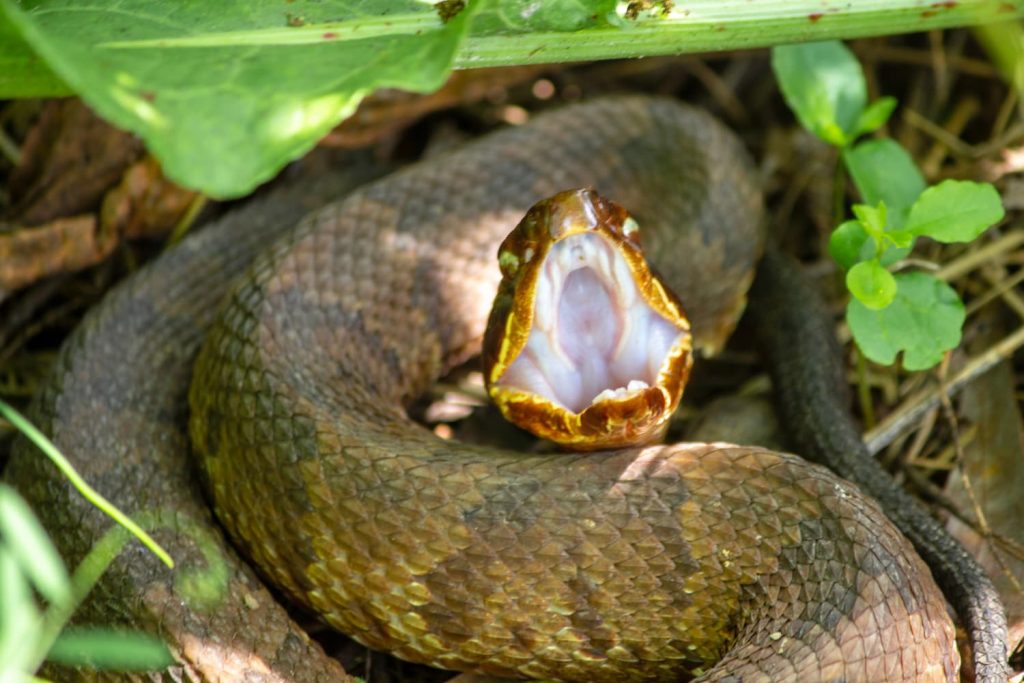
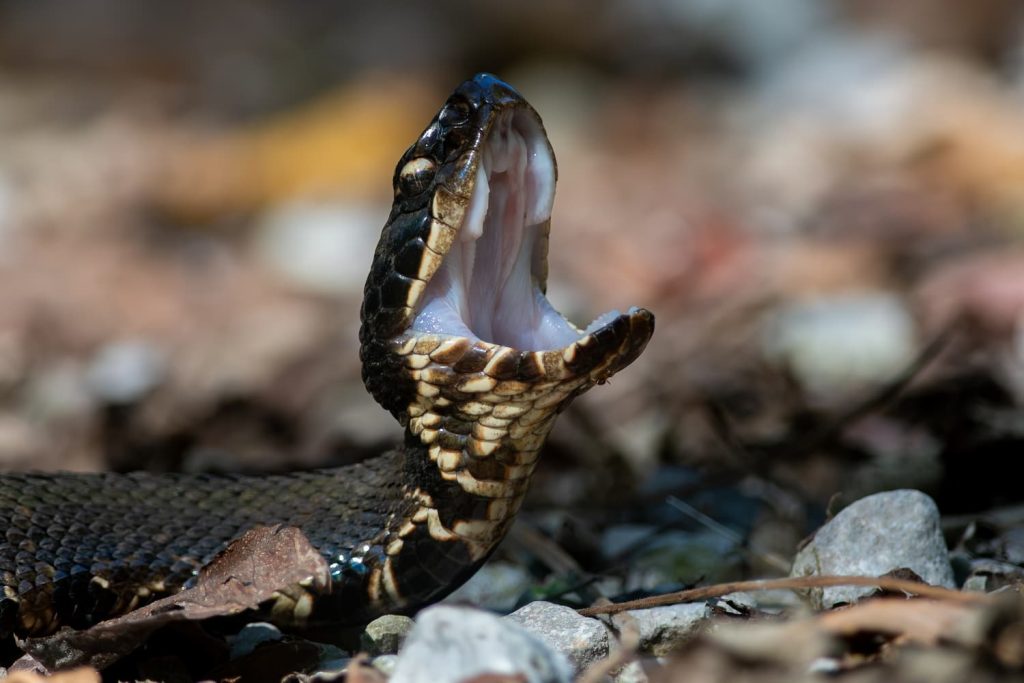
A water moccasin, also called a cottonmouth, is a venomous semi-aquatic pit viper native to the southeastern United States. In Florida it is the species Agkistrodon conanti. Adults are heavy-bodied, usually 2 to 4 feet long, and dark olive, brown, or nearly black. The name “cottonmouth” comes from the white interior of the mouth it displays when threatened.
The cottonmouth gets both of its common names from its lifestyle and its defensive display. “Water moccasin” reflects its semi-aquatic habits, while “cottonmouth” describes the startling white mouth lining it shows as a warning.
According to the Florida Museum’s Florida Snake ID Guide, cottonmouths are found throughout Florida and in every county, including several nearshore islands. They are most active around shallow fresh water, though they can also turn up in brackish coastal habitats.
Is a Cottonmouth the Same as a Water Moccasin?
Yes. “Cottonmouth” and “water moccasin” are two common names for the exact same snake. There is no biological difference between them. Scientists classify the Florida species as Agkistrodon conanti. Regional usage varies, but both terms describe the same venomous, semi-aquatic pit viper found near fresh water across the Southeast.
People often assume “cottonmouth” and “water moccasin” are two different snakes, but they are interchangeable names. You may also hear “moccasin,” “cottonmouth moccasin,” or “swamp moccasin.” All point to the same animal.
This naming confusion matters because it feeds a second, more dangerous mix-up: confusing the venomous cottonmouth with Florida’s harmless watersnakes. We will break down that distinction in detail below.
What Are the Colors of Water Moccasins and Their Markings?
Water moccasins range from light brown with darker crossbands as juveniles to nearly solid black as adults. Juveniles show reddish-brown bands speckled with dark spots and a bright yellow or sulfur-colored tail tip. As the snake ages, the pattern darkens and fades, so many older adults appear almost uniformly dark with little visible patterning.
Understanding the colors of water moccasins is easier when you separate juveniles from adults, because they look strikingly different.
Juveniles: Light brown or tan bodies with bold reddish-brown crossbands containing numerous dark speckles. They have a distinctive bright yellow tail tip used to lure prey.
Adults: Much darker. The Florida Museum notes the pattern darkens with age until adults may become uniformly black, with the eye camouflaged by a broad dark facial stripe.
The key water moccasin markings to remember are the dark cheek stripe through the eye and, in juveniles, the heavily speckled crossbands. Speckling inside the bands is an important clue, because it helps separate young cottonmouths from copperheads, whose bands are clean.
How Can You Tell If a Snake Is a Water Moccasin?
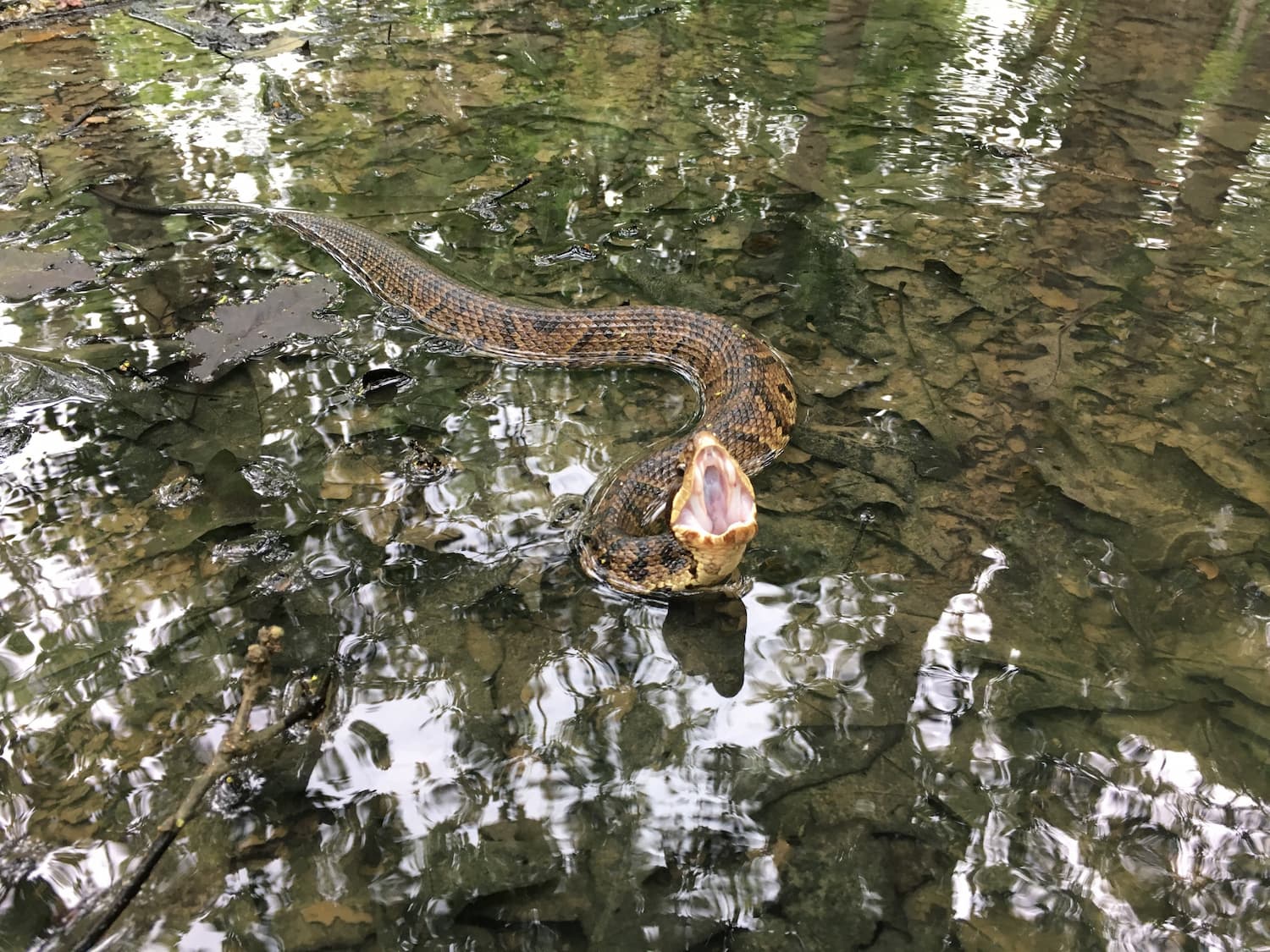
You can tell if a snake is a water moccasin by checking for three pit-viper features: a deep facial pit between each eye and nostril, vertical cat-like pupils, and a head so broad and blocky that the eyes are not visible when the snake is viewed from directly above. Cottonmouths also tend to rest with the head tilted upward at an angle.
Knowing how to tell if a snake is a water moccasin comes down to a short checklist. Never get close enough to risk a bite, but from a safe distance or in a zoomed-in photo, look for these traits documented by the Florida Museum:
- Facial pit: A heat-sensing pit sits between the nostril and the eye. Watersnakes do not have this.
- Pupils: Cottonmouths have vertical, elliptical (cat-like) pupils. Watersnakes have round pupils.
- Hidden eyes from above: A cottonmouth’s broad brow ridge hides its eyes when seen from directly overhead. A watersnake’s eyes remain visible.
- No facial bars: Watersnakes usually have thin dark vertical lines near the mouth. Cottonmouths do not.
- Resting posture: Cottonmouths often rest with the head elevated and tilted upward; watersnakes usually do not.
A single trait alone can mislead. Use several together, and when in doubt, treat the snake as venomous and keep your distance.
What Is the Difference Between a Water Snake and a Water Moccasin?
The main difference between a water snake and a water moccasin is venom and anatomy. Water moccasins are venomous pit vipers with facial pits, vertical pupils, broad blocky heads, and heavy bodies. Harmless watersnakes are nonvenomous, with round pupils, no facial pits, narrower heads, and visible eyes when viewed from above. Watersnakes are also far more common.
This is the most important distinction in this entire guide, because the difference between a water snake and a water moccasin is regularly misjudged, often with the harmless snake paying the price.
The Florida Museum reports that Florida has eight species of nonvenomous watersnakes (genus Nerodia) that overlap with cottonmouths in range and habitat, and that many are killed each year by residents who mistake them for cottonmouths. Their guidance is direct: if you see a snake in or near the water, it is most likely a harmless watersnake, and the best action is to leave it alone.
A quick contrast:
- Head: Cottonmouth is broad and blocky; watersnake is narrower and more uniform with the neck.
- Pupils: Cottonmouth vertical; watersnake round.
- Facial pit: Present on cottonmouth; absent on watersnake.
- Behavior: A cornered cottonmouth may stand its ground, coil, and gape to show its white mouth. Watersnakes typically flee into the water.
Because harmless watersnakes are both common and beneficial, accurate identification protects you and the local ecosystem.
Protect Pond Wildlife Habitat
Pond Guru can help manage shoreline vegetation to limit venomous snake habitat
Are Water Moccasins Poisonous or Venomous?
Water moccasins are venomous, not poisonous. The distinction is real: venomous animals inject toxins through a bite or sting, while poisonous animals cause harm when eaten or touched. A cottonmouth delivers venom through hollow fangs. Its bite can cause serious tissue damage and requires immediate medical care, though fatalities are rare in the United States.
When people ask whether are water moccasins poisonous, the accurate answer involves a small but meaningful correction. As medical references like the Merck Manual explain, animals that inject toxins by biting or stinging are called venomous, while “poisonous” refers to toxins absorbed by eating or touching. So the cottonmouth is venomous.
That said, the everyday meaning behind the question is clear: yes, a water moccasin’s bite is dangerous and should always be taken seriously.
Cottonmouths are pit vipers, the same family as rattlesnakes and copperheads. Their venom is primarily tissue-destroying (cytotoxic), affecting blood and local tissue rather than the nervous system.
How Dangerous Is a Cottonmouth Bite?
A cottonmouth bite is a medical emergency that can cause severe pain, swelling, tissue damage, and sometimes blood-clotting problems, but it is rarely fatal with prompt treatment. Of roughly 7,000 to 8,000 venomous snakebites reported in the U.S. each year, only about five result in death, and rattlesnakes account for almost all of those.
Understanding the real risk of a cottonmouth bite helps replace fear with informed caution. The data shows these bites are serious but usually survivable with proper care.
According to Poison Control, cottonmouth bite symptoms are usually limited to pain and swelling at the affected area, which can be intense and may take weeks to fully resolve. Systemic effects like nausea, low platelets, and abnormal clotting are less common. Some bites are “dry,” meaning no venom is injected.
A peer-reviewed analysis of cottonmouth bites in the ToxIC North American Snakebite Registry found that among 31 envenomations, swelling was the most common symptom, 19 percent of patients developed gastrointestinal symptoms, 19 percent developed coagulopathy, and antivenom was used in 84 percent of cases.
If a bite occurs:
- Call 911 or Poison Control (1-800-222-1222) immediately.
- Keep the victim calm and still, and keep the bitten limb at or slightly below heart level.
- Remove rings, watches, and tight clothing before swelling begins.
- Do not cut the wound, apply a tourniquet, use ice, or attempt to suck out venom.
Importantly, cottonmouths are not aggressive. Most bites happen when a snake is stepped on or deliberately handled, so giving them space is the most effective protection.
Are Water Moccasins Common in Florida Lakes and Ponds?
Cottonmouths live throughout Florida and are found in or near most freshwater habitats, including lakes, ponds, marshes, swamps, canals, and slow streams. However, the harmless watersnakes that share these waters are far more numerous. So while water moccasins are present statewide, the majority of snakes seen around a typical Florida pond are nonvenomous.
The question of whether are water moccasins common in Florida lakes has a two-part answer: yes, they are widespread, but no, they are not the most common snake you will encounter at the water’s edge.
The Florida Fish and Wildlife Conservation Commission notes that cottonmouths are often confused with the more common nonvenomous watersnakes. Cottonmouths favor shallow, vegetated water with plenty of cover and prey such as fish, frogs, and small animals.
For property owners, this means a healthy, well-managed pond is not automatically a cottonmouth haven. The amount of cover, the rodent population, and the shoreline vegetation all influence how attractive your water is to snakes of any kind.
How Can You Prevent Cottonmouths in Your Pond?
You can reduce cottonmouths around a pond by removing the habitat features that attract snakes and their prey. Keep grass trimmed, clear brush piles and debris, control rodent populations, manage dense shoreline vegetation, and eliminate standing clutter near the water. These steps make the area less hospitable to snakes without harming the broader ecosystem.
Knowing how to prevent cottonmouths in my pond is mostly about habitat management, because snakes go where food and cover are abundant.
Practical, humane prevention steps include:
- Reduce cover. Remove brush piles, leaf litter, woodpiles, and debris where snakes hide.
- Trim vegetation. Keep grass short and manage overgrown shoreline plants that provide cover.
- Control rodents. Rodents are a primary food source. Secure trash and reduce rodent harborage to make your property less appealing.
- Manage the water’s edge. A professionally maintained shoreline with appropriate vegetation balance is less attractive to snakes than an overgrown, neglected one.
- Do not handle or kill snakes. Most bites occur during these attempts, and killing harmless watersnakes removes beneficial predators. If a venomous snake must be removed, contact a licensed professional.
This is where ongoing pond care intersects with safety. A consistent shoreline and vegetation management program, like the lake and pond management services offered by Pond Guru, helps keep the water’s edge tidy and less inviting to snakes while supporting a healthy aquatic ecosystem.
What Other Snakes Are Confused With Water Moccasins?
Several harmless snakes are mistaken for water moccasins, especially Florida’s eight nonvenomous watersnake species (genus Nerodia). Juvenile cottonmouths are also confused with the venomous eastern copperhead, which in Florida occurs only in the Panhandle. Checking for the facial pit, pupil shape, and head shape helps distinguish the venomous species from harmless lookalikes.
Beyond the watersnakes already discussed, the Florida Museum notes that brightly colored juvenile cottonmouths are sometimes mistaken for the eastern copperhead. The distinguishing detail is speckling: juvenile cottonmouth crossbands contain numerous dark spots, while copperhead bands have few or none.
Common lookalikes include the southern watersnake, Florida green watersnake, plain-bellied watersnake, and banded watersnake. All are nonvenomous, all are beneficial, and all are far more common around the average pond than the cottonmouth itself.
When you cannot be certain, the safest and most ecologically responsible approach is simple: keep your distance and leave the snake alone.
Protect Your Property With Professional Pond and Lake Management
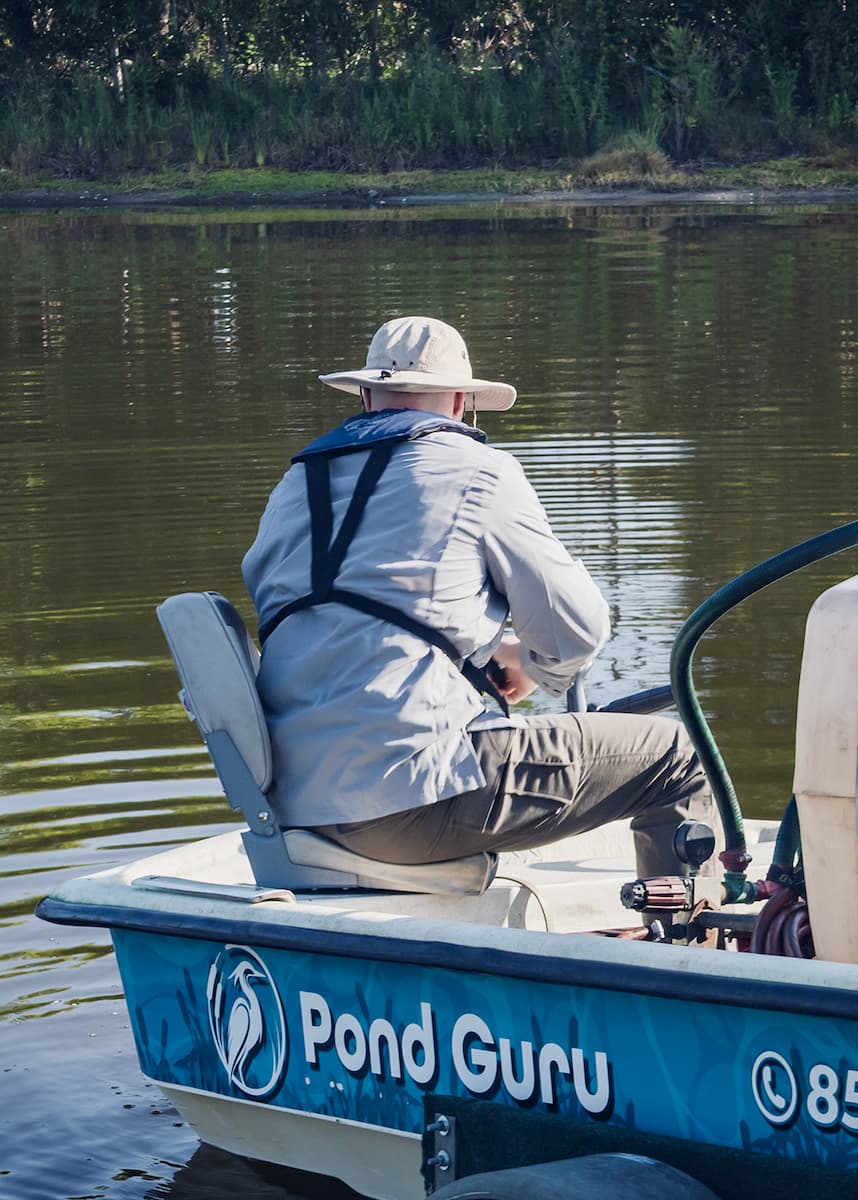
Keeping a shoreline safe, attractive, and less inviting to snakes is an ongoing effort that goes hand in hand with overall water health. Overgrown banks, excess vegetation, and poor water quality all create the kind of cover that snakes and their prey favor.
Professional pond and lake management addresses these conditions systematically, combining shoreline maintenance, vegetation control, and water quality care into a single program. The result is a healthier water body that is easier to enjoy and easier to keep safe.
Pond Guru works with homeowners, HOA boards, property managers, and golf course managers across Florida to maintain ponds and lakes that are both beautiful and well managed.
Schedule a Site Visit With Pond Guru
If you are concerned about snakes around your pond or simply want a healthier, better-maintained shoreline, a professional evaluation is a practical first step. A specialist can assess your water body, identify conditions that attract snakes and pests, and recommend a management plan suited to your property.
Contact Pond Guru to schedule a site visit. A specialist will evaluate your pond or lake conditions, shoreline vegetation, and overall water health, then build a plan to help keep your waterfront safe, clean, and well managed year-round.
Frequently Asked Questions
Yes. Cottonmouth and water moccasin are two common names for the same venomous, semi-aquatic pit viper. In Florida it is the species Agkistrodon conanti. There is no biological difference between the two names, though regional usage varies across the southeastern United States.
Look for three pit-viper traits: a facial pit between the eye and nostril, vertical cat-like pupils, and a broad blocky head that hides the eyes when viewed from above. Watersnakes have round pupils, no facial pit, and visible eyes from above. Most snakes near water are harmless watersnakes.
Water moccasins are venomous, not poisonous. Venomous animals inject toxins through a bite, while poisonous animals cause harm when eaten or touched. A cottonmouth injects venom through hollow fangs. The distinction is technical, but the practical point stands: a bite is dangerous and needs prompt medical care.
A cottonmouth bite is a medical emergency that can cause severe pain, swelling, and tissue damage, and occasionally blood-clotting problems. Fatalities are rare with prompt treatment. Of about 7,000 to 8,000 U.S. venomous snakebites yearly, roughly five are fatal, mostly from rattlesnakes. Seek emergency care immediately after any venomous bite.
Cottonmouths live statewide near most freshwater habitats, but Florida's eight nonvenomous watersnake species are far more common. So while water moccasins are present, most snakes seen at a typical pond are harmless. Habitat conditions like cover, prey, and vegetation strongly influence how many snakes a pond attracts.
Keep your distance and do not attempt to handle or kill it, since most bites occur during these attempts. Observe from a safe distance to identify it if possible. If a venomous snake must be removed, contact a licensed wildlife professional. Reducing cover and managing vegetation helps prevent future visits.
Ready to Schedule a Visit ?
Have questions about your pond or lake? Our experts are ready to help you take the next step.
Latest Article
Popular Post

Pond Smelling Like Rotten Eggs? Foul Smelling Pond Water
Table of Contents That unmistakable rotten-egg, sulfur smell drifting…
Table of Contents
If you live near a pond, lake, or canal in Florida, you have probably wondered whether that dark snake at the water’s edge is a dangerous water moccasin or a harmless lookalike. It is one of the most common, and most misunderstood, questions among waterfront property owners in the state.
This guide explains exactly how to identify a water moccasin, how to tell it apart from the harmless watersnakes it is constantly confused with, how dangerous a bite really is, and what you can do to keep your shoreline safer.
A water moccasin is a heavy-bodied venomous pit viper, typically 2 to 4 feet long, with a thick body, a broad blocky head wider than its neck, a dark facial stripe through the eye, vertical cat-like pupils, and a heat-sensing pit between each eye and nostril. It is found near fresh water throughout Florida.
Key Takeaways
- Water moccasin and cottonmouth are the same snake. Both names refer to the venomous pit viper Agkistrodon conanti (Florida cottonmouth).
- They are venomous, not poisonous. A bite is a medical emergency, but cottonmouths are not aggressive and bites are relatively uncommon.
- Most “water moccasins” people see are actually harmless watersnakes. Florida has eight nonvenomous Nerodia watersnake species that look similar and are far more abundant.
- Three reliable tells: a facial pit, vertical pupils, and a head so broad the eyes are hidden when viewed from directly above.
- Prevention is about habitat. Reducing cover, controlling rodents, and managing shoreline vegetation makes a pond less attractive to snakes.
What Is a Water Moccasin (Cottonmouth)?
A water moccasin, also called a cottonmouth, is a venomous semi-aquatic pit viper native to the southeastern United States. In Florida it is the species Agkistrodon conanti. Adults are heavy-bodied, usually 2 to 4 feet long, and dark olive, brown, or nearly black. The name “cottonmouth” comes from the white interior of the mouth it displays when threatened.
The cottonmouth gets both of its common names from its lifestyle and its defensive display. “Water moccasin” reflects its semi-aquatic habits, while “cottonmouth” describes the startling white mouth lining it shows as a warning.
According to the Florida Museum’s Florida Snake ID Guide, cottonmouths are found throughout Florida and in every county, including several nearshore islands. They are most active around shallow fresh water, though they can also turn up in brackish coastal habitats.
Is a Cottonmouth the Same as a Water Moccasin?
Yes. “Cottonmouth” and “water moccasin” are two common names for the exact same snake. There is no biological difference between them. Scientists classify the Florida species as Agkistrodon conanti. Regional usage varies, but both terms describe the same venomous, semi-aquatic pit viper found near fresh water across the Southeast.
People often assume “cottonmouth” and “water moccasin” are two different snakes, but they are interchangeable names. You may also hear “moccasin,” “cottonmouth moccasin,” or “swamp moccasin.” All point to the same animal.
This naming confusion matters because it feeds a second, more dangerous mix-up: confusing the venomous cottonmouth with Florida’s harmless watersnakes. We will break down that distinction in detail below.
What Are the Colors of Water Moccasins and Their Markings?
Water moccasins range from light brown with darker crossbands as juveniles to nearly solid black as adults. Juveniles show reddish-brown bands speckled with dark spots and a bright yellow or sulfur-colored tail tip. As the snake ages, the pattern darkens and fades, so many older adults appear almost uniformly dark with little visible patterning.
Understanding the colors of water moccasins is easier when you separate juveniles from adults, because they look strikingly different.
Juveniles: Light brown or tan bodies with bold reddish-brown crossbands containing numerous dark speckles. They have a distinctive bright yellow tail tip used to lure prey.
Adults: Much darker. The Florida Museum notes the pattern darkens with age until adults may become uniformly black, with the eye camouflaged by a broad dark facial stripe.
The key water moccasin markings to remember are the dark cheek stripe through the eye and, in juveniles, the heavily speckled crossbands. Speckling inside the bands is an important clue, because it helps separate young cottonmouths from copperheads, whose bands are clean.
How Can You Tell If a Snake Is a Water Moccasin?
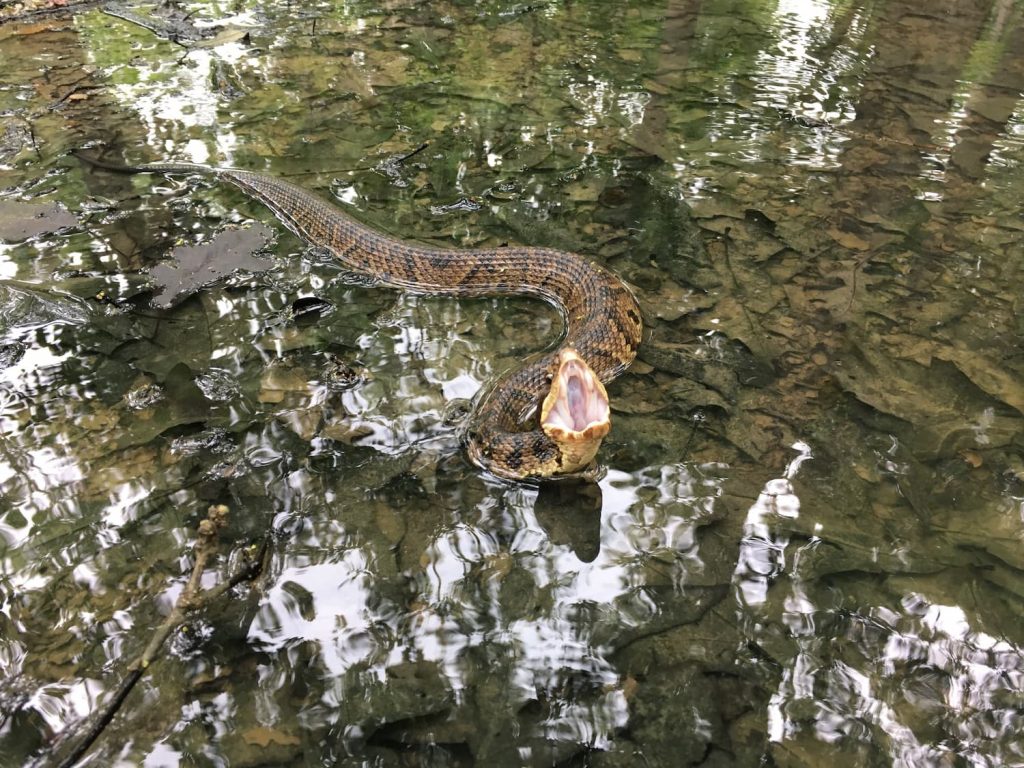
You can tell if a snake is a water moccasin by checking for three pit-viper features: a deep facial pit between each eye and nostril, vertical cat-like pupils, and a head so broad and blocky that the eyes are not visible when the snake is viewed from directly above. Cottonmouths also tend to rest with the head tilted upward at an angle.
Knowing how to tell if a snake is a water moccasin comes down to a short checklist. Never get close enough to risk a bite, but from a safe distance or in a zoomed-in photo, look for these traits documented by the Florida Museum:
- Facial pit: A heat-sensing pit sits between the nostril and the eye. Watersnakes do not have this.
- Pupils: Cottonmouths have vertical, elliptical (cat-like) pupils. Watersnakes have round pupils.
- Hidden eyes from above: A cottonmouth’s broad brow ridge hides its eyes when seen from directly overhead. A watersnake’s eyes remain visible.
- No facial bars: Watersnakes usually have thin dark vertical lines near the mouth. Cottonmouths do not.
- Resting posture: Cottonmouths often rest with the head elevated and tilted upward; watersnakes usually do not.
A single trait alone can mislead. Use several together, and when in doubt, treat the snake as venomous and keep your distance.
What Is the Difference Between a Water Snake and a Water Moccasin?
The main difference between a water snake and a water moccasin is venom and anatomy. Water moccasins are venomous pit vipers with facial pits, vertical pupils, broad blocky heads, and heavy bodies. Harmless watersnakes are nonvenomous, with round pupils, no facial pits, narrower heads, and visible eyes when viewed from above. Watersnakes are also far more common.
This is the most important distinction in this entire guide, because the difference between a water snake and a water moccasin is regularly misjudged, often with the harmless snake paying the price.
The Florida Museum reports that Florida has eight species of nonvenomous watersnakes (genus Nerodia) that overlap with cottonmouths in range and habitat, and that many are killed each year by residents who mistake them for cottonmouths. Their guidance is direct: if you see a snake in or near the water, it is most likely a harmless watersnake, and the best action is to leave it alone.
A quick contrast:
- Head: Cottonmouth is broad and blocky; watersnake is narrower and more uniform with the neck.
- Pupils: Cottonmouth vertical; watersnake round.
- Facial pit: Present on cottonmouth; absent on watersnake.
- Behavior: A cornered cottonmouth may stand its ground, coil, and gape to show its white mouth. Watersnakes typically flee into the water.
Because harmless watersnakes are both common and beneficial, accurate identification protects you and the local ecosystem.
Protect Pond Wildlife Habitat
Pond Guru can help manage shoreline vegetation to limit venomous snake habitat
Are Water Moccasins Poisonous or Venomous?
Water moccasins are venomous, not poisonous. The distinction is real: venomous animals inject toxins through a bite or sting, while poisonous animals cause harm when eaten or touched. A cottonmouth delivers venom through hollow fangs. Its bite can cause serious tissue damage and requires immediate medical care, though fatalities are rare in the United States.
When people ask whether are water moccasins poisonous, the accurate answer involves a small but meaningful correction. As medical references like the Merck Manual explain, animals that inject toxins by biting or stinging are called venomous, while “poisonous” refers to toxins absorbed by eating or touching. So the cottonmouth is venomous.
That said, the everyday meaning behind the question is clear: yes, a water moccasin’s bite is dangerous and should always be taken seriously.
Cottonmouths are pit vipers, the same family as rattlesnakes and copperheads. Their venom is primarily tissue-destroying (cytotoxic), affecting blood and local tissue rather than the nervous system.
How Dangerous Is a Cottonmouth Bite?
A cottonmouth bite is a medical emergency that can cause severe pain, swelling, tissue damage, and sometimes blood-clotting problems, but it is rarely fatal with prompt treatment. Of roughly 7,000 to 8,000 venomous snakebites reported in the U.S. each year, only about five result in death, and rattlesnakes account for almost all of those.
Understanding the real risk of a cottonmouth bite helps replace fear with informed caution. The data shows these bites are serious but usually survivable with proper care.
According to Poison Control, cottonmouth bite symptoms are usually limited to pain and swelling at the affected area, which can be intense and may take weeks to fully resolve. Systemic effects like nausea, low platelets, and abnormal clotting are less common. Some bites are “dry,” meaning no venom is injected.
A peer-reviewed analysis of cottonmouth bites in the ToxIC North American Snakebite Registry found that among 31 envenomations, swelling was the most common symptom, 19 percent of patients developed gastrointestinal symptoms, 19 percent developed coagulopathy, and antivenom was used in 84 percent of cases.
If a bite occurs:
- Call 911 or Poison Control (1-800-222-1222) immediately.
- Keep the victim calm and still, and keep the bitten limb at or slightly below heart level.
- Remove rings, watches, and tight clothing before swelling begins.
- Do not cut the wound, apply a tourniquet, use ice, or attempt to suck out venom.
Importantly, cottonmouths are not aggressive. Most bites happen when a snake is stepped on or deliberately handled, so giving them space is the most effective protection.
Are Water Moccasins Common in Florida Lakes and Ponds?
Cottonmouths live throughout Florida and are found in or near most freshwater habitats, including lakes, ponds, marshes, swamps, canals, and slow streams. However, the harmless watersnakes that share these waters are far more numerous. So while water moccasins are present statewide, the majority of snakes seen around a typical Florida pond are nonvenomous.
The question of whether are water moccasins common in Florida lakes has a two-part answer: yes, they are widespread, but no, they are not the most common snake you will encounter at the water’s edge.
The Florida Fish and Wildlife Conservation Commission notes that cottonmouths are often confused with the more common nonvenomous watersnakes. Cottonmouths favor shallow, vegetated water with plenty of cover and prey such as fish, frogs, and small animals.
For property owners, this means a healthy, well-managed pond is not automatically a cottonmouth haven. The amount of cover, the rodent population, and the shoreline vegetation all influence how attractive your water is to snakes of any kind.
How Can You Prevent Cottonmouths in Your Pond?
You can reduce cottonmouths around a pond by removing the habitat features that attract snakes and their prey. Keep grass trimmed, clear brush piles and debris, control rodent populations, manage dense shoreline vegetation, and eliminate standing clutter near the water. These steps make the area less hospitable to snakes without harming the broader ecosystem.
Knowing how to prevent cottonmouths in my pond is mostly about habitat management, because snakes go where food and cover are abundant.
Practical, humane prevention steps include:
- Reduce cover. Remove brush piles, leaf litter, woodpiles, and debris where snakes hide.
- Trim vegetation. Keep grass short and manage overgrown shoreline plants that provide cover.
- Control rodents. Rodents are a primary food source. Secure trash and reduce rodent harborage to make your property less appealing.
- Manage the water’s edge. A professionally maintained shoreline with appropriate vegetation balance is less attractive to snakes than an overgrown, neglected one.
- Do not handle or kill snakes. Most bites occur during these attempts, and killing harmless watersnakes removes beneficial predators. If a venomous snake must be removed, contact a licensed professional.
This is where ongoing pond care intersects with safety. A consistent shoreline and vegetation management program, like the lake and pond management services offered by Pond Guru, helps keep the water’s edge tidy and less inviting to snakes while supporting a healthy aquatic ecosystem.
What Other Snakes Are Confused With Water Moccasins?
Several harmless snakes are mistaken for water moccasins, especially Florida’s eight nonvenomous watersnake species (genus Nerodia). Juvenile cottonmouths are also confused with the venomous eastern copperhead, which in Florida occurs only in the Panhandle. Checking for the facial pit, pupil shape, and head shape helps distinguish the venomous species from harmless lookalikes.
Beyond the watersnakes already discussed, the Florida Museum notes that brightly colored juvenile cottonmouths are sometimes mistaken for the eastern copperhead. The distinguishing detail is speckling: juvenile cottonmouth crossbands contain numerous dark spots, while copperhead bands have few or none.
Common lookalikes include the southern watersnake, Florida green watersnake, plain-bellied watersnake, and banded watersnake. All are nonvenomous, all are beneficial, and all are far more common around the average pond than the cottonmouth itself.
When you cannot be certain, the safest and most ecologically responsible approach is simple: keep your distance and leave the snake alone.
Protect Your Property With Professional Pond and Lake Management
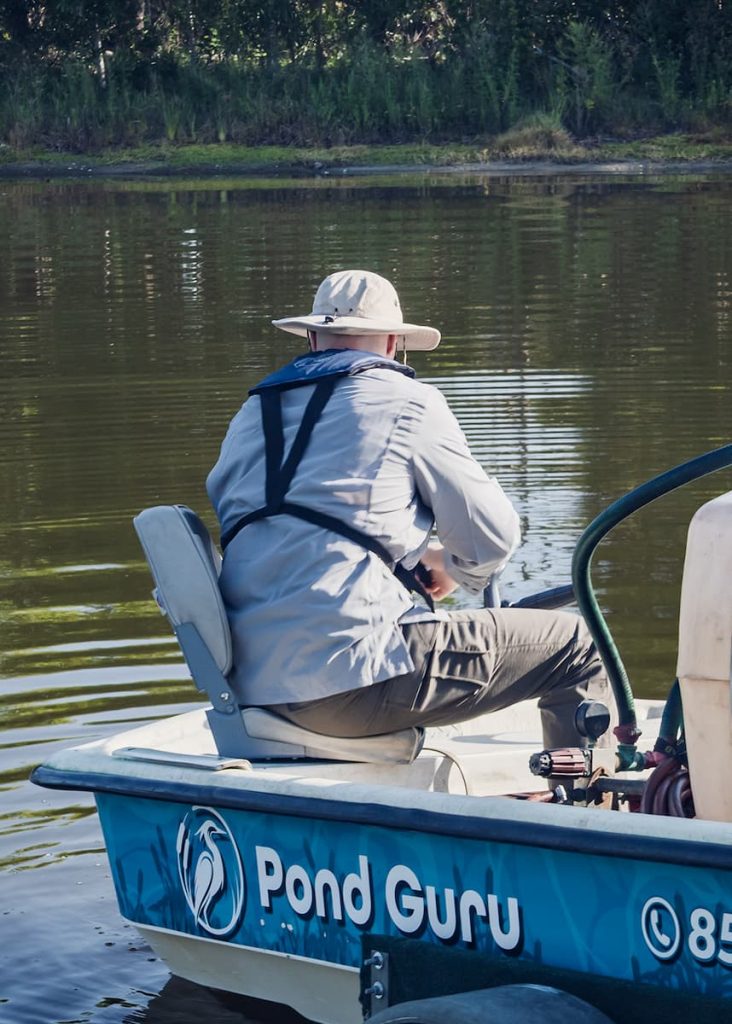
Keeping a shoreline safe, attractive, and less inviting to snakes is an ongoing effort that goes hand in hand with overall water health. Overgrown banks, excess vegetation, and poor water quality all create the kind of cover that snakes and their prey favor.
Professional pond and lake management addresses these conditions systematically, combining shoreline maintenance, vegetation control, and water quality care into a single program. The result is a healthier water body that is easier to enjoy and easier to keep safe.
Pond Guru works with homeowners, HOA boards, property managers, and golf course managers across Florida to maintain ponds and lakes that are both beautiful and well managed.
Schedule a Site Visit With Pond Guru
If you are concerned about snakes around your pond or simply want a healthier, better-maintained shoreline, a professional evaluation is a practical first step. A specialist can assess your water body, identify conditions that attract snakes and pests, and recommend a management plan suited to your property.
Contact Pond Guru to schedule a site visit. A specialist will evaluate your pond or lake conditions, shoreline vegetation, and overall water health, then build a plan to help keep your waterfront safe, clean, and well managed year-round.
Frequently Asked Questions
Yes. Cottonmouth and water moccasin are two common names for the same venomous, semi-aquatic pit viper. In Florida it is the species Agkistrodon conanti. There is no biological difference between the two names, though regional usage varies across the southeastern United States.
Look for three pit-viper traits: a facial pit between the eye and nostril, vertical cat-like pupils, and a broad blocky head that hides the eyes when viewed from above. Watersnakes have round pupils, no facial pit, and visible eyes from above. Most snakes near water are harmless watersnakes.
Water moccasins are venomous, not poisonous. Venomous animals inject toxins through a bite, while poisonous animals cause harm when eaten or touched. A cottonmouth injects venom through hollow fangs. The distinction is technical, but the practical point stands: a bite is dangerous and needs prompt medical care.
A cottonmouth bite is a medical emergency that can cause severe pain, swelling, and tissue damage, and occasionally blood-clotting problems. Fatalities are rare with prompt treatment. Of about 7,000 to 8,000 U.S. venomous snakebites yearly, roughly five are fatal, mostly from rattlesnakes. Seek emergency care immediately after any venomous bite.
Cottonmouths live statewide near most freshwater habitats, but Florida's eight nonvenomous watersnake species are far more common. So while water moccasins are present, most snakes seen at a typical pond are harmless. Habitat conditions like cover, prey, and vegetation strongly influence how many snakes a pond attracts.
Keep your distance and do not attempt to handle or kill it, since most bites occur during these attempts. Observe from a safe distance to identify it if possible. If a venomous snake must be removed, contact a licensed wildlife professional. Reducing cover and managing vegetation helps prevent future visits.
Ready to Schedule a Visit ?
Have questions about your pond or lake? Our experts are ready to help you take the next step.
Latest Article
Popular Post
Pond Smelling Like Rotten Eggs? Foul Smelling Pond Water
Table of Contents That unmistakable rotten-egg, sulfur smell drifting…