

Common White Birds in Florida | The American White Ibis
Common White Birds in Florida | The American White Ibis
Spend any time near a pond or lake in Florida and you’ll quickly notice how many of our most striking birds are white. Egrets stalking the shallows, ibises probing the lawn after a rain, even the occasional towering pelican gliding overhead. For homeowners and property managers, these birds are not just beautiful. They are also a sign that your water body is part of a working ecosystem.
This guide walks through the most common white birds in Florida, with a special focus on the American white ibis. By the end you’ll know what you’re looking at, what each species tells you about your pond, and when it might be worth scheduling a site visit with Pond Guru to make sure your habitat stays healthy.
Why Florida Hosts So Many White Wading Birds
Florida sits at the intersection of subtropical wetlands, freshwater lakes, coastal estuaries, and millions of acres of managed retention ponds. That combination of warm climate and abundant shallow water makes the state one of the best places in North America to see wading birds. White plumage helps these birds reflect heat, blend with bright sky when seen from below by fish, and signal to one another at long distances.
Most of the white birds you see on a Florida pond fall into a few groups:
- True wading birds like egrets, herons, and ibises that hunt in shallow water
- Storks like the wood stork that probe the muddy bottom
- A handful of large white birds that pass through seasonally, including the American white pelican
Each tells you something different about the water on your property.
1. American White Ibis: The Florida White Bird With a Long Curved Beak
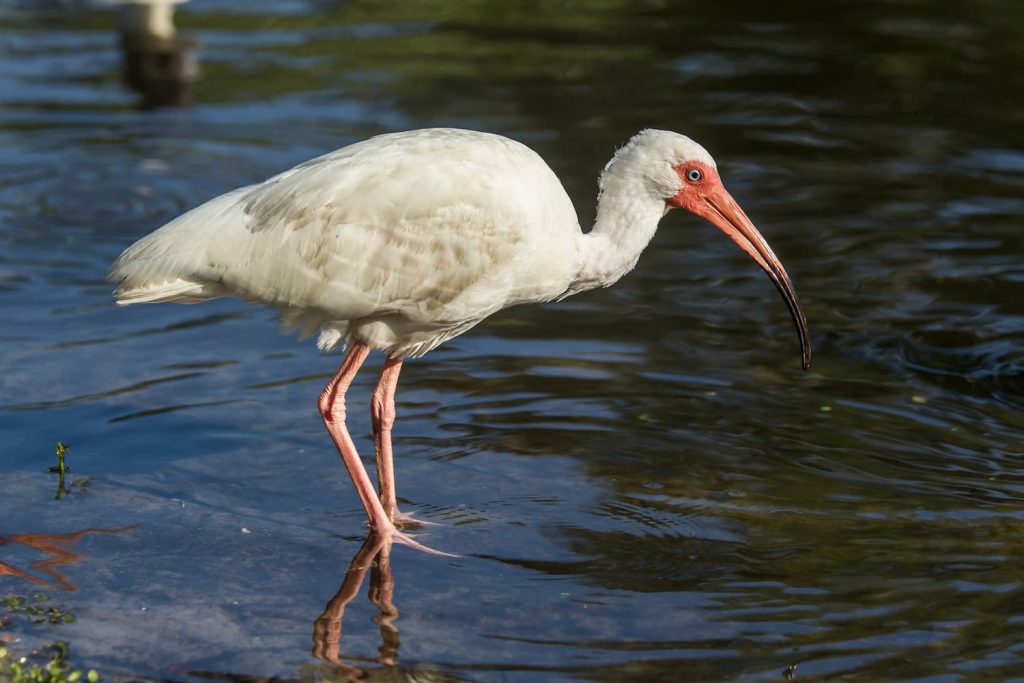
If someone describes a “Florida white bird with a long curved beak” walking across their lawn, they are almost certainly describing the American white ibis (Eudocimus albus). Few birds are more closely identified with Florida pond and lake habitats.
According to the Cornell Lab of Ornithology’s All About Birds, the American white ibis is a long-legged wading bird with all-white plumage, black wingtips, and a distinctive downcurved bright red bill. Juveniles look very different, with brown above and white below, which trips up a lot of new Florida residents.
A few quick facts worth knowing:
- Habitat: Freshwater marshes, retention ponds, mangroves, mudflats, flooded pastures, and increasingly suburban lawns.
- Diet: Crayfish, crabs, insects, frogs, snakes, and small fish, all probed from soft soil with that long curved bill.
- Behavior: Highly social. You will almost always see them in groups, walking heads-down across grass or wading in less than 8 inches of water.
- Status: Protected under the U.S. Migratory Bird Treaty Act and Florida law. Do not harm or harass them.
The ibis is the unofficial mascot of Florida ponds for a reason. A healthy flock cycling through your property is a sign that food, water, and cover are all working together.
2. Great Egret: One of the Largest White Birds in Florida
When people ask which are the “large white birds in Florida,” the Great Egret (Ardea alba) is usually at the top of the list. The Cornell Lab notes that Great Egrets are tall, long-legged wading birds with long S-curved necks and long, dagger-like yellow-orange bills. Their legs and feet are black, which is the easiest way to separate them from other white egrets.
Great Egrets hunt by standing still in shallow water and then striking with surprising speed. They are equally at home on freshwater lakes, retention ponds, and saltwater wetlands. If you have a single tall white bird standing motionless at the edge of your pond, it is almost certainly a Great Egret.
3. Snowy Egret: The Active Hunter
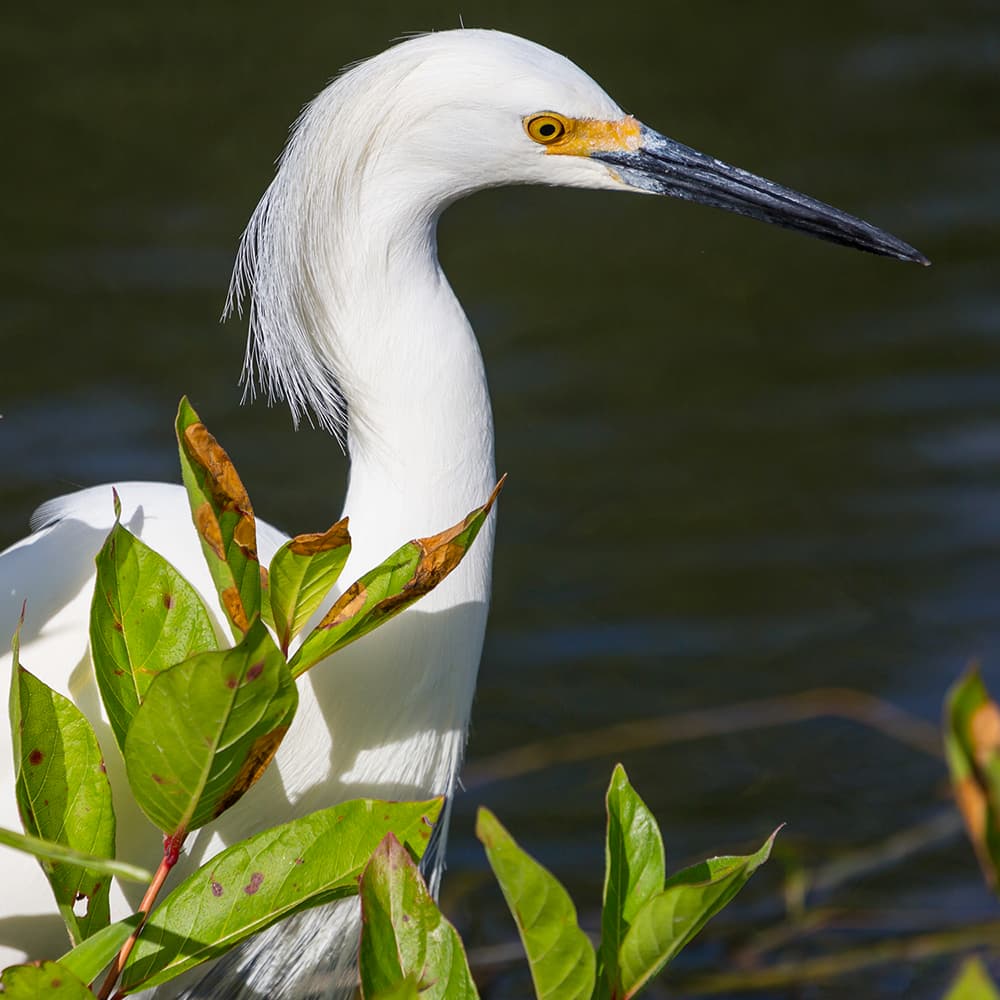
The Snowy Egret (Egretta thula) is smaller and far more animated than its larger cousin. The Florida Fish and Wildlife Conservation Commission describes it as a small, active wading bird with a full white body, black legs, bright yellow feet, and a slender black bill.
You can often identify a Snowy Egret by behavior alone. Instead of standing still, it runs through the water with wings spread, stirring up small fish, shrimp, and invertebrates. Those famous yellow “golden slippers” are sometimes used to vibrate the mud and flush prey.
For pond owners, a Snowy Egret is a good sign that your shallow margins hold a healthy population of small aquatic life.
4. Cattle Egret: One of the Most Common Little White Birds in Florida
If you’re scanning a pasture, sports field, or even a roadside median and seeing small white birds following livestock or lawn equipment, you are looking at Cattle Egrets (Bubulcus ibis). The Cornell Lab describes them as compact, stocky egrets with short yellow bills and yellow legs, smaller than a Snowy Egret and far more terrestrial in their habits.
Cattle Egrets are one of the most familiar little white birds in Florida because they often forage well away from water, picking off insects stirred up by cattle or mowers. During breeding season they develop golden-orange plumes on their head, chest, and back, which can confuse first-time observers.
While they don’t depend on your pond directly, their presence near your property points to a broader healthy landscape.
Manage Your Aquatic Habitat
Balancing an aquatic habitat for wildlife like ibis, cranes, and other white birds in florida can be tricky. Let the pond expert help you today!
5. Wood Stork: Another Large White Long-Beak Bird
The Wood Stork (Mycteria americana) is a true Florida icon and another white long beak bird people often mistake for an ibis at first glance. Visit Florida describes the wood stork as the only stork native to North America, standing about three feet tall with a grey, featherless head and a long, slightly downcurved dark bill.
Per the FWC, Wood Storks reach 35 to 45 inches in length with a wingspan of about 60 to 65 inches. The body is white with black flight feathers and tail. They feed by “tactolocation,” sweeping their open bills through the water and snapping shut on contact with prey in as little as 25 milliseconds.
The Wood Stork is federally listed as a Threatened species, having been downlisted from Endangered in 2014. If one is using your pond, that is meaningful, and any management work on the water body should be careful not to disturb nesting or foraging.

6. Great White Heron: The South Florida Specialty
In the Florida Keys and parts of South Florida, you may spot what looks like a Great Egret on steroids. This is the Great White Heron, a white color morph of the Great Blue Heron (Ardea herodias). It is one of the largest white birds in Florida, with the long, heavy build of a Great Blue Heron rather than the slender frame of an egret.
The easiest way to tell a Great White Heron from a Great Egret is by leg color. The Great White Heron has pale yellow legs, while the Great Egret has black legs. Bill structure also differs slightly, with the heron’s being thicker.
If you are managing a pond in South Florida, knowing the difference matters for accurate bird records and for understanding which species are actually using your water.
7. American White Pelican: The Largest White Bird You'll See in Florida
When people ask about the largest white bird they can expect to see in Florida, the answer is usually the American White Pelican (Pelecanus erythrorhynchos). These birds visit Florida in large numbers during winter, especially around big lakes, estuaries, and shallow bays.
American White Pelicans are massive, with wingspans of nine feet or more. They have all-white bodies, black wing edges visible in flight, and the unmistakable long yellow-orange bill with a stretchy throat pouch. Unlike Brown Pelicans, they do not plunge-dive. They feed cooperatively by herding fish into shallow water and then scooping them up together in their pouches.
Seeing a flock of American White Pelicans soaring over your lake on a winter day is one of the great spectacles of Florida wildlife.
8. Juvenile Little Blue Heron: The White Imposter
Here is a twist that catches many Florida residents off guard. The Little Blue Heron (Egretta caerulea) is a slate blue bird as an adult, but it is bright white as a juvenile. Young Little Blue Herons are sometimes mistaken for Snowy Egrets or small Great Egrets.
A few clues help with identification:
- Juvenile Little Blue Herons have a pale, two-tone bill with a dark tip, not a fully black or yellow bill.
- Their legs are dull greenish-yellow, not black or bright yellow.
- As they molt into adult plumage, they go through a patchy “calico” phase that is unmistakable.
Including this species in your shortlist of common white birds in Florida helps you avoid one of the most frequent ID mistakes around freshwater ponds.
Wading Birds vs. Shore Birds: What's the Difference?
A lot of people use the terms wading birds and shore birds interchangeably, but they describe different groups.
- Wading birds are tall, long-legged species that hunt by standing or walking in shallow water. Egrets, herons, ibises, storks, and spoonbills all qualify. Most of the white birds on your pond fall here.
- Shore birds are typically smaller, shorter-legged species that run along beaches, mudflats, and lake edges. Sandpipers, plovers, sanderlings, and willets are classic shorebirds.
You are most likely to see wading birds on inland freshwater ponds and lakes. Shore birds are more common along the coast, but smaller shorebirds can show up on freshwater lake edges and exposed mudflats during migration.
What White Birds Tell You About Your Pond's Health
Here is the part that matters most for property owners. The mix of white birds in Florida showing up on your pond is one of the best at-a-glance indicators of how healthy your water body actually is.
A few things to watch for:
- A regular ibis flock probing the bank suggests healthy invertebrate populations and accessible shallow zones.
- Egrets and herons hunting consistently indicates a productive fish population.
- Visiting wood storks point to a system with the right water depth and prey concentration.
- Sudden disappearance of birds can be an early warning that water quality, prey availability, or habitat structure has changed.
If you used to see ibis and egrets daily and they have stopped showing up, that is worth investigating. The birds are often noticing changes in your pond long before you do.

Florida Lake Management and Pond Management With Pond Guru
Keeping a pond or lake attractive to wading birds like the American white ibis is not just about leaving it alone. In most developed Florida communities, pond management and Florida lake management are essential to maintaining the shallow margins, water quality, and prey populations that birds depend on.
Professional management work that supports bird habitat typically includes:
- Shoreline vegetation care that preserves native plants and removes invasives
- Water quality monitoring for nutrient levels, dissolved oxygen, and clarity
- Aeration and circulation to support fish populations
- Algae and aquatic weed control that does not harm wildlife
- Habitat features like littoral shelves and natural buffers
Pond Guru specializes in this kind of practical, ecologically grounded pond and lake management for HOAs, golf courses, property managers, and homeowners across Florida. Every pond is different, so a Pond Guru engagement starts with a site visit to see what is actually happening on your water body and which species are using it.
Schedule a Site Visit With Pond Guru
If you want your pond to keep attracting the American white ibis, Great Egrets, and other beautiful white birds in Florida, the best move is to make sure your water and habitat are working for them. A professional assessment is the smartest first step.
Contact Pond Guru to schedule your site visit and find out how the right pond management and Florida lake management plan can protect your water body, your property value, and the wildlife that makes Florida home.
Frequently Asked Questions
The American white ibis is widely considered the most common white wading bird in Florida, with the Great Egret close behind. Both are seen across the state on freshwater ponds, lakes, and lawns.
That is almost certainly the American white ibis. Adults have all-white plumage with black wingtips, bright red legs, and a long, downcurved red bill.
The largest white bird you are likely to see in Florida is the American White Pelican, a winter visitor with a wingspan of about nine feet. Among year-round residents, the Great Egret and Great White Heron are the largest.
Not always. Many small white birds, such as juvenile Little Blue Herons and Cattle Egrets, are distinct species from larger Great Egrets and Wood Storks. Size, leg color, and bill shape are the best identification clues.
Pond Guru provides pond management and Florida lake management services that protect water quality, support shoreline habitat, and maintain the prey populations that wading birds depend on. Start with a site visit to get a plan tailored to your property.
Ready to Schedule a Visit ?
Have questions about your pond or lake? Our experts are ready to help you take the next step.
Latest Article
Popular Post

Why Keeping Culverts Clear of Debris Matters for Stormwater Systems
Table of Contents A culvert is one of those…
Spend any time near a pond or lake in Florida and you’ll quickly notice how many of our most striking birds are white. Egrets stalking the shallows, ibises probing the lawn after a rain, even the occasional towering pelican gliding overhead. For homeowners and property managers, these birds are not just beautiful. They are also a sign that your water body is part of a working ecosystem.
This guide walks through the most common white birds in Florida, with a special focus on the American white ibis. By the end you’ll know what you’re looking at, what each species tells you about your pond, and when it might be worth scheduling a site visit with Pond Guru to make sure your habitat stays healthy.
Why Florida Hosts So Many White Wading Birds
Florida sits at the intersection of subtropical wetlands, freshwater lakes, coastal estuaries, and millions of acres of managed retention ponds. That combination of warm climate and abundant shallow water makes the state one of the best places in North America to see wading birds. White plumage helps these birds reflect heat, blend with bright sky when seen from below by fish, and signal to one another at long distances.
Most of the white birds you see on a Florida pond fall into a few groups:
- True wading birds like egrets, herons, and ibises that hunt in shallow water
- Storks like the wood stork that probe the muddy bottom
- A handful of large white birds that pass through seasonally, including the American white pelican
Each tells you something different about the water on your property.
1. American White Ibis: The Florida White Bird With a Long Curved Beak
If someone describes a “Florida white bird with a long curved beak” walking across their lawn, they are almost certainly describing the American white ibis (Eudocimus albus). Few birds are more closely identified with Florida pond and lake habitats.
According to the Cornell Lab of Ornithology’s All About Birds, the American white ibis is a long-legged wading bird with all-white plumage, black wingtips, and a distinctive downcurved bright red bill. Juveniles look very different, with brown above and white below, which trips up a lot of new Florida residents.
A few quick facts worth knowing:
- Habitat: Freshwater marshes, retention ponds, mangroves, mudflats, flooded pastures, and increasingly suburban lawns.
- Diet: Crayfish, crabs, insects, frogs, snakes, and small fish, all probed from soft soil with that long curved bill.
- Behavior: Highly social. You will almost always see them in groups, walking heads-down across grass or wading in less than 8 inches of water.
- Status: Protected under the U.S. Migratory Bird Treaty Act and Florida law. Do not harm or harass them.
The ibis is the unofficial mascot of Florida ponds for a reason. A healthy flock cycling through your property is a sign that food, water, and cover are all working together.
2. Great Egret: One of the Largest White Birds in Florida
When people ask which are the “large white birds in Florida,” the Great Egret (Ardea alba) is usually at the top of the list. The Cornell Lab notes that Great Egrets are tall, long-legged wading birds with long S-curved necks and long, dagger-like yellow-orange bills. Their legs and feet are black, which is the easiest way to separate them from other white egrets.
Great Egrets hunt by standing still in shallow water and then striking with surprising speed. They are equally at home on freshwater lakes, retention ponds, and saltwater wetlands. If you have a single tall white bird standing motionless at the edge of your pond, it is almost certainly a Great Egret.
3. Snowy Egret: The Active Hunter
The Snowy Egret (Egretta thula) is smaller and far more animated than its larger cousin. The Florida Fish and Wildlife Conservation Commission describes it as a small, active wading bird with a full white body, black legs, bright yellow feet, and a slender black bill.
You can often identify a Snowy Egret by behavior alone. Instead of standing still, it runs through the water with wings spread, stirring up small fish, shrimp, and invertebrates. Those famous yellow “golden slippers” are sometimes used to vibrate the mud and flush prey.
For pond owners, a Snowy Egret is a good sign that your shallow margins hold a healthy population of small aquatic life.
4. Cattle Egret: One of the Most Common Little White Birds in Florida
If you’re scanning a pasture, sports field, or even a roadside median and seeing small white birds following livestock or lawn equipment, you are looking at Cattle Egrets (Bubulcus ibis). The Cornell Lab describes them as compact, stocky egrets with short yellow bills and yellow legs, smaller than a Snowy Egret and far more terrestrial in their habits.
Cattle Egrets are one of the most familiar little white birds in Florida because they often forage well away from water, picking off insects stirred up by cattle or mowers. During breeding season they develop golden-orange plumes on their head, chest, and back, which can confuse first-time observers.
While they don’t depend on your pond directly, their presence near your property points to a broader healthy landscape.
Manage Your Aquatic Habitat
Balancing an aquatic habitat for wildlife like ibis, cranes, and other white birds in florida can be tricky. Let the pond expert help you today!
5. Wood Stork: Another Large White Long-Beak Bird
The Wood Stork (Mycteria americana) is a true Florida icon and another white long beak bird people often mistake for an ibis at first glance. Visit Florida describes the wood stork as the only stork native to North America, standing about three feet tall with a grey, featherless head and a long, slightly downcurved dark bill.
Per the FWC, Wood Storks reach 35 to 45 inches in length with a wingspan of about 60 to 65 inches. The body is white with black flight feathers and tail. They feed by “tactolocation,” sweeping their open bills through the water and snapping shut on contact with prey in as little as 25 milliseconds.
The Wood Stork is federally listed as a Threatened species, having been downlisted from Endangered in 2014. If one is using your pond, that is meaningful, and any management work on the water body should be careful not to disturb nesting or foraging.
6. Great White Heron: The South Florida Specialty
In the Florida Keys and parts of South Florida, you may spot what looks like a Great Egret on steroids. This is the Great White Heron, a white color morph of the Great Blue Heron (Ardea herodias). It is one of the largest white birds in Florida, with the long, heavy build of a Great Blue Heron rather than the slender frame of an egret.
The easiest way to tell a Great White Heron from a Great Egret is by leg color. The Great White Heron has pale yellow legs, while the Great Egret has black legs. Bill structure also differs slightly, with the heron’s being thicker.
If you are managing a pond in South Florida, knowing the difference matters for accurate bird records and for understanding which species are actually using your water.
7. American White Pelican: The Largest White Bird You'll See in Florida
When people ask about the largest white bird they can expect to see in Florida, the answer is usually the American White Pelican (Pelecanus erythrorhynchos). These birds visit Florida in large numbers during winter, especially around big lakes, estuaries, and shallow bays.
American White Pelicans are massive, with wingspans of nine feet or more. They have all-white bodies, black wing edges visible in flight, and the unmistakable long yellow-orange bill with a stretchy throat pouch. Unlike Brown Pelicans, they do not plunge-dive. They feed cooperatively by herding fish into shallow water and then scooping them up together in their pouches.
Seeing a flock of American White Pelicans soaring over your lake on a winter day is one of the great spectacles of Florida wildlife.
8. Juvenile Little Blue Heron: The White Imposter
Here is a twist that catches many Florida residents off guard. The Little Blue Heron (Egretta caerulea) is a slate blue bird as an adult, but it is bright white as a juvenile. Young Little Blue Herons are sometimes mistaken for Snowy Egrets or small Great Egrets.
A few clues help with identification:
- Juvenile Little Blue Herons have a pale, two-tone bill with a dark tip, not a fully black or yellow bill.
- Their legs are dull greenish-yellow, not black or bright yellow.
- As they molt into adult plumage, they go through a patchy “calico” phase that is unmistakable.
Including this species in your shortlist of common white birds in Florida helps you avoid one of the most frequent ID mistakes around freshwater ponds.
Wading Birds vs. Shore Birds: What's the Difference?
A lot of people use the terms wading birds and shore birds interchangeably, but they describe different groups.
- Wading birds are tall, long-legged species that hunt by standing or walking in shallow water. Egrets, herons, ibises, storks, and spoonbills all qualify. Most of the white birds on your pond fall here.
- Shore birds are typically smaller, shorter-legged species that run along beaches, mudflats, and lake edges. Sandpipers, plovers, sanderlings, and willets are classic shorebirds.
You are most likely to see wading birds on inland freshwater ponds and lakes. Shore birds are more common along the coast, but smaller shorebirds can show up on freshwater lake edges and exposed mudflats during migration.

What White Birds Tell You About Your Pond's Health
Here is the part that matters most for property owners. The mix of white birds in Florida showing up on your pond is one of the best at-a-glance indicators of how healthy your water body actually is.
A few things to watch for:
- A regular ibis flock probing the bank suggests healthy invertebrate populations and accessible shallow zones.
- Egrets and herons hunting consistently indicates a productive fish population.
- Visiting wood storks point to a system with the right water depth and prey concentration.
- Sudden disappearance of birds can be an early warning that water quality, prey availability, or habitat structure has changed.
If you used to see ibis and egrets daily and they have stopped showing up, that is worth investigating. The birds are often noticing changes in your pond long before you do.
Florida Lake Management and Pond Management With Pond Guru
Keeping a pond or lake attractive to wading birds like the American white ibis is not just about leaving it alone. In most developed Florida communities, pond management and Florida lake management are essential to maintaining the shallow margins, water quality, and prey populations that birds depend on.
Professional management work that supports bird habitat typically includes:
- Shoreline vegetation care that preserves native plants and removes invasives
- Water quality monitoring for nutrient levels, dissolved oxygen, and clarity
- Aeration and circulation to support fish populations
- Algae and aquatic weed control that does not harm wildlife
- Habitat features like littoral shelves and natural buffers
Pond Guru specializes in this kind of practical, ecologically grounded pond and lake management for HOAs, golf courses, property managers, and homeowners across Florida. Every pond is different, so a Pond Guru engagement starts with a site visit to see what is actually happening on your water body and which species are using it.
Schedule a Site Visit With Pond Guru
If you want your pond to keep attracting the American white ibis, Great Egrets, and other beautiful white birds in Florida, the best move is to make sure your water and habitat are working for them. A professional assessment is the smartest first step.
Contact Pond Guru to schedule your site visit and find out how the right pond management and Florida lake management plan can protect your water body, your property value, and the wildlife that makes Florida home.
Frequently Asked Questions
The American white ibis is widely considered the most common white wading bird in Florida, with the Great Egret close behind. Both are seen across the state on freshwater ponds, lakes, and lawns.
That is almost certainly the American white ibis. Adults have all-white plumage with black wingtips, bright red legs, and a long, downcurved red bill.
The largest white bird you are likely to see in Florida is the American White Pelican, a winter visitor with a wingspan of about nine feet. Among year-round residents, the Great Egret and Great White Heron are the largest.
Not always. Many small white birds, such as juvenile Little Blue Herons and Cattle Egrets, are distinct species from larger Great Egrets and Wood Storks. Size, leg color, and bill shape are the best identification clues.
Pond Guru provides pond management and Florida lake management services that protect water quality, support shoreline habitat, and maintain the prey populations that wading birds depend on. Start with a site visit to get a plan tailored to your property.
Ready to Schedule a Visit ?
Have questions about your pond or lake? Our experts are ready to help you take the next step.
Latest Article
Popular Post
Why Keeping Culverts Clear of Debris Matters for Stormwater Systems
Table of Contents A culvert is one of those…