

Broadleaf Arrowhead (Duck Potato): A Florida Pond Plant Guide
Broadleaf Arrowhead (Duck Potato): A Florida Pond Plant Guide
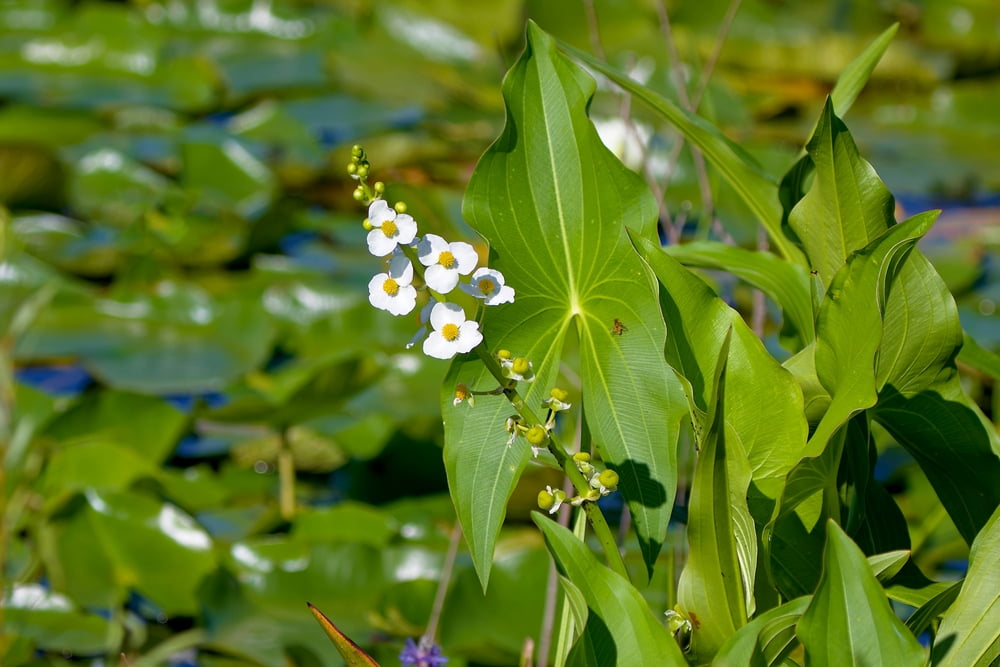
Table of Contents
Walk the shallow edge of almost any Florida lake, pond, or roadside ditch and you will eventually meet a plant with unmistakable arrow-shaped leaves and small white three-petaled flowers. That is broadleaf arrowhead, better known by the nickname duck potato, and it is one of the most useful native plants available for a community shoreline.
It also generates more questions than almost any other littoral plant, starting with whether ducks actually eat it (the answer is more complicated than you would expect), whether it is the same thing as the plant your contractor called duck potato, and whether those tubers are really edible. This guide covers all of it.
Broadleaf arrowhead (Sagittaria latifolia) is a native Florida wetland perennial with distinctive arrow-shaped leaves and white three-petaled flowers. It grows in shallow water along pond and lake edges, produces starchy underground tubers called corms, filters nutrients from the water, stabilizes shorelines, and supports wildlife.
Key Takeaways
- Broadleaf arrowhead is a Florida native found in most counties, growing in the shallow margins of lakes, ponds, marshes, and ditches.
- The arrow-shaped leaf is the giveaway. The genus name Sagittaria comes from the Latin sagitta, meaning arrow.
- The name “duck potato” is misleading. Sources disagree on whether ducks eat the buried corms, and the name is also applied to a different species.
- It earns its place in a littoral planting through nutrient uptake, shoreline stabilization, and wildlife value.
- The tubers are historically edible, but foraging from a community stormwater pond is a genuinely bad idea for reasons covered below.
What Is Broadleaf Arrowhead?
Broadleaf arrowhead (Sagittaria latifolia) is an emergent aquatic perennial in the water plantain family, native to Florida and most of North America. It grows from underground tubers in shallow water, produces large arrow-shaped leaves and white three-petaled flowers, and forms spreading colonies along pond and wetland edges.
The plant is what botanists call an obligate wetland species, meaning it almost always occurs in wetlands. It is built for saturated soil and standing water, not for garden beds.
According to the Florida Wildflower Foundation, broadleaf arrowhead occurs naturally in the shallow waters of marshes, swamps, streams, spring runs, rivers, lakes, and roadside ditches, typically blooming spring through fall and attracting a variety of pollinators. Thirteen Sagittaria species occur in Florida, twelve of them native, and broadleaf arrowhead is among the largest.
Its range is enormous. Beyond Florida, the species is reported from all of the lower 48 states and into southern Canada, which makes it one of the most widely distributed native aquatic plants on the continent.

Why Is It Called Duck Potato, and Do Ducks Actually Eat It?
The name comes from the starchy, potato-like corms the plant produces underground. Whether ducks actually eat those corms is genuinely disputed. Some authorities state that ducks do not eat the buried tubers and that larger waterfowl like geese and swans do, while others report the tubers are preferred by numerous duck species.
This is worth addressing directly, because the disagreement is real and appears in otherwise reliable sources.
The Florida Wildflower Foundation states plainly that despite the name, ducks do not eat the corms, although larger waterfowl like geese and swans will. Meanwhile, the Lady Bird Johnson Wildflower Center reports that the underground tubers are preferred by at least fifteen species of ducks, as well as snapping turtles.
Both can be partly right, and the likely explanation is mechanical. The corms sit buried in muck, which puts them out of reach for most dabbling ducks that feed by tipping at the surface. Diving species and larger waterfowl with more excavating power have better access. Muskrats dig them up in quantity, and anything exposed by that digging becomes available to other animals.
What is not disputed is the rest of the plant’s wildlife value. The seeds are readily eaten by waterfowl and other birds, the flowers support butterflies and bees, and the foliage provides cover for aquatic life. Whether or not a mallard is eating the tubers, the plant is feeding your pond’s food web.
Is Duck Potato the Same as Lanceleaf Arrowhead?

No, though the names are used interchangeably and cause constant confusion. “Duck potato” is applied to both Sagittaria latifolia (broadleaf arrowhead) and Sagittaria lancifolia (lanceleaf arrowhead). They are close relatives in the same genus, but the leaf shape separates them clearly: broadleaf has arrow-shaped leaves, lanceleaf has narrow, blade-shaped leaves.
If you have ever had a contractor, nursery, and plant list each use “duck potato” for what turned out to be different plants, this is why.
UF/IFAS Extension publishes its duck potato fact sheet under Sagittaria lancifolia, describing lanceleaf arrowhead with large lance-shaped leaves about 4 inches wide and up to 2 feet long. The Florida Wildflower Foundation uses “duck potato” as an alternate name for Sagittaria latifolia. Both usages are established, and neither is wrong.
The practical distinction:
- Broadleaf arrowhead (S. latifolia): Leaves shaped like arrowheads, with two distinct backward-pointing lobes at the base.
- Lanceleaf arrowhead (S. lancifolia): Leaves long and narrow with no lobes, shaped more like a spear blade.
When specifying plants for a littoral installation, use the scientific name. It is the only way to be certain you receive what you intended, and the two species behave somewhat differently in a planting.
How Do You Identify Broadleaf Arrowhead?
Identify broadleaf arrowhead by its arrow-shaped leaves with two backward-pointing basal lobes, growing on long stalks from the base of the plant. Flowers have three rounded white petals with yellow centers and three green sepals, borne in whorls on an erect stalk. Plants typically reach 2 to 4 feet in shallow water.
The leaf shape is diagnostic enough that most people can identify this plant confidently after seeing it once.
Per the Florida Wildflower Foundation, the dark green leaf blades arise from long petioles at the base of the plant, are arrow-shaped and up to 14 inches long, and are often more than 8 inches across, though leaf width varies considerably and can be under 2 inches on some plants. Flowers have three white petals with yellow centers and three green, often red-tinged, sepals on erect elongated stalks.
Key identification features:
- Leaves: Arrow-shaped with two pointed lobes flaring backward at the base, held on long stalks rising from the plant’s base.
- Flowers: Three white petals, yellow center, arranged in whorls of three along an upright stalk, blooming spring through fall.
- Height: Commonly 2 to 4 feet, occasionally taller in ideal conditions.
- Habit: Colony-forming, spreading from underground tubers to create dense stands.
- Location: Shallow water at the edge, generally from the waterline to about 6 inches deep.
One important caution on leaf width: because it varies so much, a narrow-leaved broadleaf arrowhead can look confusingly like other Sagittaria species. The backward-pointing basal lobes are the more reliable feature.
Plant Duck Potato in Your Pond
Beneficial littoral plants like Duck Potato can help filter nutrients and create wildlife habitat.
Where Does Broadleaf Arrowhead Grow in Florida?
Broadleaf arrowhead grows throughout most of Florida in shallow freshwater habitats, including lake and pond margins, marshes, swamps, streams, spring runs, and roadside ditches. It requires consistently wet conditions and full to partial sun. It is not salt tolerant, so it is unsuitable for brackish or coastal saltwater sites.
Habitat requirements are simple but non-negotiable: shallow fresh water, sun, and stability.
The plant thrives in the zone from the waterline down to roughly 6 inches of standing water, which is precisely the shallow shelf engineered into most Florida stormwater ponds. That overlap is why it appears so consistently in littoral planting specifications.
Conditions it needs:
- Water depth: Waterline to about 6 inches deep, tolerating some fluctuation.
- Light: Full sun to partial shade.
- Water type: Freshwater only. It has no meaningful salt tolerance.
- Soil: Sand, loam, or organic muck.
Because it holds its leaves through winter in much of Florida while dying back to the ground farther north, Florida plantings tend to provide more year-round structure than the same species does in colder states.

What Are the Benefits of Broadleaf Arrowhead for Pond Health?
Broadleaf arrowhead benefits ponds by absorbing nitrogen and phosphorus that would otherwise fuel algae, stabilizing shoreline soil with its root and tuber system, providing habitat and food for wildlife, and occupying shallow space that might otherwise fill with nuisance vegetation. It also supports pollinators during its long bloom period.
For an HOA lake or stormwater pond, the plant does several jobs at once, which is the mark of a good littoral species.
Nutrient uptake. Like other emergent wetland plants, broadleaf arrowhead draws nitrogen and phosphorus from the water and sediment to fuel its growth. Those are the same nutrients that drive algae blooms, so a vegetated shallow zone competes directly with the algae for the available supply.
Shoreline stabilization. The plant’s rhizomes and tubers bind sediment at the waterline, and the standing foliage absorbs wave energy before it reaches bare soil. This is the same mechanism that makes littoral vegetation a frontline defense against bank loss, and it complements engineered shoreline restoration and erosion control work.
Wildlife support. Seeds feed waterfowl and other birds, flowers support butterflies and bees, tubers feed muskrats and turtles, and the stems provide cover for small fish, amphibians, and invertebrates. It contributes meaningfully to the food web that broader pond wildlife management aims to sustain.
Aesthetic and functional coverage. A planted shallow zone looks intentional rather than neglected, and dense native coverage leaves less open ground for nuisance or invasive species to colonize.
For communities with permit-required littoral coverage, broadleaf arrowhead is a practical component of a compliant littoral zone planting, typically installed alongside other natives like pickerelweed, bulrush, and golden canna for diversity.
How Do You Plant and Establish Broadleaf Arrowhead?
Plant broadleaf arrowhead in the shallow littoral zone, from the waterline to about 6 inches deep, in full to partial sun. It establishes from tuber or rhizome division or from nursery plugs, and spreads on its own once rooted. Plant during the warm growing season and protect new plantings from grazing wildlife until established.
Establishment is generally straightforward, and the plant is vigorous once it takes hold.
Practical guidance:
- Timing. Install during the warm growing season so roots establish before any stress period.
- Depth. Set plugs at the waterline or in a few inches of water. Too deep and the plant struggles; too dry and it will not persist.
- Propagation. Division of tubers or rhizomes is the most reliable method, and nursery plugs are widely available commercially. Seed propagation is possible but slower.
- Spacing. Space plants to allow spread, since colonies fill in over time rather than requiring dense initial planting.
- Protection. New plantings are vulnerable to grazing by waterfowl and turtles. Temporary exclosures during establishment substantially improve survival rates.
- Patience. Expect at least a full growing season before the stand looks established.
The most common failure mode is planting at the wrong depth. Because water levels fluctuate in stormwater ponds, matching the plant to the correct elevation band matters more than most people expect, which is one reason professional installation improves outcomes.
Can Broadleaf Arrowhead Become Too Aggressive?
It can spread vigorously. Broadleaf arrowhead forms colonies from underground tubers and can develop dense stands over time, and some regional sources describe it as potentially weedy. In a managed littoral zone this vigor is usually an asset, but it may occasionally need thinning to maintain open water views or access points.
Honest assessment matters here, because a plant that spreads is a feature in a restoration context and a nuisance in an amenity context.
The North Carolina Extension Gardener Plant Toolbox notes that the species can become weedy, and that characterization is fair. The plant spreads from tubers and forms large masses at pond edges over time.
Important context, though: this is a Florida native, not an invasive species. Native vigor is fundamentally different from invasive behavior. Broadleaf arrowhead integrates into the ecosystem it evolved in and supports native wildlife, whereas invasive plants like hydrilla or torpedograss displace natives and require aggressive control.
For a community lake, the practical implications:
- Expect the stand to expand and fill its zone over a few seasons.
- Periodic thinning may be needed to preserve sightlines, fishing access, or open water.
- Thinning is routine maintenance, not a control problem.
- Keep an eye on whether coverage is drifting above or below any permit-specified percentage.
If a community wants a manicured look, plan for occasional maintenance from the outset rather than being surprised by it.
Is Duck Potato Edible?
The tubers are historically edible and were a staple food for Indigenous peoples across North America, known as wapato. However, foraging duck potato from a community stormwater pond is not advisable. These ponds collect runoff carrying fertilizer, pesticides, automotive fluids, and other contaminants that accumulate in sediment where the tubers grow.
The plant’s food history is genuinely significant, and worth knowing even if you never eat one.
UF/IFAS documents that Native Americans harvested the corms between late summer and fall, wading into shallow water or working from canoes and loosening the roots with their toes so the corms floated up to be gathered into floating baskets. The corms were then baked in embers, boiled, or roasted in ashes before being skinned and eaten. There is also a recorded practice among First Nations of opening muskrat caches to collect the roots the animals had already gathered.
That said, three cautions apply to anyone considering foraging:
- Contamination risk. Stormwater ponds are engineered to capture pollutants. Tubers grow in exactly the sediment where those pollutants settle. This alone rules out harvesting from most community lakes.
- Misidentification risk. Arrow arum (Peltandra virginica) grows in similar habitat with similar arrow-shaped leaves and contains calcium oxalate crystals that cause intense burning and irritation. Distinguishing the two requires attention to flower structure, not just leaf shape.
- Permission and regulation. Harvesting from HOA common areas, public lands, or conservation areas may be restricted.
Treat duck potato as an ecologically and historically interesting plant rather than a foraging target on managed community water.
Schedule a Site Visit With Pond Guru
Broadleaf arrowhead is a strong example of what a well-chosen native plant does for a waterbody: it filters nutrients, holds the bank, feeds wildlife, and looks like the shoreline was designed rather than forgotten. It works best as part of a diverse littoral planting matched to your pond’s specific depth, slope, and water conditions.
Pond Guru works with HOA boards, property managers, and homeowners across Florida to design and install native littoral plantings, restore eroding shorelines, and manage water quality in community lakes and ponds.
Because plant selection depends on water depth, sunlight, fluctuation, and any permit requirements attached to your pond, the process starts with an evaluation. To find out what your shoreline can support, schedule a site visit with Pond Guru and a specialist will assess conditions and recommend a planting plan.

Frequently Asked Questions
Broadleaf arrowhead (Sagittaria latifolia) is a native Florida wetland perennial, also called duck potato, with distinctive arrow-shaped leaves and white three-petaled flowers. It grows in shallow freshwater along pond and lake edges, produces starchy underground tubers, and is widely used in littoral plantings for water quality and shoreline stability.
It is disputed. Some authorities state ducks do not eat the buried corms and that geese and swans do, while others report the tubers are preferred by numerous duck species. The corms sit in muck, out of reach for most dabbling ducks. What is not disputed is that waterfowl readily eat the seeds.
Partly. "Duck potato" is used for both broadleaf arrowhead (Sagittaria latifolia) and lanceleaf arrowhead (Sagittaria lancifolia). They are close relatives distinguished by leaf shape: broadleaf has arrow-shaped leaves with backward lobes, lanceleaf has narrow blade-shaped leaves. Use scientific names when specifying plants to avoid confusion.
No. It is a Florida native found in most counties, not an invasive species. It does spread vigorously from underground tubers and can form dense colonies, which may require occasional thinning to maintain views or access. Native vigor is different from invasive behavior, since it supports rather than displaces local wildlife.
Historically yes. The tubers, known as wapato, were a staple food for Indigenous peoples and were baked, boiled, or roasted. However, harvesting from community stormwater ponds is inadvisable because those ponds accumulate runoff contaminants in sediment. Arrow arum is also a dangerous lookalike containing irritating calcium oxalate crystals.
Plant it in the shallow littoral zone, from the waterline down to roughly 6 inches of standing water, in full to partial sun. Correct depth is the most common factor in establishment success. Install during the warm growing season and protect new plantings from waterfowl and turtle grazing until they are rooted.
Ready to Schedule a Visit ?
Have questions about your pond or lake? Our experts are ready to help you take the next step.
Latest Article
Popular Post

Broadleaf Arrowhead (Duck Potato): A Florida Pond Plant Guide
Source: AZGardens.com Table of Contents Walk the shallow edge…
Table of Contents
Walk the shallow edge of almost any Florida lake, pond, or roadside ditch and you will eventually meet a plant with unmistakable arrow-shaped leaves and small white three-petaled flowers. That is broadleaf arrowhead, better known by the nickname duck potato, and it is one of the most useful native plants available for a community shoreline.
It also generates more questions than almost any other littoral plant, starting with whether ducks actually eat it (the answer is more complicated than you would expect), whether it is the same thing as the plant your contractor called duck potato, and whether those tubers are really edible. This guide covers all of it.
Broadleaf arrowhead (Sagittaria latifolia) is a native Florida wetland perennial with distinctive arrow-shaped leaves and white three-petaled flowers. It grows in shallow water along pond and lake edges, produces starchy underground tubers called corms, filters nutrients from the water, stabilizes shorelines, and supports wildlife.
Key Takeaways
- Broadleaf arrowhead is a Florida native found in most counties, growing in the shallow margins of lakes, ponds, marshes, and ditches.
- The arrow-shaped leaf is the giveaway. The genus name Sagittaria comes from the Latin sagitta, meaning arrow.
- The name “duck potato” is misleading. Sources disagree on whether ducks eat the buried corms, and the name is also applied to a different species.
- It earns its place in a littoral planting through nutrient uptake, shoreline stabilization, and wildlife value.
- The tubers are historically edible, but foraging from a community stormwater pond is a genuinely bad idea for reasons covered below.
What Is Broadleaf Arrowhead?
Broadleaf arrowhead (Sagittaria latifolia) is an emergent aquatic perennial in the water plantain family, native to Florida and most of North America. It grows from underground tubers in shallow water, produces large arrow-shaped leaves and white three-petaled flowers, and forms spreading colonies along pond and wetland edges.
The plant is what botanists call an obligate wetland species, meaning it almost always occurs in wetlands. It is built for saturated soil and standing water, not for garden beds.
According to the Florida Wildflower Foundation, broadleaf arrowhead occurs naturally in the shallow waters of marshes, swamps, streams, spring runs, rivers, lakes, and roadside ditches, typically blooming spring through fall and attracting a variety of pollinators. Thirteen Sagittaria species occur in Florida, twelve of them native, and broadleaf arrowhead is among the largest.
Its range is enormous. Beyond Florida, the species is reported from all of the lower 48 states and into southern Canada, which makes it one of the most widely distributed native aquatic plants on the continent.
Why Is It Called Duck Potato, and Do Ducks Actually Eat It?
The name comes from the starchy, potato-like corms the plant produces underground. Whether ducks actually eat those corms is genuinely disputed. Some authorities state that ducks do not eat the buried tubers and that larger waterfowl like geese and swans do, while others report the tubers are preferred by numerous duck species.
This is worth addressing directly, because the disagreement is real and appears in otherwise reliable sources.
The Florida Wildflower Foundation states plainly that despite the name, ducks do not eat the corms, although larger waterfowl like geese and swans will. Meanwhile, the Lady Bird Johnson Wildflower Center reports that the underground tubers are preferred by at least fifteen species of ducks, as well as snapping turtles.
Both can be partly right, and the likely explanation is mechanical. The corms sit buried in muck, which puts them out of reach for most dabbling ducks that feed by tipping at the surface. Diving species and larger waterfowl with more excavating power have better access. Muskrats dig them up in quantity, and anything exposed by that digging becomes available to other animals.
What is not disputed is the rest of the plant’s wildlife value. The seeds are readily eaten by waterfowl and other birds, the flowers support butterflies and bees, and the foliage provides cover for aquatic life. Whether or not a mallard is eating the tubers, the plant is feeding your pond’s food web.
Is Duck Potato the Same as Lanceleaf Arrowhead?
No, though the names are used interchangeably and cause constant confusion. “Duck potato” is applied to both Sagittaria latifolia (broadleaf arrowhead) and Sagittaria lancifolia (lanceleaf arrowhead). They are close relatives in the same genus, but the leaf shape separates them clearly: broadleaf has arrow-shaped leaves, lanceleaf has narrow, blade-shaped leaves.
If you have ever had a contractor, nursery, and plant list each use “duck potato” for what turned out to be different plants, this is why.
UF/IFAS Extension publishes its duck potato fact sheet under Sagittaria lancifolia, describing lanceleaf arrowhead with large lance-shaped leaves about 4 inches wide and up to 2 feet long. The Florida Wildflower Foundation uses “duck potato” as an alternate name for Sagittaria latifolia. Both usages are established, and neither is wrong.
The practical distinction:
- Broadleaf arrowhead (S. latifolia): Leaves shaped like arrowheads, with two distinct backward-pointing lobes at the base.
- Lanceleaf arrowhead (S. lancifolia): Leaves long and narrow with no lobes, shaped more like a spear blade.
When specifying plants for a littoral installation, use the scientific name. It is the only way to be certain you receive what you intended, and the two species behave somewhat differently in a planting.
How Do You Identify Broadleaf Arrowhead?
Identify broadleaf arrowhead by its arrow-shaped leaves with two backward-pointing basal lobes, growing on long stalks from the base of the plant. Flowers have three rounded white petals with yellow centers and three green sepals, borne in whorls on an erect stalk. Plants typically reach 2 to 4 feet in shallow water.
The leaf shape is diagnostic enough that most people can identify this plant confidently after seeing it once.
Per the Florida Wildflower Foundation, the dark green leaf blades arise from long petioles at the base of the plant, are arrow-shaped and up to 14 inches long, and are often more than 8 inches across, though leaf width varies considerably and can be under 2 inches on some plants. Flowers have three white petals with yellow centers and three green, often red-tinged, sepals on erect elongated stalks.
Key identification features:
- Leaves: Arrow-shaped with two pointed lobes flaring backward at the base, held on long stalks rising from the plant’s base.
- Flowers: Three white petals, yellow center, arranged in whorls of three along an upright stalk, blooming spring through fall.
- Height: Commonly 2 to 4 feet, occasionally taller in ideal conditions.
- Habit: Colony-forming, spreading from underground tubers to create dense stands.
- Location: Shallow water at the edge, generally from the waterline to about 6 inches deep.
One important caution on leaf width: because it varies so much, a narrow-leaved broadleaf arrowhead can look confusingly like other Sagittaria species. The backward-pointing basal lobes are the more reliable feature.
Plant Duck Potato in Your Pond
Beneficial littoral plants like Duck Potato can help filter nutrients and create wildlife habitat.
Where Does Broadleaf Arrowhead Grow in Florida?
Broadleaf arrowhead grows throughout most of Florida in shallow freshwater habitats, including lake and pond margins, marshes, swamps, streams, spring runs, and roadside ditches. It requires consistently wet conditions and full to partial sun. It is not salt tolerant, so it is unsuitable for brackish or coastal saltwater sites.
Habitat requirements are simple but non-negotiable: shallow fresh water, sun, and stability.
The plant thrives in the zone from the waterline down to roughly 6 inches of standing water, which is precisely the shallow shelf engineered into most Florida stormwater ponds. That overlap is why it appears so consistently in littoral planting specifications.
Conditions it needs:
- Water depth: Waterline to about 6 inches deep, tolerating some fluctuation.
- Light: Full sun to partial shade.
- Water type: Freshwater only. It has no meaningful salt tolerance.
- Soil: Sand, loam, or organic muck.
Because it holds its leaves through winter in much of Florida while dying back to the ground farther north, Florida plantings tend to provide more year-round structure than the same species does in colder states.
What Are the Benefits of Broadleaf Arrowhead for Pond Health?
Broadleaf arrowhead benefits ponds by absorbing nitrogen and phosphorus that would otherwise fuel algae, stabilizing shoreline soil with its root and tuber system, providing habitat and food for wildlife, and occupying shallow space that might otherwise fill with nuisance vegetation. It also supports pollinators during its long bloom period.
For an HOA lake or stormwater pond, the plant does several jobs at once, which is the mark of a good littoral species.
Nutrient uptake. Like other emergent wetland plants, broadleaf arrowhead draws nitrogen and phosphorus from the water and sediment to fuel its growth. Those are the same nutrients that drive algae blooms, so a vegetated shallow zone competes directly with the algae for the available supply.
Shoreline stabilization. The plant’s rhizomes and tubers bind sediment at the waterline, and the standing foliage absorbs wave energy before it reaches bare soil. This is the same mechanism that makes littoral vegetation a frontline defense against bank loss, and it complements engineered shoreline restoration and erosion control work.
Wildlife support. Seeds feed waterfowl and other birds, flowers support butterflies and bees, tubers feed muskrats and turtles, and the stems provide cover for small fish, amphibians, and invertebrates. It contributes meaningfully to the food web that broader pond wildlife management aims to sustain.
Aesthetic and functional coverage. A planted shallow zone looks intentional rather than neglected, and dense native coverage leaves less open ground for nuisance or invasive species to colonize.
For communities with permit-required littoral coverage, broadleaf arrowhead is a practical component of a compliant littoral zone planting, typically installed alongside other natives like pickerelweed, bulrush, and golden canna for diversity.
How Do You Plant and Establish Broadleaf Arrowhead?
Plant broadleaf arrowhead in the shallow littoral zone, from the waterline to about 6 inches deep, in full to partial sun. It establishes from tuber or rhizome division or from nursery plugs, and spreads on its own once rooted. Plant during the warm growing season and protect new plantings from grazing wildlife until established.
Establishment is generally straightforward, and the plant is vigorous once it takes hold.
Practical guidance:
- Timing. Install during the warm growing season so roots establish before any stress period.
- Depth. Set plugs at the waterline or in a few inches of water. Too deep and the plant struggles; too dry and it will not persist.
- Propagation. Division of tubers or rhizomes is the most reliable method, and nursery plugs are widely available commercially. Seed propagation is possible but slower.
- Spacing. Space plants to allow spread, since colonies fill in over time rather than requiring dense initial planting.
- Protection. New plantings are vulnerable to grazing by waterfowl and turtles. Temporary exclosures during establishment substantially improve survival rates.
- Patience. Expect at least a full growing season before the stand looks established.
The most common failure mode is planting at the wrong depth. Because water levels fluctuate in stormwater ponds, matching the plant to the correct elevation band matters more than most people expect, which is one reason professional installation improves outcomes.
Can Broadleaf Arrowhead Become Too Aggressive?
It can spread vigorously. Broadleaf arrowhead forms colonies from underground tubers and can develop dense stands over time, and some regional sources describe it as potentially weedy. In a managed littoral zone this vigor is usually an asset, but it may occasionally need thinning to maintain open water views or access points.
Honest assessment matters here, because a plant that spreads is a feature in a restoration context and a nuisance in an amenity context.
The North Carolina Extension Gardener Plant Toolbox notes that the species can become weedy, and that characterization is fair. The plant spreads from tubers and forms large masses at pond edges over time.
Important context, though: this is a Florida native, not an invasive species. Native vigor is fundamentally different from invasive behavior. Broadleaf arrowhead integrates into the ecosystem it evolved in and supports native wildlife, whereas invasive plants like hydrilla or torpedograss displace natives and require aggressive control.
For a community lake, the practical implications:
- Expect the stand to expand and fill its zone over a few seasons.
- Periodic thinning may be needed to preserve sightlines, fishing access, or open water.
- Thinning is routine maintenance, not a control problem.
- Keep an eye on whether coverage is drifting above or below any permit-specified percentage.
If a community wants a manicured look, plan for occasional maintenance from the outset rather than being surprised by it.
Is Duck Potato Edible?
The tubers are historically edible and were a staple food for Indigenous peoples across North America, known as wapato. However, foraging duck potato from a community stormwater pond is not advisable. These ponds collect runoff carrying fertilizer, pesticides, automotive fluids, and other contaminants that accumulate in sediment where the tubers grow.
The plant’s food history is genuinely significant, and worth knowing even if you never eat one.
UF/IFAS documents that Native Americans harvested the corms between late summer and fall, wading into shallow water or working from canoes and loosening the roots with their toes so the corms floated up to be gathered into floating baskets. The corms were then baked in embers, boiled, or roasted in ashes before being skinned and eaten. There is also a recorded practice among First Nations of opening muskrat caches to collect the roots the animals had already gathered.
That said, three cautions apply to anyone considering foraging:
- Contamination risk. Stormwater ponds are engineered to capture pollutants. Tubers grow in exactly the sediment where those pollutants settle. This alone rules out harvesting from most community lakes.
- Misidentification risk. Arrow arum (Peltandra virginica) grows in similar habitat with similar arrow-shaped leaves and contains calcium oxalate crystals that cause intense burning and irritation. Distinguishing the two requires attention to flower structure, not just leaf shape.
- Permission and regulation. Harvesting from HOA common areas, public lands, or conservation areas may be restricted.
Treat duck potato as an ecologically and historically interesting plant rather than a foraging target on managed community water.
Schedule a Site Visit With Pond Guru
Broadleaf arrowhead is a strong example of what a well-chosen native plant does for a waterbody: it filters nutrients, holds the bank, feeds wildlife, and looks like the shoreline was designed rather than forgotten. It works best as part of a diverse littoral planting matched to your pond’s specific depth, slope, and water conditions.
Pond Guru works with HOA boards, property managers, and homeowners across Florida to design and install native littoral plantings, restore eroding shorelines, and manage water quality in community lakes and ponds.
Because plant selection depends on water depth, sunlight, fluctuation, and any permit requirements attached to your pond, the process starts with an evaluation. To find out what your shoreline can support, schedule a site visit with Pond Guru and a specialist will assess conditions and recommend a planting plan.
Frequently Asked Questions
Broadleaf arrowhead (Sagittaria latifolia) is a native Florida wetland perennial, also called duck potato, with distinctive arrow-shaped leaves and white three-petaled flowers. It grows in shallow freshwater along pond and lake edges, produces starchy underground tubers, and is widely used in littoral plantings for water quality and shoreline stability.
It is disputed. Some authorities state ducks do not eat the buried corms and that geese and swans do, while others report the tubers are preferred by numerous duck species. The corms sit in muck, out of reach for most dabbling ducks. What is not disputed is that waterfowl readily eat the seeds.
Partly. "Duck potato" is used for both broadleaf arrowhead (Sagittaria latifolia) and lanceleaf arrowhead (Sagittaria lancifolia). They are close relatives distinguished by leaf shape: broadleaf has arrow-shaped leaves with backward lobes, lanceleaf has narrow blade-shaped leaves. Use scientific names when specifying plants to avoid confusion.
No. It is a Florida native found in most counties, not an invasive species. It does spread vigorously from underground tubers and can form dense colonies, which may require occasional thinning to maintain views or access. Native vigor is different from invasive behavior, since it supports rather than displaces local wildlife.
Historically yes. The tubers, known as wapato, were a staple food for Indigenous peoples and were baked, boiled, or roasted. However, harvesting from community stormwater ponds is inadvisable because those ponds accumulate runoff contaminants in sediment. Arrow arum is also a dangerous lookalike containing irritating calcium oxalate crystals.
Plant it in the shallow littoral zone, from the waterline down to roughly 6 inches of standing water, in full to partial sun. Correct depth is the most common factor in establishment success. Install during the warm growing season and protect new plantings from waterfowl and turtle grazing until they are rooted.
Ready to Schedule a Visit ?
Have questions about your pond or lake? Our experts are ready to help you take the next step.
Latest Article
Popular Post
Broadleaf Arrowhead (Duck Potato): A Florida Pond Plant Guide
Source: AZGardens.com Table of Contents Walk the shallow edge…