

Seawall Maintenance: How to Protect and Extend Your Seawall
Seawall Maintenance: How to Protect and Extend Your Seawall

Table of Contents
A seawall is one of the most valuable and most overlooked pieces of infrastructure on a waterfront property. It quietly holds back the soil, protects the shoreline, and defends everything behind it, right up until neglect lets small problems become expensive failures. The good news is that most seawall damage is preventable, and regular maintenance can add years or decades to a wall’s life at a fraction of the cost of replacement.
This guide covers what seawall maintenance involves, how to manage the algae and marine growth that accumulate in Florida’s warm water, why cleaning and drainage matter so much, how to spot early signs of erosion and damage, and when to bring in professional help.
Seawall maintenance involves regularly cleaning algae and marine growth, keeping weep holes and drainage clear, inspecting for cracks and erosion, and addressing small problems before they escalate. In Florida’s warm water, algae and organic growth accumulate quickly, so routine cleaning and drainage care are essential to protect the wall and extend its lifespan.
Key Takeaways
- Seawall maintenance is preventive. Catching small problems early avoids expensive structural failures later.
- Algae and marine growth accumulate fast in Florida’s warm water, creating slip hazards and trapping moisture against the wall.
- Weep holes and drainage are critical, since clogged drainage builds pressure behind the wall that can crack or collapse it.
- Erosion and toe scour at the base and behind the wall are among the most serious threats.
- Some work is DIY, some is not. Cleaning and monitoring are manageable, while structural repairs call for a professional.
Why Does a Seawall Need Regular Maintenance?
A seawall needs regular maintenance because it is constantly exposed to water, pressure, and growth that gradually wear it down. Algae and marine organisms accumulate, drainage clogs, soil shifts, and small cracks form. Left unaddressed, these lead to erosion, structural damage, and eventually failure. Maintenance catches problems early, when they are far cheaper to fix.
Recognizing a seawall as working infrastructure under constant stress explains why upkeep is not optional.
A seawall faces relentless pressure. On the water side, waves, currents, and marine growth work against it. On the land side, saturated soil pushes against the wall, and water tries to escape through it. Over time this combination produces predictable problems:
- Marine growth and algae accumulate on the surface, especially in warm water.
- Drainage systems clog, letting water pressure build behind the wall.
- Soil erodes behind and beneath the wall, undermining its support.
- Cracks and joints open, allowing water infiltration and soil loss.
- Metal components corrode in seawalls that use steel tie-backs or anchors.
The central principle of seawall maintenance is that small problems escalate. A clogged weep hole, a hairline crack, or a patch of erosion is inexpensive to address early but can lead to bulging, major cracking, or collapse if ignored. Proactive maintenance is dramatically cheaper than repair or replacement.

How Do You Manage Algae and Growth on a Seawall?
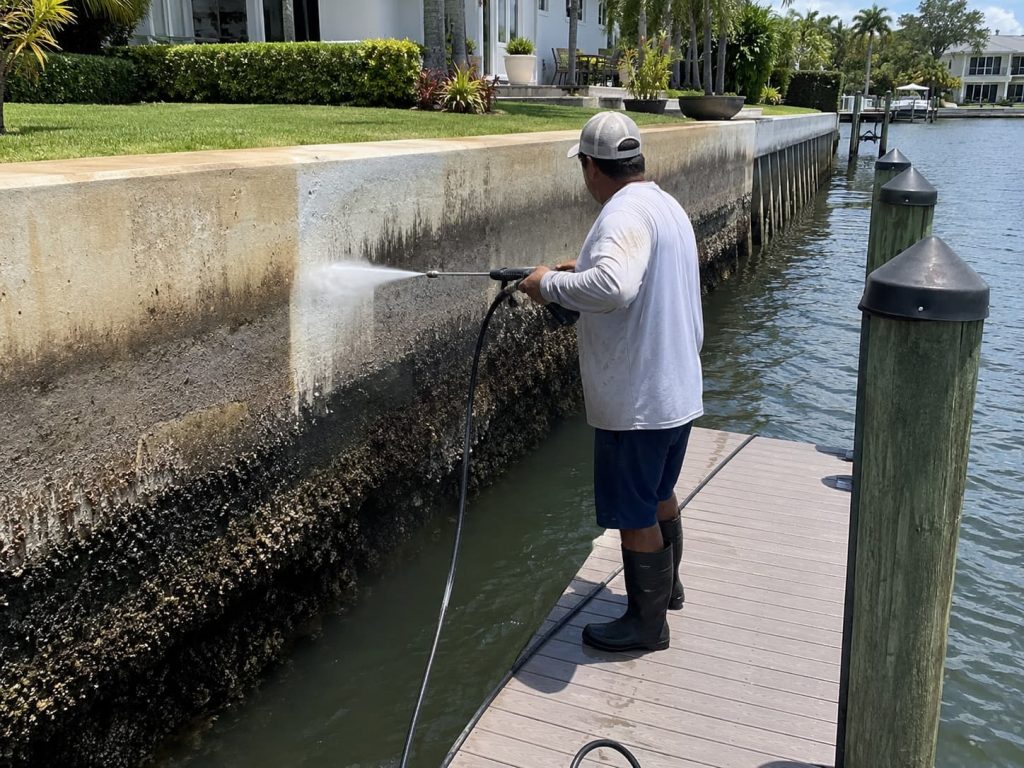
You manage algae and marine growth on a seawall by cleaning it regularly, typically with pressure washing or scrubbing, to remove the buildup before it accumulates. In Florida’s warm water, algae, barnacles, and other organisms grow quickly, creating slippery safety hazards and trapping moisture that can accelerate deterioration of the wall material.
Algae management is the most frequent maintenance need, and in Florida it is a recurring one.
South Florida’s warm waters accelerate marine growth on seawalls, with algae and organic growth accumulating quickly, especially on structures in tidal canals and waterways. This growth causes several problems:
- Slip hazards. Algae makes seawall caps and surfaces dangerously slippery for anyone walking on or accessing them.
- Trapped moisture. Heavy marine growth traps moisture against concrete, which can accelerate deterioration over time.
- Material weakening. On some surfaces, accumulated organic growth can contribute to breakdown of the wall material.
- Appearance. A growth-covered seawall looks neglected and drags down the look of the whole waterfront.
Regular cleaning is the answer. Pressure washing removes algae and growth effectively, restoring both safety and appearance. For a community or waterfront property, scheduling periodic cleaning as part of a maintenance routine keeps the wall in good condition and prevents the buildup from ever becoming severe. Because seawall cleaning shares the same waterside access and equipment as shoreline and aquatic vegetation management, it fits naturally into a broader waterfront maintenance program.
Bring Your Seawall Back
Work with Pond Guru to restore and maintain your seawall to protect against algae buildup and erosion.
Why Are Weep Holes and Drainage So Important?

Weep holes and drainage are critical because they relieve water pressure that builds up behind a seawall. Weep holes are small openings that let trapped water escape. When they clog with sand, shells, or debris, water pressure, called hydrostatic pressure, builds behind the wall and can cause cracking, bulging, or collapse. Keeping them clear is one of the most important maintenance tasks.
Drainage is the single most underappreciated aspect of seawall care, and clogged drainage is behind many failures.
Weep holes allow water that collects behind the seawall to escape, relieving the hydrostatic pressure that would otherwise push against the wall. As multiple seawall specialists emphasize, blocked or clogged weep holes let pressure build, leading to cracks, bulging, or even collapse.
Maintaining drainage involves:
- Checking weep holes regularly, ideally quarterly and after major storms, since Florida weep holes frequently clog with sand, shells, and organic debris.
- Clearing obstructions promptly whenever weep holes are blocked or water is pooling.
- Considering weep hole filters on openings that clog often, which keep soil in place while letting water out.
- Managing surface drainage so rainwater flows away from, not toward, the wall.
The reason this matters so much is physics: water trapped behind a wall exerts enormous pressure. A functioning drainage system relieves that pressure continuously, while a clogged one lets it build until something gives. Keeping weep holes clear is a small task that prevents some of the most expensive seawall failures.
What Are the Signs of Seawall Erosion and Damage?
Signs of seawall erosion and damage include sinkholes or depressions behind the wall, gaps or voids, cracks in the cap or face, tilting or bowing, and exposed soil or roots. Erosion at the base, called toe scour, undermines the foundation. Catching these signs early allows repair before they become major structural problems.
Knowing what to look for lets an owner or board intervene while repairs are still minor.
The warning signs fall into a few categories:
- Soil erosion behind the wall. Sinkholes, depressions, or gaps forming behind the seawall indicate soil is washing out, often through cracks or failed joints. These voids can eventually collapse into visible sinkholes.
- Toe scour at the base. Wave action and currents can erode the soil and material at the base of the wall, undermining its foundation and leading to settling or tilting.
- Cracks. Small cracks in the cap or face can quickly widen into significant structural weaknesses if not sealed.
- Movement. Tilting, bowing, or shifting of the wall signals that soil pressure or a compromised foundation is overwhelming the structure.
- Exposed roots or shifting soil. Changes in soil level or exposed roots near the wall point to erosion.
A useful habit is to inspect the seawall after severe storms and high-tide events, when damage and erosion are most likely to occur. Removing weeds growing near the wall also helps, since their roots can invade and widen cracks. Spotting these signs early is the difference between a minor repair and a major reconstruction, which is why regular inspection is central to seawall maintenance.

Can Vegetation and Erosion Control Protect a Seawall?
Yes. Managing the soil and shoreline around a seawall helps protect it. Erosion control measures like riprap at the base can reduce toe scour, and stabilizing the soil behind the wall reduces washouts. Native vegetation and proper drainage in the surrounding area also reduce the erosion pressures that undermine seawalls over time.
This is where seawall care overlaps directly with the shoreline and erosion work that supports any waterfront.
Several approaches reduce the erosion forces acting on a seawall:
- Riprap at the toe. Large stones placed at the base absorb wave energy before it can scour away foundation material, protecting one of the wall’s most vulnerable areas.
- Soil stabilization behind the wall. Reinforcing and stabilizing the backfill soil reduces the washouts that create voids and sinkholes.
- Surrounding vegetation. Native plantings and stable ground near the wall help hold soil and absorb water, reducing erosion pressure.
- Drainage management. Directing surface water away from the wall keeps the backfill from becoming saturated and unstable.
These measures connect seawall protection to broader shoreline health. Managing erosion and vegetation around the wall through erosion control and shoreline restoration reduces the forces that damage seawalls, while healthy littoral vegetation stabilizes the surrounding shoreline. A seawall does not exist in isolation, and caring for the shoreline around it extends the wall’s life.
When Should You Call a Professional for Seawall Work?
You should call a professional for structural seawall repairs, significant erosion or voids, major cracks, tilting or bowing walls, and corroded metal components. Routine cleaning, weep hole clearing, and inspection can often be handled as regular maintenance, but structural issues require specialized assessment and equipment to fix safely and correctly.
Knowing the line between routine maintenance and structural repair helps a property owner respond appropriately.
Tasks that generally fall under routine maintenance:
- Cleaning algae and marine growth, including pressure washing.
- Clearing weep holes and keeping drainage functional.
- Regular inspection for early signs of damage.
- Removing weeds growing against the wall.
- Managing surrounding vegetation and drainage.
Issues that call for professional assessment:
- Structural cracks, tilting, or bowing that indicate the wall’s integrity is compromised.
- Significant erosion, voids, or sinkholes behind or beneath the wall.
- Toe scour undermining the foundation.
- Corroded steel components in walls that use them.
- Any sign the wall is failing, which is a safety hazard for people and boats.
The guiding principle is that cosmetic and preventive care protects the wall, but anything affecting its structure, stability, or foundation warrants expert evaluation. Addressing the surrounding water, vegetation, erosion, and growth is where an aquatic management partner adds value, keeping the conditions around the wall healthy so the structure itself lasts longer.
Schedule a Site Visit With Pond Guru
A seawall protects everything behind it, and protecting the seawall in turn comes down to consistent care: keeping it clean, keeping the water draining, watching for early signs of trouble, and managing the shoreline and growth around it. Most seawall failures trace back to problems that routine maintenance would have caught.
Pond Guru works with waterfront HOA boards, property managers, and homeowners across Florida to manage the algae, vegetation, erosion, and shoreline conditions that affect seawalls and waterfront infrastructure, keeping the environment around your wall healthy and well-maintained.
Because every waterfront is different, the process starts with an on-site evaluation. To keep your seawall and shoreline in good condition, schedule a site visit with Pond Guru and a specialist will assess conditions and recommend a plan.

Frequently Asked Questions
A seawall should be inspected regularly and after major storms, with cleaning and weep hole checks on a recurring schedule. In Florida's warm water, algae and marine growth accumulate quickly, so periodic cleaning is needed to prevent buildup, and weep holes should be checked quarterly since they frequently clog with sand, shells, and debris.
Algae and marine growth are typically removed by pressure washing or scrubbing the surface. In Florida's warm water this growth accumulates quickly, creating slip hazards and trapping moisture against the wall, so regular cleaning is important. Scheduling periodic cleaning as part of a maintenance routine prevents buildup from ever becoming severe.
Weep holes are small openings that let water trapped behind the seawall escape, relieving hydrostatic pressure. When they clog with sand, shells, or debris, pressure builds behind the wall and can cause cracking, bulging, or even collapse. Keeping weep holes clear is one of the most important and cost-effective seawall maintenance tasks.
Warning signs include sinkholes or depressions behind the wall, gaps and voids, cracks in the cap or face, tilting or bowing, exposed soil or roots, and erosion at the base called toe scour. These indicate erosion or structural stress. Catching them early allows repair before they become major, costly failures.
Yes. Riprap at the base reduces wave-driven toe scour, stabilizing the backfill soil reduces washouts, and native vegetation with proper drainage around the wall reduces erosion pressure. Managing the shoreline and erosion around a seawall reduces the forces that damage it over time, helping extend the structure's lifespan.
Ready to Schedule a Visit ?
Have questions about your pond or lake? Our experts are ready to help you take the next step.
Latest Article
Popular Post

The Secchi Disk: Measuring Water Clarity
Table of Contents For a tool that is essentially…
Table of Contents
A seawall is one of the most valuable and most overlooked pieces of infrastructure on a waterfront property. It quietly holds back the soil, protects the shoreline, and defends everything behind it, right up until neglect lets small problems become expensive failures. The good news is that most seawall damage is preventable, and regular maintenance can add years or decades to a wall’s life at a fraction of the cost of replacement.
This guide covers what seawall maintenance involves, how to manage the algae and marine growth that accumulate in Florida’s warm water, why cleaning and drainage matter so much, how to spot early signs of erosion and damage, and when to bring in professional help.
Seawall maintenance involves regularly cleaning algae and marine growth, keeping weep holes and drainage clear, inspecting for cracks and erosion, and addressing small problems before they escalate. In Florida’s warm water, algae and organic growth accumulate quickly, so routine cleaning and drainage care are essential to protect the wall and extend its lifespan.
Key Takeaways
- Seawall maintenance is preventive. Catching small problems early avoids expensive structural failures later.
- Algae and marine growth accumulate fast in Florida’s warm water, creating slip hazards and trapping moisture against the wall.
- Weep holes and drainage are critical, since clogged drainage builds pressure behind the wall that can crack or collapse it.
- Erosion and toe scour at the base and behind the wall are among the most serious threats.
- Some work is DIY, some is not. Cleaning and monitoring are manageable, while structural repairs call for a professional.
Why Does a Seawall Need Regular Maintenance?
A seawall needs regular maintenance because it is constantly exposed to water, pressure, and growth that gradually wear it down. Algae and marine organisms accumulate, drainage clogs, soil shifts, and small cracks form. Left unaddressed, these lead to erosion, structural damage, and eventually failure. Maintenance catches problems early, when they are far cheaper to fix.
Recognizing a seawall as working infrastructure under constant stress explains why upkeep is not optional.
A seawall faces relentless pressure. On the water side, waves, currents, and marine growth work against it. On the land side, saturated soil pushes against the wall, and water tries to escape through it. Over time this combination produces predictable problems:
- Marine growth and algae accumulate on the surface, especially in warm water.
- Drainage systems clog, letting water pressure build behind the wall.
- Soil erodes behind and beneath the wall, undermining its support.
- Cracks and joints open, allowing water infiltration and soil loss.
- Metal components corrode in seawalls that use steel tie-backs or anchors.
The central principle of seawall maintenance is that small problems escalate. A clogged weep hole, a hairline crack, or a patch of erosion is inexpensive to address early but can lead to bulging, major cracking, or collapse if ignored. Proactive maintenance is dramatically cheaper than repair or replacement.
How Do You Manage Algae and Growth on a Seawall?
You manage algae and marine growth on a seawall by cleaning it regularly, typically with pressure washing or scrubbing, to remove the buildup before it accumulates. In Florida’s warm water, algae, barnacles, and other organisms grow quickly, creating slippery safety hazards and trapping moisture that can accelerate deterioration of the wall material.
Algae management is the most frequent maintenance need, and in Florida it is a recurring one.
South Florida’s warm waters accelerate marine growth on seawalls, with algae and organic growth accumulating quickly, especially on structures in tidal canals and waterways. This growth causes several problems:
- Slip hazards. Algae makes seawall caps and surfaces dangerously slippery for anyone walking on or accessing them.
- Trapped moisture. Heavy marine growth traps moisture against concrete, which can accelerate deterioration over time.
- Material weakening. On some surfaces, accumulated organic growth can contribute to breakdown of the wall material.
- Appearance. A growth-covered seawall looks neglected and drags down the look of the whole waterfront.
Regular cleaning is the answer. Pressure washing removes algae and growth effectively, restoring both safety and appearance. For a community or waterfront property, scheduling periodic cleaning as part of a maintenance routine keeps the wall in good condition and prevents the buildup from ever becoming severe. Because seawall cleaning shares the same waterside access and equipment as shoreline and aquatic vegetation management, it fits naturally into a broader waterfront maintenance program.
Bring Your Seawall Back
Work with Pond Guru to restore and maintain your seawall to protect against algae buildup and erosion.
Why Are Weep Holes and Drainage So Important?

Weep holes and drainage are critical because they relieve water pressure that builds up behind a seawall. Weep holes are small openings that let trapped water escape. When they clog with sand, shells, or debris, water pressure, called hydrostatic pressure, builds behind the wall and can cause cracking, bulging, or collapse. Keeping them clear is one of the most important maintenance tasks.
Drainage is the single most underappreciated aspect of seawall care, and clogged drainage is behind many failures.
Weep holes allow water that collects behind the seawall to escape, relieving the hydrostatic pressure that would otherwise push against the wall. As multiple seawall specialists emphasize, blocked or clogged weep holes let pressure build, leading to cracks, bulging, or even collapse.
Maintaining drainage involves:
- Checking weep holes regularly, ideally quarterly and after major storms, since Florida weep holes frequently clog with sand, shells, and organic debris.
- Clearing obstructions promptly whenever weep holes are blocked or water is pooling.
- Considering weep hole filters on openings that clog often, which keep soil in place while letting water out.
- Managing surface drainage so rainwater flows away from, not toward, the wall.
The reason this matters so much is physics: water trapped behind a wall exerts enormous pressure. A functioning drainage system relieves that pressure continuously, while a clogged one lets it build until something gives. Keeping weep holes clear is a small task that prevents some of the most expensive seawall failures.
What Are the Signs of Seawall Erosion and Damage?
Signs of seawall erosion and damage include sinkholes or depressions behind the wall, gaps or voids, cracks in the cap or face, tilting or bowing, and exposed soil or roots. Erosion at the base, called toe scour, undermines the foundation. Catching these signs early allows repair before they become major structural problems.
Knowing what to look for lets an owner or board intervene while repairs are still minor.
The warning signs fall into a few categories:
- Soil erosion behind the wall. Sinkholes, depressions, or gaps forming behind the seawall indicate soil is washing out, often through cracks or failed joints. These voids can eventually collapse into visible sinkholes.
- Toe scour at the base. Wave action and currents can erode the soil and material at the base of the wall, undermining its foundation and leading to settling or tilting.
- Cracks. Small cracks in the cap or face can quickly widen into significant structural weaknesses if not sealed.
- Movement. Tilting, bowing, or shifting of the wall signals that soil pressure or a compromised foundation is overwhelming the structure.
- Exposed roots or shifting soil. Changes in soil level or exposed roots near the wall point to erosion.
A useful habit is to inspect the seawall after severe storms and high-tide events, when damage and erosion are most likely to occur. Removing weeds growing near the wall also helps, since their roots can invade and widen cracks. Spotting these signs early is the difference between a minor repair and a major reconstruction, which is why regular inspection is central to seawall maintenance.
Can Vegetation and Erosion Control Protect a Seawall?
Yes. Managing the soil and shoreline around a seawall helps protect it. Erosion control measures like riprap at the base can reduce toe scour, and stabilizing the soil behind the wall reduces washouts. Native vegetation and proper drainage in the surrounding area also reduce the erosion pressures that undermine seawalls over time.
This is where seawall care overlaps directly with the shoreline and erosion work that supports any waterfront.
Several approaches reduce the erosion forces acting on a seawall:
- Riprap at the toe. Large stones placed at the base absorb wave energy before it can scour away foundation material, protecting one of the wall’s most vulnerable areas.
- Soil stabilization behind the wall. Reinforcing and stabilizing the backfill soil reduces the washouts that create voids and sinkholes.
- Surrounding vegetation. Native plantings and stable ground near the wall help hold soil and absorb water, reducing erosion pressure.
- Drainage management. Directing surface water away from the wall keeps the backfill from becoming saturated and unstable.
These measures connect seawall protection to broader shoreline health. Managing erosion and vegetation around the wall through erosion control and shoreline restoration reduces the forces that damage seawalls, while healthy littoral vegetation stabilizes the surrounding shoreline. A seawall does not exist in isolation, and caring for the shoreline around it extends the wall’s life.
When Should You Call a Professional for Seawall Work?
You should call a professional for structural seawall repairs, significant erosion or voids, major cracks, tilting or bowing walls, and corroded metal components. Routine cleaning, weep hole clearing, and inspection can often be handled as regular maintenance, but structural issues require specialized assessment and equipment to fix safely and correctly.
Knowing the line between routine maintenance and structural repair helps a property owner respond appropriately.
Tasks that generally fall under routine maintenance:
- Cleaning algae and marine growth, including pressure washing.
- Clearing weep holes and keeping drainage functional.
- Regular inspection for early signs of damage.
- Removing weeds growing against the wall.
- Managing surrounding vegetation and drainage.
Issues that call for professional assessment:
- Structural cracks, tilting, or bowing that indicate the wall’s integrity is compromised.
- Significant erosion, voids, or sinkholes behind or beneath the wall.
- Toe scour undermining the foundation.
- Corroded steel components in walls that use them.
- Any sign the wall is failing, which is a safety hazard for people and boats.
The guiding principle is that cosmetic and preventive care protects the wall, but anything affecting its structure, stability, or foundation warrants expert evaluation. Addressing the surrounding water, vegetation, erosion, and growth is where an aquatic management partner adds value, keeping the conditions around the wall healthy so the structure itself lasts longer.
Schedule a Site Visit With Pond Guru
A seawall protects everything behind it, and protecting the seawall in turn comes down to consistent care: keeping it clean, keeping the water draining, watching for early signs of trouble, and managing the shoreline and growth around it. Most seawall failures trace back to problems that routine maintenance would have caught.
Pond Guru works with waterfront HOA boards, property managers, and homeowners across Florida to manage the algae, vegetation, erosion, and shoreline conditions that affect seawalls and waterfront infrastructure, keeping the environment around your wall healthy and well-maintained.
Because every waterfront is different, the process starts with an on-site evaluation. To keep your seawall and shoreline in good condition, schedule a site visit with Pond Guru and a specialist will assess conditions and recommend a plan.
Frequently Asked Questions
A seawall should be inspected regularly and after major storms, with cleaning and weep hole checks on a recurring schedule. In Florida's warm water, algae and marine growth accumulate quickly, so periodic cleaning is needed to prevent buildup, and weep holes should be checked quarterly since they frequently clog with sand, shells, and debris.
Algae and marine growth are typically removed by pressure washing or scrubbing the surface. In Florida's warm water this growth accumulates quickly, creating slip hazards and trapping moisture against the wall, so regular cleaning is important. Scheduling periodic cleaning as part of a maintenance routine prevents buildup from ever becoming severe.
Weep holes are small openings that let water trapped behind the seawall escape, relieving hydrostatic pressure. When they clog with sand, shells, or debris, pressure builds behind the wall and can cause cracking, bulging, or even collapse. Keeping weep holes clear is one of the most important and cost-effective seawall maintenance tasks.
Warning signs include sinkholes or depressions behind the wall, gaps and voids, cracks in the cap or face, tilting or bowing, exposed soil or roots, and erosion at the base called toe scour. These indicate erosion or structural stress. Catching them early allows repair before they become major, costly failures.
Yes. Riprap at the base reduces wave-driven toe scour, stabilizing the backfill soil reduces washouts, and native vegetation with proper drainage around the wall reduces erosion pressure. Managing the shoreline and erosion around a seawall reduces the forces that damage it over time, helping extend the structure's lifespan.
Ready to Schedule a Visit ?
Have questions about your pond or lake? Our experts are ready to help you take the next step.
Latest Article
Popular Post
The Secchi Disk: Measuring Water Clarity
Table of Contents For a tool that is essentially…