

Blue-Green Algae in HOA Lakes: How to Identify It and Report It
Blue-Green Algae in HOA Lakes: How to Identify It and Report It
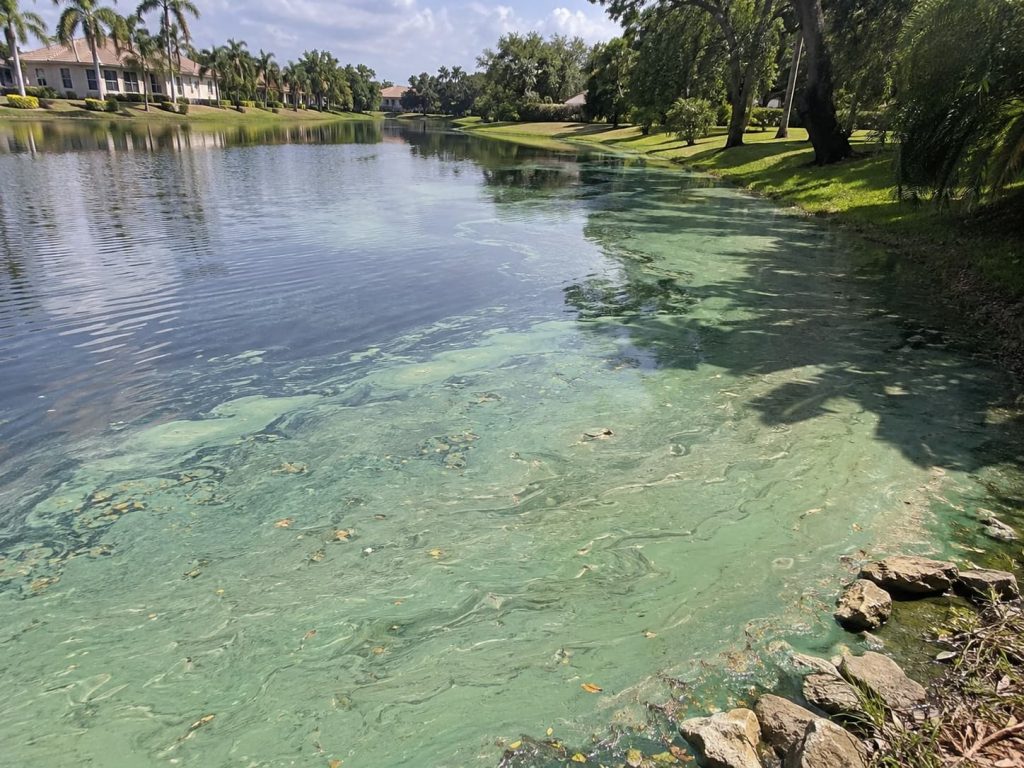
Table of Contents
Of all the things that can go wrong in a community lake, a blue-green algae bloom is the one that turns from an eyesore into a genuine safety emergency. Unlike ordinary pond algae, blue-green algae can produce toxins dangerous to people and deadly to dogs, sometimes within minutes of contact. For an HOA board or property manager, knowing how to recognize it and act fast is not optional.
This guide explains how to identify blue-green algae, the serious risks it poses to pets and children, exactly how and when to report a bloom to Florida authorities, and a clear emergency action plan for when one appears in your community lake.
Blue-green algae, or cyanobacteria, can produce harmful toxins and often appears as blue-green surface scum that looks like spilled paint or pea soup. It is dangerous to people and especially to dogs. If you suspect a bloom, keep people and pets away, report it to Florida’s DEP hotline at 855-305-3903, and treat any pet exposure as an emergency.
Key Takeaways
- Blue-green algae is not ordinary algae. It is cyanobacteria, and it can produce toxins harmful to people and deadly to pets.
- It often looks like spilled paint or pea soup, forming a blue-green scum or sheen on the surface, sometimes with a swampy odor.
- You cannot tell if a bloom is toxic just by looking. When in doubt, stay out and keep pets out.
- Dogs are at highest risk and can die within hours. Any exposure is a veterinary emergency.
- Report blooms in Florida to the DEP hotline at 855-305-3903 or online at ReportAlgalBloom.com.
What Is Blue-Green Algae?
Blue-green algae is the common name for cyanobacteria, a type of bacteria, not true algae, that lives in freshwater. Under warm, calm, nutrient-rich conditions it can multiply rapidly into a bloom. Some cyanobacteria produce toxins called cyanotoxins that are harmful to humans, pets, and wildlife, which is what makes these blooms a safety concern.
The distinction from ordinary green algae matters, because blue-green algae is a fundamentally different and more dangerous organism.
According to guidance compiled from the American Animal Hospital Association, blue-green algae is not actually algae but a type of bacteria called cyanobacteria that thrives in warm, nutrient-rich water and can form dense clusters called blooms, which grow quickly when nutrients like fertilizer runoff or animal waste are abundant.
The conditions that trigger a bloom are predictable:
- Warm water, typically above 75 degrees Fahrenheit, so blooms peak in summer and early fall.
- Excess nutrients, especially phosphorus and nitrogen from fertilizer runoff and other sources.
- Calm, stagnant water with little circulation.
- Sunlight, which the cyanobacteria use to grow.
Not every blue-green algae bloom produces toxins, but there is no way to tell a toxic bloom from a non-toxic one by sight. That uncertainty is exactly why every suspected bloom should be treated as potentially dangerous.

How Do You Identify Blue-Green Algae?
Blue-green algae typically appears as a blue-green, green, or blue surface scum that can look like spilled paint, pea soup, or a thick mat on the water. It may also appear brown, red, or produce a paint-like sheen, often with a foul, swampy odor. It usually collects along downwind shorelines where wind pushes it.
Learning to recognize the visual signs is the first line of defense, though it comes with an important caveat covered below.
The most common visual and sensory signs:
- Surface scum or mats, often thick and concentrated, especially along shorelines.
- A spilled-paint or pea-soup appearance, one of the most reliable visual cues.
- Color that may be blue-green, bright green, blue, brown, or red.
- A paint-like sheen or streaky film on the surface.
- A foul, swampy, or musty odor.
- Accumulation on the downwind side, where wind pushes the bloom against the bank.
There is also a key thing to look for beyond the water itself: dead fish, birds, or other wildlife near the water can be a warning sign of a toxic bloom, and should prompt extra caution.
The critical limitation, emphasized by every health authority: you cannot confirm toxicity by appearance alone. As Florida’s water quality authorities state plainly, there are no visual signs that indicate when blue-green algae are producing toxins, so people and animals should not drink or swim in water where a bloom is present. When a bloom looks suspicious, the only safe assumption is that it could be toxic.
Why Is Blue-Green Algae Dangerous to Dogs and Pets?

Blue-green algae is especially dangerous to dogs because they swim in, drink, and lick contaminated water from their fur, ingesting toxins quickly. The two main cyanotoxins, microcystin and anatoxin, can cause fatal liver failure or neurological collapse. Signs can appear within minutes to hours, and exposure is often fatal, so it is always an emergency.
Dogs are the most common and most tragic victims of blue-green algae, and this section deserves the most attention.
The Cornell University College of Veterinary Medicine explains that blue-green algae poisoning occurs when dogs drink or swim in water contaminated by a bloom, and the two most serious cyanotoxins, microcystin and anatoxin, can cause liver or neurologic injury, with shock, liver failure, respiratory arrest, and even death possible.
The two main toxins act differently and fast:
- Microcystin (a liver toxin). Causes severe liver damage that can progress to fatal liver failure within hours to days. Signs may include vomiting, diarrhea sometimes with blood, and jaundice.
- Anatoxin (a nerve toxin). Attacks the nervous system, causing excessive drooling, muscle tremors, difficulty breathing, seizures, paralysis, and rapid death.
The timeline is frighteningly short. Veterinary sources note that when nerve toxins are involved, signs can appear within 15 to 60 minutes, while liver-toxin signs may take one or more hours, occasionally up to 24. Because so many exposed dogs do not survive long enough to reach care, speed is everything.
Why dogs are so vulnerable: they swim in it, they drink it, and then they lick it off their fur, giving them multiple routes of exposure. Their smaller size also means a smaller toxic dose. This is why keeping dogs away from any suspicious water is the single most important prevention step, and why any suspected exposure is a genuine emergency, covered in the action plan below.
Is Blue-Green Algae Dangerous to People?
Yes, blue-green algae can harm people, though healthy adults are generally less severely affected than pets. Exposure through swallowing water, skin contact, or breathing airborne droplets can cause rash, eye and throat irritation, stomach upset, and, with significant exposure, more serious effects. Children are at higher risk than adults.
While the pet danger is most acute, the human health risks are real and worth taking seriously, especially for vulnerable groups.
Health authorities describe several exposure routes for people: unintentionally swallowing contaminated water, direct skin contact with the bloom, and breathing in airborne water spray or droplets near the water. The effects can include:
- Skin, eye, nose, and throat irritation from contact or airborne droplets.
- Gastrointestinal illness, including nausea, vomiting, and diarrhea, from swallowing water.
- More serious effects with significant exposure, particularly to the liver or nervous system.
Certain people face higher risk: children, because they are smaller and more likely to swallow water while playing, along with older adults and anyone with underlying health conditions. For a community with a lake, this means keeping children well away from any bloom is a priority on par with protecting pets.
The universal guidance is simple: if a bloom is present, no one should swim in, wade in, or let water spray near them, and no one should ever drink or cook with the water.

Emergency Action Plan: What to Do If You Suspect a Bloom
If you suspect a blue-green algae bloom, act immediately: keep all people and pets away from the water, post warnings, report the bloom to Florida’s DEP, and seek emergency care for anyone or any pet that was exposed. Do not wait for confirmation, since toxins can act within minutes and blooms cannot be judged safe by sight.
Here is a clear, ordered action plan a board or property manager can follow the moment a suspicious bloom appears.
Step 1: Keep everyone away from the water. Immediately stop all contact. No swimming, wading, fishing, or letting pets near the water. Alert residents right away through whatever fast channels the community has.
Step 2: Post warning signs. Place clear warnings at all access points advising people and pets to stay out of and away from the water until further notice.
Step 3: Report the bloom to FDEP. Call the Florida Department of Environmental Protection Algal Bloom Reporting Hotline at 855-305-3903, or report online at ReportAlgalBloom.com. This is available 24 hours a day, seven days a week. Reporting triggers state sampling that can confirm whether toxins are present. The detailed reporting steps are in the next section.
Step 4: Get emergency help for any exposure.
- For a pet: Contact your veterinarian or an emergency animal hospital immediately. Do not wait for symptoms. If possible, rinse the pet with clean water, avoiding letting them lick their fur, and go straight to the vet.
- For a person: For health symptoms, call the Florida Poison Information Center at 800-222-1222 to speak with a specialist, and seek medical care. For a medical emergency, call 911.
Step 5: Report related problems. For fish kills or wildlife deaths, contact the Florida Fish and Wildlife Conservation Commission at 800-636-0511.
Step 6: Bring in professional help. Contact a lake management professional to assess the lake and advise on next steps, including safe treatment and prevention.
The guiding principle throughout: when in doubt, keep out, and treat exposure as an emergency. Rapid action saves lives, especially for pets.
Report Blue-Green Algae Immediately!
Blue-green algae can be very dangerous if not managed correctly. Report sightings to FDEP and call Pond Guru to manage conditions.
How Do You Report a Blue-Green Algae Bloom in Florida?
To report a blue-green algae bloom in Florida, call the Department of Environmental Protection’s toll-free Algal Bloom Reporting Hotline at 855-305-3903, or file a report online at ReportAlgalBloom.com. Reporting is available around the clock and prompts state agencies to collect and analyze samples to determine whether the bloom is toxic.
Reporting matters because it is how a bloom gets officially sampled and confirmed, and how the state tracks and responds to the problem.
The key Florida contacts, each for a specific purpose:
- Report a freshwater bloom: Florida DEP Algal Bloom Hotline, 855-305-3903, or online at ReportAlgalBloom.com, available 24/7.
- Human health symptoms: Florida Poison Information Center, 800-222-1222, to speak with a specialist immediately.
- Fish kills or wildlife deaths: Florida Fish and Wildlife Conservation Commission, 800-636-0511.
- Pet illness: Contact your veterinarian or an emergency animal hospital immediately.
When you report a bloom, it helps to provide the location, the date and time you observed it, a description of what you saw such as color and extent, and photos if you have them. As UF/IFAS Extension notes, reporting a suspected bloom to FDEP is an important step, and the online form is short and straightforward.
After a report, DEP and its partner agencies review it and coordinate to send a sampling team based on the bloom’s location and their monitoring schedule. This is what turns a resident’s observation into confirmed data about whether toxins are present, which then guides any health advisories.
How Do You Prevent and Manage Blue-Green Algae?
Preventing blue-green algae comes down to controlling the nutrients that fuel it, especially phosphorus and nitrogen, and keeping water moving. Reducing fertilizer runoff, maintaining shoreline buffers, aerating the lake, and monitoring water quality all lower bloom risk. Active blooms should be managed by professionals, since improper treatment can worsen toxin release.
Because blooms are driven by nutrients and stagnation, long-term prevention targets those conditions, the same fundamentals that keep any lake healthy.
Prevention measures:
- Reduce nutrient inputs, especially fertilizer runoff, which is the primary fuel. Limiting phosphorus is particularly important.
- Maintain shoreline buffers. Native vegetation filters nutrients before they reach the water, a core benefit of littoral zone management.
- Aerate and circulate. Moving, oxygenated water discourages the stagnant conditions cyanobacteria prefer.
- Monitor water quality. Regular pond water quality testing tracks the nutrient levels that drive blooms, giving early warning.
A critical safety note on treatment: an active toxic bloom should not be treated casually. Killing a large cyanobacteria bloom at once can cause the cells to rupture and release their stored toxins all at once, temporarily worsening the hazard. This is a key reason professional lake management matters for these blooms specifically, since the treatment approach and timing must account for toxin release and oxygen impacts.
The most durable protection is prevention through nutrient control, which stops blooms from forming in the first place rather than forcing a risky reaction once one appears.
Schedule a Site Visit With Pond Guru
Blue-green algae is the one pond problem where getting it right is a genuine safety matter, for residents, children, and pets. Recognizing a bloom, responding fast, and preventing the next one all benefit from professional support, and the underlying nutrient problems that cause blooms are exactly what a good management program addresses.
Pond Guru works with HOA boards and property managers across Florida to test water quality, manage nutrients and shorelines, respond to algae problems safely, and build prevention programs that reduce the risk of harmful blooms.
Because every lake and bloom is different, and because toxic blooms require careful handling, the process starts with an on-site evaluation. To protect your community’s lake and the people and pets who use it, schedule a site visit with Pond Guru and a specialist will assess conditions and recommend a plan.

Frequently Asked Questions
Blue-green algae usually appears as a blue-green, green, or blue surface scum resembling spilled paint or pea soup, sometimes brown or red, often with a swampy odor. It tends to collect along downwind shorelines. Importantly, you cannot confirm whether a bloom is toxic by appearance alone, so treat any suspicious bloom as dangerous.
Yes, extremely. Dogs can be poisoned by swimming in, drinking, or licking contaminated water. The toxins can cause fatal liver failure or neurological collapse, sometimes within minutes to hours. Any suspected exposure is a veterinary emergency, so contact a vet immediately rather than waiting for symptoms to appear.
Yes. Exposure through swallowing water, skin contact, or breathing airborne droplets can cause skin, eye, and throat irritation, stomach illness, and more serious effects with significant exposure. Children are at higher risk than adults. No one should swim in, drink, or let spray from a bloom-affected lake reach them.
Call the Florida DEP Algal Bloom Reporting Hotline at 855-305-3903 or report online at ReportAlgalBloom.com, available 24 hours a day. For human health symptoms, call the Florida Poison Information Center at 800-222-1222. For fish kills, contact FWC at 800-636-0511. Reporting prompts official sampling to confirm toxicity.
Prevention through nutrient control, shoreline buffers, and aeration is the durable solution. Active toxic blooms should be handled by professionals, because killing a bloom too quickly can rupture the cells and release their toxins all at once. A lake management professional can treat a bloom safely and address the nutrient causes behind it.
Ready to Schedule a Visit ?
Have questions about your pond or lake? Our experts are ready to help you take the next step.
Latest Article
Popular Post

Why Keeping Culverts Clear of Debris Matters for Stormwater Systems
Table of Contents A culvert is one of those…
Table of Contents
Of all the things that can go wrong in a community lake, a blue-green algae bloom is the one that turns from an eyesore into a genuine safety emergency. Unlike ordinary pond algae, blue-green algae can produce toxins dangerous to people and deadly to dogs, sometimes within minutes of contact. For an HOA board or property manager, knowing how to recognize it and act fast is not optional.
This guide explains how to identify blue-green algae, the serious risks it poses to pets and children, exactly how and when to report a bloom to Florida authorities, and a clear emergency action plan for when one appears in your community lake.
Blue-green algae, or cyanobacteria, can produce harmful toxins and often appears as blue-green surface scum that looks like spilled paint or pea soup. It is dangerous to people and especially to dogs. If you suspect a bloom, keep people and pets away, report it to Florida’s DEP hotline at 855-305-3903, and treat any pet exposure as an emergency.
Key Takeaways
- Blue-green algae is not ordinary algae. It is cyanobacteria, and it can produce toxins harmful to people and deadly to pets.
- It often looks like spilled paint or pea soup, forming a blue-green scum or sheen on the surface, sometimes with a swampy odor.
- You cannot tell if a bloom is toxic just by looking. When in doubt, stay out and keep pets out.
- Dogs are at highest risk and can die within hours. Any exposure is a veterinary emergency.
- Report blooms in Florida to the DEP hotline at 855-305-3903 or online at ReportAlgalBloom.com.
What Is Blue-Green Algae?
Blue-green algae is the common name for cyanobacteria, a type of bacteria, not true algae, that lives in freshwater. Under warm, calm, nutrient-rich conditions it can multiply rapidly into a bloom. Some cyanobacteria produce toxins called cyanotoxins that are harmful to humans, pets, and wildlife, which is what makes these blooms a safety concern.
The distinction from ordinary green algae matters, because blue-green algae is a fundamentally different and more dangerous organism.
According to guidance compiled from the American Animal Hospital Association, blue-green algae is not actually algae but a type of bacteria called cyanobacteria that thrives in warm, nutrient-rich water and can form dense clusters called blooms, which grow quickly when nutrients like fertilizer runoff or animal waste are abundant.
The conditions that trigger a bloom are predictable:
- Warm water, typically above 75 degrees Fahrenheit, so blooms peak in summer and early fall.
- Excess nutrients, especially phosphorus and nitrogen from fertilizer runoff and other sources.
- Calm, stagnant water with little circulation.
- Sunlight, which the cyanobacteria use to grow.
Not every blue-green algae bloom produces toxins, but there is no way to tell a toxic bloom from a non-toxic one by sight. That uncertainty is exactly why every suspected bloom should be treated as potentially dangerous.
How Do You Identify Blue-Green Algae?
Blue-green algae typically appears as a blue-green, green, or blue surface scum that can look like spilled paint, pea soup, or a thick mat on the water. It may also appear brown, red, or produce a paint-like sheen, often with a foul, swampy odor. It usually collects along downwind shorelines where wind pushes it.
Learning to recognize the visual signs is the first line of defense, though it comes with an important caveat covered below.
The most common visual and sensory signs:
- Surface scum or mats, often thick and concentrated, especially along shorelines.
- A spilled-paint or pea-soup appearance, one of the most reliable visual cues.
- Color that may be blue-green, bright green, blue, brown, or red.
- A paint-like sheen or streaky film on the surface.
- A foul, swampy, or musty odor.
- Accumulation on the downwind side, where wind pushes the bloom against the bank.
There is also a key thing to look for beyond the water itself: dead fish, birds, or other wildlife near the water can be a warning sign of a toxic bloom, and should prompt extra caution.
The critical limitation, emphasized by every health authority: you cannot confirm toxicity by appearance alone. As Florida’s water quality authorities state plainly, there are no visual signs that indicate when blue-green algae are producing toxins, so people and animals should not drink or swim in water where a bloom is present. When a bloom looks suspicious, the only safe assumption is that it could be toxic.
Why Is Blue-Green Algae Dangerous to Dogs and Pets?

Blue-green algae is especially dangerous to dogs because they swim in, drink, and lick contaminated water from their fur, ingesting toxins quickly. The two main cyanotoxins, microcystin and anatoxin, can cause fatal liver failure or neurological collapse. Signs can appear within minutes to hours, and exposure is often fatal, so it is always an emergency.
Dogs are the most common and most tragic victims of blue-green algae, and this section deserves the most attention.
The Cornell University College of Veterinary Medicine explains that blue-green algae poisoning occurs when dogs drink or swim in water contaminated by a bloom, and the two most serious cyanotoxins, microcystin and anatoxin, can cause liver or neurologic injury, with shock, liver failure, respiratory arrest, and even death possible.
The two main toxins act differently and fast:
- Microcystin (a liver toxin). Causes severe liver damage that can progress to fatal liver failure within hours to days. Signs may include vomiting, diarrhea sometimes with blood, and jaundice.
- Anatoxin (a nerve toxin). Attacks the nervous system, causing excessive drooling, muscle tremors, difficulty breathing, seizures, paralysis, and rapid death.
The timeline is frighteningly short. Veterinary sources note that when nerve toxins are involved, signs can appear within 15 to 60 minutes, while liver-toxin signs may take one or more hours, occasionally up to 24. Because so many exposed dogs do not survive long enough to reach care, speed is everything.
Why dogs are so vulnerable: they swim in it, they drink it, and then they lick it off their fur, giving them multiple routes of exposure. Their smaller size also means a smaller toxic dose. This is why keeping dogs away from any suspicious water is the single most important prevention step, and why any suspected exposure is a genuine emergency, covered in the action plan below.
Is Blue-Green Algae Dangerous to People?
Yes, blue-green algae can harm people, though healthy adults are generally less severely affected than pets. Exposure through swallowing water, skin contact, or breathing airborne droplets can cause rash, eye and throat irritation, stomach upset, and, with significant exposure, more serious effects. Children are at higher risk than adults.
While the pet danger is most acute, the human health risks are real and worth taking seriously, especially for vulnerable groups.
Health authorities describe several exposure routes for people: unintentionally swallowing contaminated water, direct skin contact with the bloom, and breathing in airborne water spray or droplets near the water. The effects can include:
- Skin, eye, nose, and throat irritation from contact or airborne droplets.
- Gastrointestinal illness, including nausea, vomiting, and diarrhea, from swallowing water.
- More serious effects with significant exposure, particularly to the liver or nervous system.
Certain people face higher risk: children, because they are smaller and more likely to swallow water while playing, along with older adults and anyone with underlying health conditions. For a community with a lake, this means keeping children well away from any bloom is a priority on par with protecting pets.
The universal guidance is simple: if a bloom is present, no one should swim in, wade in, or let water spray near them, and no one should ever drink or cook with the water.
Emergency Action Plan: What to Do If You Suspect a Bloom
If you suspect a blue-green algae bloom, act immediately: keep all people and pets away from the water, post warnings, report the bloom to Florida’s DEP, and seek emergency care for anyone or any pet that was exposed. Do not wait for confirmation, since toxins can act within minutes and blooms cannot be judged safe by sight.
Here is a clear, ordered action plan a board or property manager can follow the moment a suspicious bloom appears.
Step 1: Keep everyone away from the water. Immediately stop all contact. No swimming, wading, fishing, or letting pets near the water. Alert residents right away through whatever fast channels the community has.
Step 2: Post warning signs. Place clear warnings at all access points advising people and pets to stay out of and away from the water until further notice.
Step 3: Report the bloom to FDEP. Call the Florida Department of Environmental Protection Algal Bloom Reporting Hotline at 855-305-3903, or report online at ReportAlgalBloom.com. This is available 24 hours a day, seven days a week. Reporting triggers state sampling that can confirm whether toxins are present. The detailed reporting steps are in the next section.
Step 4: Get emergency help for any exposure.
- For a pet: Contact your veterinarian or an emergency animal hospital immediately. Do not wait for symptoms. If possible, rinse the pet with clean water, avoiding letting them lick their fur, and go straight to the vet.
- For a person: For health symptoms, call the Florida Poison Information Center at 800-222-1222 to speak with a specialist, and seek medical care. For a medical emergency, call 911.
Step 5: Report related problems. For fish kills or wildlife deaths, contact the Florida Fish and Wildlife Conservation Commission at 800-636-0511.
Step 6: Bring in professional help. Contact a lake management professional to assess the lake and advise on next steps, including safe treatment and prevention.
The guiding principle throughout: when in doubt, keep out, and treat exposure as an emergency. Rapid action saves lives, especially for pets.
Report Blue-Green Algae Immediately!
Blue-green algae can be very dangerous if not managed correctly. Report sightings to FDEP and call Pond Guru to manage conditions.
How Do You Report a Blue-Green Algae Bloom in Florida?
To report a blue-green algae bloom in Florida, call the Department of Environmental Protection’s toll-free Algal Bloom Reporting Hotline at 855-305-3903, or file a report online at ReportAlgalBloom.com. Reporting is available around the clock and prompts state agencies to collect and analyze samples to determine whether the bloom is toxic.
Reporting matters because it is how a bloom gets officially sampled and confirmed, and how the state tracks and responds to the problem.
The key Florida contacts, each for a specific purpose:
- Report a freshwater bloom: Florida DEP Algal Bloom Hotline, 855-305-3903, or online at ReportAlgalBloom.com, available 24/7.
- Human health symptoms: Florida Poison Information Center, 800-222-1222, to speak with a specialist immediately.
- Fish kills or wildlife deaths: Florida Fish and Wildlife Conservation Commission, 800-636-0511.
- Pet illness: Contact your veterinarian or an emergency animal hospital immediately.
When you report a bloom, it helps to provide the location, the date and time you observed it, a description of what you saw such as color and extent, and photos if you have them. As UF/IFAS Extension notes, reporting a suspected bloom to FDEP is an important step, and the online form is short and straightforward.
After a report, DEP and its partner agencies review it and coordinate to send a sampling team based on the bloom’s location and their monitoring schedule. This is what turns a resident’s observation into confirmed data about whether toxins are present, which then guides any health advisories.
How Do You Prevent and Manage Blue-Green Algae?
Preventing blue-green algae comes down to controlling the nutrients that fuel it, especially phosphorus and nitrogen, and keeping water moving. Reducing fertilizer runoff, maintaining shoreline buffers, aerating the lake, and monitoring water quality all lower bloom risk. Active blooms should be managed by professionals, since improper treatment can worsen toxin release.
Because blooms are driven by nutrients and stagnation, long-term prevention targets those conditions, the same fundamentals that keep any lake healthy.
Prevention measures:
- Reduce nutrient inputs, especially fertilizer runoff, which is the primary fuel. Limiting phosphorus is particularly important.
- Maintain shoreline buffers. Native vegetation filters nutrients before they reach the water, a core benefit of littoral zone management.
- Aerate and circulate. Moving, oxygenated water discourages the stagnant conditions cyanobacteria prefer.
- Monitor water quality. Regular pond water quality testing tracks the nutrient levels that drive blooms, giving early warning.
A critical safety note on treatment: an active toxic bloom should not be treated casually. Killing a large cyanobacteria bloom at once can cause the cells to rupture and release their stored toxins all at once, temporarily worsening the hazard. This is a key reason professional lake management matters for these blooms specifically, since the treatment approach and timing must account for toxin release and oxygen impacts.
The most durable protection is prevention through nutrient control, which stops blooms from forming in the first place rather than forcing a risky reaction once one appears.
Schedule a Site Visit With Pond Guru

Blue-green algae is the one pond problem where getting it right is a genuine safety matter, for residents, children, and pets. Recognizing a bloom, responding fast, and preventing the next one all benefit from professional support, and the underlying nutrient problems that cause blooms are exactly what a good management program addresses.
Pond Guru works with HOA boards and property managers across Florida to test water quality, manage nutrients and shorelines, respond to algae problems safely, and build prevention programs that reduce the risk of harmful blooms.
Because every lake and bloom is different, and because toxic blooms require careful handling, the process starts with an on-site evaluation. To protect your community’s lake and the people and pets who use it, schedule a site visit with Pond Guru and a specialist will assess conditions and recommend a plan.
Frequently Asked Questions
Blue-green algae usually appears as a blue-green, green, or blue surface scum resembling spilled paint or pea soup, sometimes brown or red, often with a swampy odor. It tends to collect along downwind shorelines. Importantly, you cannot confirm whether a bloom is toxic by appearance alone, so treat any suspicious bloom as dangerous.
Yes, extremely. Dogs can be poisoned by swimming in, drinking, or licking contaminated water. The toxins can cause fatal liver failure or neurological collapse, sometimes within minutes to hours. Any suspected exposure is a veterinary emergency, so contact a vet immediately rather than waiting for symptoms to appear.
Yes. Exposure through swallowing water, skin contact, or breathing airborne droplets can cause skin, eye, and throat irritation, stomach illness, and more serious effects with significant exposure. Children are at higher risk than adults. No one should swim in, drink, or let spray from a bloom-affected lake reach them.
Call the Florida DEP Algal Bloom Reporting Hotline at 855-305-3903 or report online at ReportAlgalBloom.com, available 24 hours a day. For human health symptoms, call the Florida Poison Information Center at 800-222-1222. For fish kills, contact FWC at 800-636-0511. Reporting prompts official sampling to confirm toxicity.
Prevention through nutrient control, shoreline buffers, and aeration is the durable solution. Active toxic blooms should be handled by professionals, because killing a bloom too quickly can rupture the cells and release their toxins all at once. A lake management professional can treat a bloom safely and address the nutrient causes behind it.
Ready to Schedule a Visit ?
Have questions about your pond or lake? Our experts are ready to help you take the next step.
Latest Article
Popular Post
Why Keeping Culverts Clear of Debris Matters for Stormwater Systems
Table of Contents A culvert is one of those…