

Common Pond Insects: How to Identify the Bugs in Your Pond
Common Pond Insects: How to Identify the Bugs in Your Pond
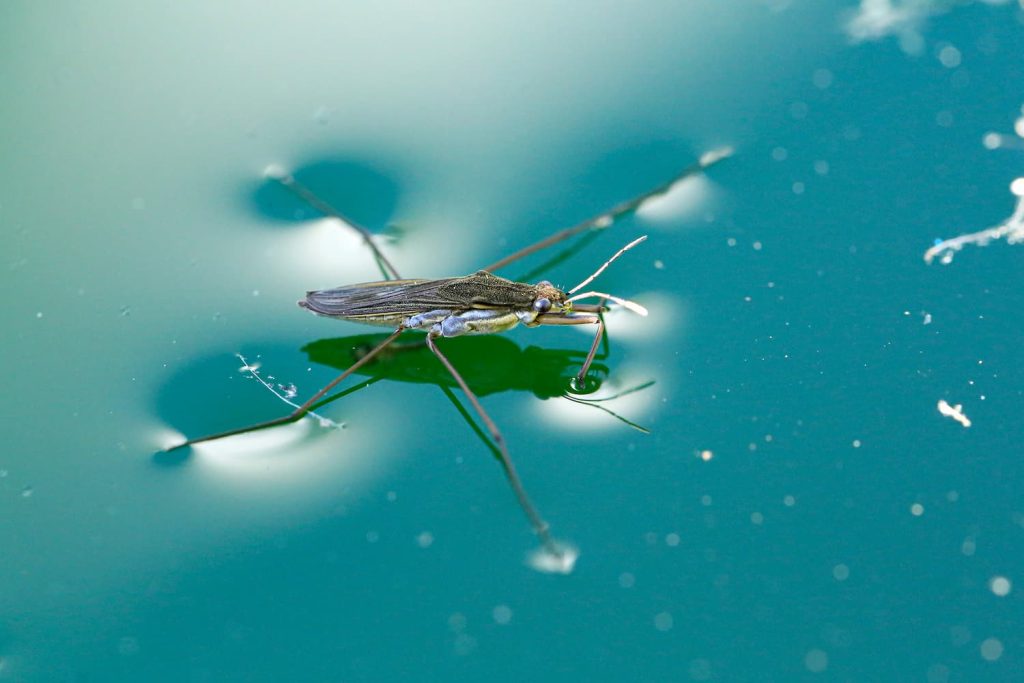
Table of Contents
Look closely at the surface and shallows of any healthy pond and you will find it teeming with insects. Some skate across the top, some row through the water, and some lurk on the bottom waiting to ambush prey. For most pond owners and community managers, the first questions are simple: what is that thing, will it bite me, and is it a sign of a problem?
The reassuring answer is that the vast majority of pond insects are harmless, beneficial, and a sign of a living, functioning waterbody. This guide identifies the most common pond insects, explains which few can bite, and shows what their presence reveals about your water quality.
Common pond insects include water striders, water boatmen, backswimmers, diving beetles, dragonfly and damselfly larvae, mayfly larvae, and mosquito larvae. Most are harmless and beneficial, forming the base of the pond food web. Their variety is generally a sign of a healthy pond, since many aquatic insects are sensitive to pollution.
Key Takeaways
- Most pond insects are harmless and beneficial, serving as food for fish, birds, and amphibians.
- Only a few bite. Backswimmers and giant water bugs can deliver a painful bite if handled, but water boatmen and most others cannot.
- Insect variety signals a healthy pond. Many aquatic insects are sensitive to pollution, so a diverse population is a good sign.
- The most confused pair is the water boatman and backswimmer. Swimming posture is the quickest way to tell them apart.
- Some insects help control mosquitoes. Backswimmers, dragonfly larvae, and diving beetles all prey on mosquito larvae.
What Kinds of Insects Live in Ponds?
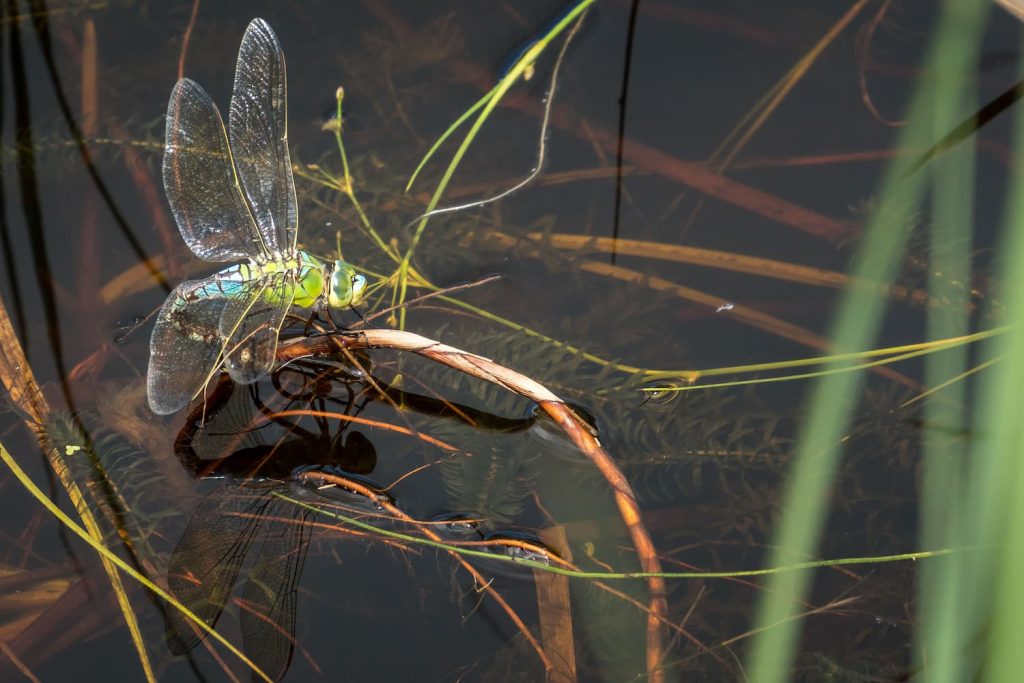
Ponds host a wide variety of insects, generally grouped by where they live: on the surface, swimming in the water column, or on the bottom. Surface dwellers include water striders. Swimmers include water boatmen, backswimmers, and diving beetles. Predatory larvae of dragonflies, damselflies, and mayflies develop underwater before emerging as adults.
Understanding these zones helps make sense of the variety, because each insect is adapted to a specific part of the pond.
Many of the insects people notice are the aquatic juvenile stages of familiar flying adults. Dragonflies, damselflies, mayflies, and caddisflies all lay their eggs in water, and their larvae, sometimes called nymphs, spend months or even years underwater before emerging. As the Susquehanna River Basin Commission notes, these insect larvae play an important role in freshwater ecosystems and are a key food source for fish.
Broadly, pond insects fall into a few groups:
- Surface skaters: Water striders that walk on the surface film.
- Active swimmers: Water boatmen, backswimmers, and diving beetles that move through the water column.
- Predatory larvae: Dragonfly and damselfly nymphs that hunt underwater.
- Filter feeders and grazers: Mayfly and caddisfly larvae that process organic matter.
- Surface-film dwellers: Mosquito larvae that hang just below the surface to breathe.
How Do You Identify Common Pond Insects?
You can identify most pond insects by size, body shape, how they move, and where in the water they are found. Water striders walk on the surface, water boatmen row along the bottom right-side up, backswimmers swim upside down, and diving beetles dart through open water. The table below summarizes the key identifying features.
The single most useful identification clue is often behavior, specifically how and where the insect swims.
Insect | Size | Key features | How it moves | Bites? |
|---|---|---|---|---|
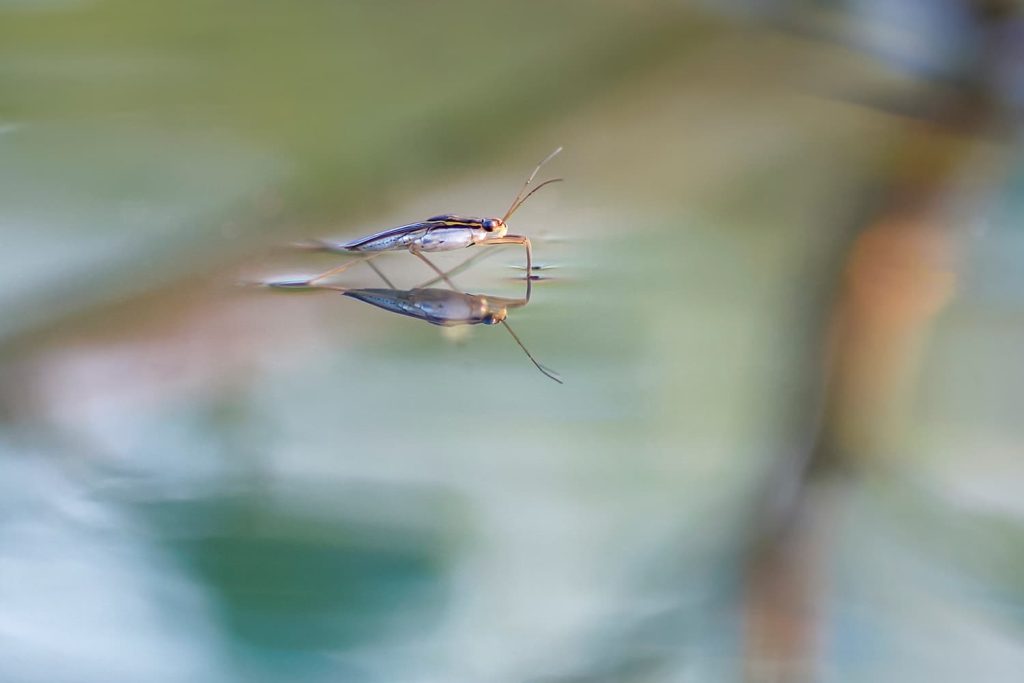
Water strider | 8 to 15 mm | Long thin legs, slender body | Walks on the surface film | No |
Water boatman | 3 to 12 mm | Oval, brown, fine crosslines on back | Rows right-side up, often near bottom | No |
Backswimmer | 8 to 16 mm | Light back, dark belly, keeled body | Swims upside down | Yes, painful |
Diving beetle | 5 to 40 mm | Smooth oval, hard shell, fringed hind legs | Darts through open water | Large ones can |
Dragonfly larva | 15 to 50 mm | Stocky, six legs, large eyes | Crawls, or jets by expelling water | No |
Damselfly larva | 10 to 35 mm | Slender, three leaf-like tail gills | Slow crawling and swimming | No |
Mayfly larva | 3 to 30 mm | Slender, usually three tail filaments | Crawls on bottom and plants | No |
Mosquito larva | 3 to 12 mm | Thin, wriggling, hangs at surface | Wriggles, hangs below surface film | No |
Each of these is covered in more detail below, with special attention to the two that cause the most confusion.
Water Boatman vs Backswimmer: What Is the Difference?

The quickest way to tell them apart is swimming posture: water boatmen swim right-side up, while backswimmers swim upside down. Water boatmen are smaller, brownish with fine crosslines, and harmless algae-eaters. Backswimmers have a pale back and dark belly, are predatory, and can deliver a painful bite if handled.
This is the most common identification question in all of pond life, and getting it right matters because one bites and the other does not.
According to the Missouri Department of Conservation, backswimmers are predaceous and can deliver a painful bite if mishandled, and they are often confused with water boatmen, which are not predaceous and do not bite. Water boatmen have a flatter body, are usually darker, and show noticeable parallel crosslines on the back.
The distinctions that matter:
- Swimming posture. Backswimmers swim belly-up, on their backs. Water boatmen swim normally, right-side up. This is the fastest tell.
- Diet. Water boatmen are largely herbivorous, feeding on algae and diatoms. Backswimmers are predators that hunt other insects, mosquito larvae, and even small fish.
- Coloring. Backswimmers have a light back and dark underside. Water boatmen are uniformly brownish with fine dark crosslines.
- Biting. Backswimmers can bite in self-defense if grabbed, sometimes earning the nickname “water wasp.” Water boatmen cannot bite people at all.
Reports of a “water boatman bite,” which are common around swimming pools, are almost always backswimmers that were misidentified. If something in the water bit you, it was very likely a backswimmer.
Which Pond Insects Actually Bite?
Very few pond insects bite people. Backswimmers and giant water bugs are the main ones, and both only bite defensively when handled or stepped on. Their bites are painful but not dangerous to healthy people, comparable to a bee sting. Water boatmen, water striders, and the larvae of dragonflies, mayflies, and damselflies do not bite humans.
Because fear of biting bugs is what drives many pond-insect searches, it is worth being precise rather than alarmist.
The insects capable of biting:
- Backswimmers. Deliver a sharp, wasp-like bite if handled, using the same beak they use to hunt prey. Painful but harmless to most people.
- Giant water bugs. Large predators, sometimes called “toe-biters,” that can inflict a genuinely painful bite when stepped on or handled. Impressive but not medically dangerous to healthy adults.
- Large diving beetles. Can pinch or nip if grabbed, though this is uncommon.
The insects that cannot or effectively do not bite include water boatmen, water striders, dragonfly larvae, damselfly larvae, mayfly larvae, caddisfly larvae, and mosquito larvae. The adult mosquito, of course, is the biting stage, but the aquatic larva does not bite.
The practical takeaway: do not pick up pond insects with bare hands, and biting is essentially never a problem if you simply leave them alone. None of these insects seek out or pursue people.
Protect Your Pond From Biting Insects
Pond Guru can treat your waterbody for mosquito and midge larvae to limit those biting nuisances.
What Do Pond Insects Tell You About Water Quality?
The variety of insects in a pond is a useful indicator of its water quality. Many aquatic insects, especially mayfly larvae, are highly sensitive to pollution, so their presence suggests clean water. A pond with only a few pollution-tolerant species may signal a water quality problem worth investigating.
This is where pond insects become genuinely useful to a property manager: they are a free, living water quality gauge.
Scientists formalize this through the EPT index. As the Ausable Freshwater Center explains, the index is named for three insect orders, Ephemeroptera (mayflies), Plecoptera (stoneflies), and Trichoptera (caddisflies), that are sensitive to declining water quality and are not typically found in polluted or disturbed water. The more of these sensitive insects present, the better the water quality.
A rough hierarchy of what insects suggest:
- Sensitive, clean-water indicators: Mayfly larvae are among the most pollution-sensitive. Their presence is a good sign.
- Moderately tolerant: Dragonfly and damselfly larvae, and many beetles, tolerate a range of conditions.
- Pollution-tolerant: Certain species, and an abundance of mosquito larvae with little else, can indicate poorer conditions or stagnation.
A important caution: insect observation is a helpful clue, not a substitute for measurement. If insect life seems sparse or skewed toward tolerant species, that is a reason to confirm conditions through pond water quality testing rather than to guess. The insects tell you where to look; the test tells you what is actually happening.

Are Pond Insects Good or Bad for a Pond?
The vast majority of pond insects are beneficial. They form the base of the food web, feeding fish, birds, frogs, and turtles, and many prey on mosquito larvae, providing natural pest control. Only a few, primarily large numbers of mosquito larvae, are undesirable, and their abundance usually points to stagnant water rather than an insect problem.
It is worth reframing the whole question, because most pond insects are assets, not pests.
The benefits they provide:
- Food web foundation. Insects and their larvae are the primary food for pond fish, and for the wading birds, frogs, and turtles that make a pond feel alive.
- Natural mosquito control. Backswimmers, dragonfly larvae, and diving beetles all prey on mosquito larvae. A pond rich in these predators tends to have fewer mosquitoes, not more.
- Nutrient cycling. Larvae that process algae and organic debris help recycle nutrients through the system.
- Fish forage for stocked ponds. A healthy insect population supports the small fish that in turn support sport fish, which matters for any fish stocking program.
The main genuine nuisance is mosquito larvae in large numbers. The solution there is rarely to attack the insects directly and usually to address the conditions: reducing stagnation, improving circulation, and supporting the predators and fish that eat larvae. A balanced pond with good wildlife management and healthy vegetation tends to keep mosquitoes in check on its own.
How Can You Support a Healthy Pond Insect Community?
Support beneficial pond insects by maintaining good water quality, establishing native shoreline and aquatic plants, avoiding unnecessary pesticide use, and keeping water moving to prevent stagnation. A diverse, well-vegetated pond naturally develops a balanced insect community that supports wildlife and keeps nuisance species like mosquitoes in check.
A healthy insect population is less something you build directly and more something that follows from a healthy pond.
Practical measures:
- Establish native aquatic and shoreline plants, which provide habitat, cover, and egg-laying sites. This is a core benefit of littoral zone management.
- Keep water from stagnating, since still, low-oxygen water favors mosquitoes over most beneficial insects.
- Avoid broad pesticide use, which kills beneficial predators along with pests and can worsen mosquito problems by removing their natural controls.
- Maintain water quality, since the sensitive, desirable insects depend on it.
- Support fish and wildlife, which keep insect populations balanced through natural predation.
The through-line is that the same conditions that make a pond healthy overall, clean water, native plants, good circulation, and a balanced food web, are exactly what produce a diverse and beneficial insect community.
Schedule a Site Visit With Pond Guru
Pond insects are usually a sign that a waterbody is alive and functioning. When the balance tips, whether toward nuisance mosquitoes or away from the sensitive species that signal clean water, it usually reflects an underlying condition worth understanding.
Pond Guru works with HOA boards, property managers, and homeowners across Florida to test water quality, manage vegetation, support balanced wildlife, and keep community ponds healthy and enjoyable.
Because every pond’s conditions are different, the process starts with an on-site evaluation. To understand what is happening in your water, schedule a site visit with Pond Guru and a specialist will assess conditions and recommend a plan.

Frequently Asked Questions
Common pond insects include water striders that skate on the surface, water boatmen and backswimmers that swim in the water column, diving beetles, and the aquatic larvae of dragonflies, damselflies, mayflies, and mosquitoes. Most are harmless and beneficial, forming the base of the pond's food web.
Watch how it swims. Water boatmen swim right-side up, usually near the bottom, and are harmless algae-eaters. Backswimmers swim upside down, have a pale back and dark belly, are predatory, and can bite if handled. Swimming posture is the fastest and most reliable way to tell them apart.
Very few do. Backswimmers and giant water bugs can deliver a painful but harmless bite if handled or stepped on. Water boatmen, water striders, and the larvae of dragonflies and mayflies do not bite people. As a rule, pond insects only bite defensively, so leaving them alone avoids any problem.
Usually the opposite. Many aquatic insects, especially mayfly larvae, are sensitive to pollution, so a diverse insect community indicates clean, healthy water. A pond with very few insect types, or dominated by mosquito larvae, is more likely to signal a water quality or stagnation problem worth checking.
Support the natural predators that eat mosquito larvae, including backswimmers, dragonfly larvae, diving beetles, and fish. Keep water circulating to prevent stagnation, maintain native vegetation, and avoid broad pesticides that kill beneficial insects. A balanced, well-managed pond usually controls mosquitoes on its own.
Ready to Schedule a Visit ?
Have questions about your pond or lake? Our experts are ready to help you take the next step.
Latest Article
Popular Post

Why Keeping Culverts Clear of Debris Matters for Stormwater Systems
Table of Contents A culvert is one of those…
Table of Contents
Look closely at the surface and shallows of any healthy pond and you will find it teeming with insects. Some skate across the top, some row through the water, and some lurk on the bottom waiting to ambush prey. For most pond owners and community managers, the first questions are simple: what is that thing, will it bite me, and is it a sign of a problem?
The reassuring answer is that the vast majority of pond insects are harmless, beneficial, and a sign of a living, functioning waterbody. This guide identifies the most common pond insects, explains which few can bite, and shows what their presence reveals about your water quality.
Common pond insects include water striders, water boatmen, backswimmers, diving beetles, dragonfly and damselfly larvae, mayfly larvae, and mosquito larvae. Most are harmless and beneficial, forming the base of the pond food web. Their variety is generally a sign of a healthy pond, since many aquatic insects are sensitive to pollution.
Key Takeaways
- Most pond insects are harmless and beneficial, serving as food for fish, birds, and amphibians.
- Only a few bite. Backswimmers and giant water bugs can deliver a painful bite if handled, but water boatmen and most others cannot.
- Insect variety signals a healthy pond. Many aquatic insects are sensitive to pollution, so a diverse population is a good sign.
- The most confused pair is the water boatman and backswimmer. Swimming posture is the quickest way to tell them apart.
- Some insects help control mosquitoes. Backswimmers, dragonfly larvae, and diving beetles all prey on mosquito larvae.
What Kinds of Insects Live in Ponds?
Ponds host a wide variety of insects, generally grouped by where they live: on the surface, swimming in the water column, or on the bottom. Surface dwellers include water striders. Swimmers include water boatmen, backswimmers, and diving beetles. Predatory larvae of dragonflies, damselflies, and mayflies develop underwater before emerging as adults.
Understanding these zones helps make sense of the variety, because each insect is adapted to a specific part of the pond.
Many of the insects people notice are the aquatic juvenile stages of familiar flying adults. Dragonflies, damselflies, mayflies, and caddisflies all lay their eggs in water, and their larvae, sometimes called nymphs, spend months or even years underwater before emerging. As the Susquehanna River Basin Commission notes, these insect larvae play an important role in freshwater ecosystems and are a key food source for fish.
Broadly, pond insects fall into a few groups:
- Surface skaters: Water striders that walk on the surface film.
- Active swimmers: Water boatmen, backswimmers, and diving beetles that move through the water column.
- Predatory larvae: Dragonfly and damselfly nymphs that hunt underwater.
- Filter feeders and grazers: Mayfly and caddisfly larvae that process organic matter.
- Surface-film dwellers: Mosquito larvae that hang just below the surface to breathe.
How Do You Identify Common Pond Insects?
You can identify most pond insects by size, body shape, how they move, and where in the water they are found. Water striders walk on the surface, water boatmen row along the bottom right-side up, backswimmers swim upside down, and diving beetles dart through open water. The table below summarizes the key identifying features.
The single most useful identification clue is often behavior, specifically how and where the insect swims.
Water strider (8 to 15 mm): Long thin legs, slender body. Walks on the surface film. Does not bite.
Water boatman (3 to 12 mm): Oval, brown, with fine crosslines on the back. Rows right-side up, often near the bottom. Does not bite.
Backswimmer (8 to 16 mm): Light back, dark belly, keeled body. Swims upside down. Can bite, painfully.
Diving beetle (5 to 40 mm): Smooth oval, hard shell, fringed hind legs. Darts through open water. Large ones can nip.
Dragonfly larva (15 to 50 mm): Stocky, six legs, large eyes. Crawls, or jets by expelling water. Does not bite.
Damselfly larva (10 to 35 mm): Slender, with three leaf-like tail gills. Slow crawling and swimming. Does not bite.
Mayfly larva (3 to 30 mm): Slender, usually with three tail filaments. Crawls on the bottom and plants. Does not bite.
Mosquito larva (3 to 12 mm): Thin and wriggling, hangs at the surface. Wriggles and hangs below the surface film. Does not bite.
Each of these is covered in more detail below, with special attention to the two that cause the most confusion.
Water Boatman vs Backswimmer: What Is the Difference?
The quickest way to tell them apart is swimming posture: water boatmen swim right-side up, while backswimmers swim upside down. Water boatmen are smaller, brownish with fine crosslines, and harmless algae-eaters. Backswimmers have a pale back and dark belly, are predatory, and can deliver a painful bite if handled.
This is the most common identification question in all of pond life, and getting it right matters because one bites and the other does not.
According to the Missouri Department of Conservation, backswimmers are predaceous and can deliver a painful bite if mishandled, and they are often confused with water boatmen, which are not predaceous and do not bite. Water boatmen have a flatter body, are usually darker, and show noticeable parallel crosslines on the back.
The distinctions that matter:
- Swimming posture. Backswimmers swim belly-up, on their backs. Water boatmen swim normally, right-side up. This is the fastest tell.
- Diet. Water boatmen are largely herbivorous, feeding on algae and diatoms. Backswimmers are predators that hunt other insects, mosquito larvae, and even small fish.
- Coloring. Backswimmers have a light back and dark underside. Water boatmen are uniformly brownish with fine dark crosslines.
- Biting. Backswimmers can bite in self-defense if grabbed, sometimes earning the nickname “water wasp.” Water boatmen cannot bite people at all.
Reports of a “water boatman bite,” which are common around swimming pools, are almost always backswimmers that were misidentified. If something in the water bit you, it was very likely a backswimmer.
Which Pond Insects Actually Bite?
Very few pond insects bite people. Backswimmers and giant water bugs are the main ones, and both only bite defensively when handled or stepped on. Their bites are painful but not dangerous to healthy people, comparable to a bee sting. Water boatmen, water striders, and the larvae of dragonflies, mayflies, and damselflies do not bite humans.
Because fear of biting bugs is what drives many pond-insect searches, it is worth being precise rather than alarmist.
The insects capable of biting:
- Backswimmers. Deliver a sharp, wasp-like bite if handled, using the same beak they use to hunt prey. Painful but harmless to most people.
- Giant water bugs. Large predators, sometimes called “toe-biters,” that can inflict a genuinely painful bite when stepped on or handled. Impressive but not medically dangerous to healthy adults.
- Large diving beetles. Can pinch or nip if grabbed, though this is uncommon.
The insects that cannot or effectively do not bite include water boatmen, water striders, dragonfly larvae, damselfly larvae, mayfly larvae, caddisfly larvae, and mosquito larvae. The adult mosquito, of course, is the biting stage, but the aquatic larva does not bite.
The practical takeaway: do not pick up pond insects with bare hands, and biting is essentially never a problem if you simply leave them alone. None of these insects seek out or pursue people.
Protect Your Pond From Biting Insects
Pond Guru can treat your waterbody for mosquito and midge larvae to limit those biting nuisances.
What Do Pond Insects Tell You About Water Quality?
The variety of insects in a pond is a useful indicator of its water quality. Many aquatic insects, especially mayfly larvae, are highly sensitive to pollution, so their presence suggests clean water. A pond with only a few pollution-tolerant species may signal a water quality problem worth investigating.
This is where pond insects become genuinely useful to a property manager: they are a free, living water quality gauge.
Scientists formalize this through the EPT index. As the Ausable Freshwater Center explains, the index is named for three insect orders, Ephemeroptera (mayflies), Plecoptera (stoneflies), and Trichoptera (caddisflies), that are sensitive to declining water quality and are not typically found in polluted or disturbed water. The more of these sensitive insects present, the better the water quality.
A rough hierarchy of what insects suggest:
- Sensitive, clean-water indicators: Mayfly larvae are among the most pollution-sensitive. Their presence is a good sign.
- Moderately tolerant: Dragonfly and damselfly larvae, and many beetles, tolerate a range of conditions.
- Pollution-tolerant: Certain species, and an abundance of mosquito larvae with little else, can indicate poorer conditions or stagnation.
A important caution: insect observation is a helpful clue, not a substitute for measurement. If insect life seems sparse or skewed toward tolerant species, that is a reason to confirm conditions through pond water quality testing rather than to guess. The insects tell you where to look; the test tells you what is actually happening.
Are Pond Insects Good or Bad for a Pond?
The vast majority of pond insects are beneficial. They form the base of the food web, feeding fish, birds, frogs, and turtles, and many prey on mosquito larvae, providing natural pest control. Only a few, primarily large numbers of mosquito larvae, are undesirable, and their abundance usually points to stagnant water rather than an insect problem.
It is worth reframing the whole question, because most pond insects are assets, not pests.
The benefits they provide:
- Food web foundation. Insects and their larvae are the primary food for pond fish, and for the wading birds, frogs, and turtles that make a pond feel alive.
- Natural mosquito control. Backswimmers, dragonfly larvae, and diving beetles all prey on mosquito larvae. A pond rich in these predators tends to have fewer mosquitoes, not more.
- Nutrient cycling. Larvae that process algae and organic debris help recycle nutrients through the system.
- Fish forage for stocked ponds. A healthy insect population supports the small fish that in turn support sport fish, which matters for any fish stocking program.
The main genuine nuisance is mosquito larvae in large numbers. The solution there is rarely to attack the insects directly and usually to address the conditions: reducing stagnation, improving circulation, and supporting the predators and fish that eat larvae. A balanced pond with good wildlife management and healthy vegetation tends to keep mosquitoes in check on its own.
How Can You Support a Healthy Pond Insect Community?
Support beneficial pond insects by maintaining good water quality, establishing native shoreline and aquatic plants, avoiding unnecessary pesticide use, and keeping water moving to prevent stagnation. A diverse, well-vegetated pond naturally develops a balanced insect community that supports wildlife and keeps nuisance species like mosquitoes in check.
A healthy insect population is less something you build directly and more something that follows from a healthy pond.
Practical measures:
- Establish native aquatic and shoreline plants, which provide habitat, cover, and egg-laying sites. This is a core benefit of littoral zone management.
- Keep water from stagnating, since still, low-oxygen water favors mosquitoes over most beneficial insects.
- Avoid broad pesticide use, which kills beneficial predators along with pests and can worsen mosquito problems by removing their natural controls.
- Maintain water quality, since the sensitive, desirable insects depend on it.
- Support fish and wildlife, which keep insect populations balanced through natural predation.
The through-line is that the same conditions that make a pond healthy overall, clean water, native plants, good circulation, and a balanced food web, are exactly what produce a diverse and beneficial insect community.
Schedule a Site Visit With Pond Guru
Pond insects are usually a sign that a waterbody is alive and functioning. When the balance tips, whether toward nuisance mosquitoes or away from the sensitive species that signal clean water, it usually reflects an underlying condition worth understanding.
Pond Guru works with HOA boards, property managers, and homeowners across Florida to test water quality, manage vegetation, support balanced wildlife, and keep community ponds healthy and enjoyable.
Because every pond’s conditions are different, the process starts with an on-site evaluation. To understand what is happening in your water, schedule a site visit with Pond Guru and a specialist will assess conditions and recommend a plan.
Frequently Asked Questions
Common pond insects include water striders that skate on the surface, water boatmen and backswimmers that swim in the water column, diving beetles, and the aquatic larvae of dragonflies, damselflies, mayflies, and mosquitoes. Most are harmless and beneficial, forming the base of the pond's food web.
Watch how it swims. Water boatmen swim right-side up, usually near the bottom, and are harmless algae-eaters. Backswimmers swim upside down, have a pale back and dark belly, are predatory, and can bite if handled. Swimming posture is the fastest and most reliable way to tell them apart.
Very few do. Backswimmers and giant water bugs can deliver a painful but harmless bite if handled or stepped on. Water boatmen, water striders, and the larvae of dragonflies and mayflies do not bite people. As a rule, pond insects only bite defensively, so leaving them alone avoids any problem.
Usually the opposite. Many aquatic insects, especially mayfly larvae, are sensitive to pollution, so a diverse insect community indicates clean, healthy water. A pond with very few insect types, or dominated by mosquito larvae, is more likely to signal a water quality or stagnation problem worth checking.
Support the natural predators that eat mosquito larvae, including backswimmers, dragonfly larvae, diving beetles, and fish. Keep water circulating to prevent stagnation, maintain native vegetation, and avoid broad pesticides that kill beneficial insects. A balanced, well-managed pond usually controls mosquitoes on its own.
Ready to Schedule a Visit ?
Have questions about your pond or lake? Our experts are ready to help you take the next step.
Latest Article
Popular Post
Why Keeping Culverts Clear of Debris Matters for Stormwater Systems
Table of Contents A culvert is one of those…