

Erosion Control Blankets for Pond Banks
Erosion Control Blankets for Pond Banks
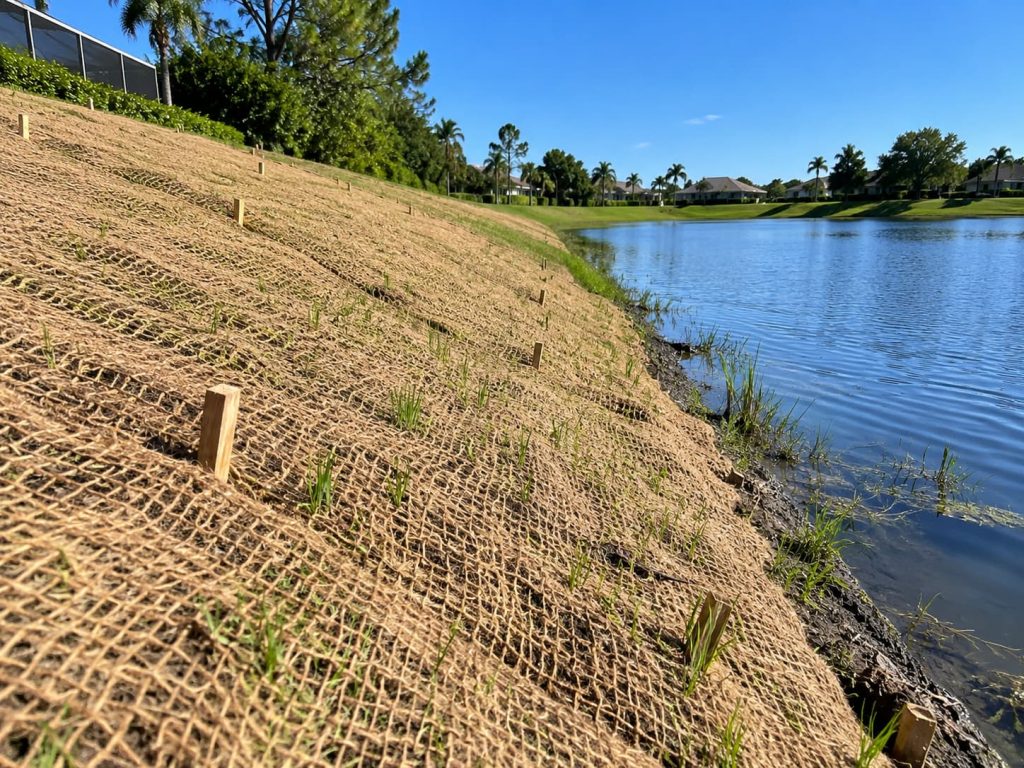
Table of Contents
A freshly graded or replanted pond bank is at its most vulnerable right after the work is done, before any roots have taken hold. One hard rain can wash away the soil and the seed with it. Erosion control blankets solve that problem, holding the soil and seed in place long enough for vegetation to establish and take over the job permanently. For a pond shoreline fighting erosion, they are one of the most practical and cost-effective tools available.
This guide explains what erosion control blankets are, how they work, the main types, when to use them, and how they are installed on a pond bank.
An erosion control blanket is a biodegradable mat of straw, coconut fiber, or wood fibers laid over a graded, seeded pond bank. It holds soil and seed in place against rain and runoff while vegetation establishes. As the plants root through it and the blanket breaks down, the roots take over erosion control permanently.
Key Takeaways
- Erosion control blankets protect bare soil on a pond bank while vegetation establishes.
- They are biodegradable, made from straw, coconut coir, or wood fibers that break down over time.
- They hold soil and seed in place against rain, runoff, and wave energy during the vulnerable establishment period.
- Different types last different lengths, with coir lasting longest for shorelines and high-flow areas.
- They are a temporary bridge, with established plant roots taking over erosion control once the blanket breaks down.
What Is an Erosion Control Blanket?
An erosion control blanket is a biodegradable mat laid over exposed soil to protect it from erosion while vegetation establishes. Made from natural fibers like straw, coconut coir, or wood excelsior held together with netting, it shields a graded, seeded bank from rain and runoff, holds the seed in place, and breaks down as plants root through it.
Understanding the blanket as a temporary shield for bare soil is the key to how it works.
As erosion control resources describe, these blankets, sometimes called erosion control matting, are rolled out over prepared soil and anchored, providing immediate protection while slower natural processes take hold. Key features:
- Material. Natural biodegradable fibers, commonly straw, coconut coir, or wood excelsior, bound with netting.
- Purpose. To protect bare, vulnerable soil from erosion during the period before vegetation establishes.
- Function. It holds soil and seed in place, absorbs the impact of rain, and slows runoff across the surface.
- Lifespan. It is biodegradable, breaking down over months to a few years depending on the material.
The blanket is a bridge, not a permanent structure. Its whole purpose is to protect the bank during the vulnerable window after grading and seeding, until the vegetation it shelters can take over the job of holding the soil. This makes it a natural complement to erosion control and shoreline restoration work.

How Does an Erosion Control Blanket Work?
An erosion control blanket works by covering bare soil to absorb the impact of rain, slow runoff, and hold soil and seed in place while plants germinate and root. As vegetation grows up through the blanket, its roots bind the soil, and the blanket gradually breaks down, leaving the established plants to control erosion permanently.
The blanket does its job in stages, handing off to vegetation over time.
How it protects a bank:
- It absorbs rain impact. The blanket takes the force of raindrops that would otherwise dislodge and splash away bare soil.
- It slows runoff. By covering the surface, it reduces the speed of water running down the slope, which limits its ability to carry soil away.
- It holds soil and seed. It keeps the graded soil and the seed beneath it in place rather than letting them wash off.
- It lets plants root through. Vegetation germinates and grows up through the open mesh, with roots anchoring into the soil below.
- It breaks down. As the biodegradable fibers decompose, the now-established plant roots take over erosion control.
This staged handoff is the elegant part of the system. The blanket provides immediate, temporary protection exactly when the bank is most exposed, then disappears as the permanent solution, plant roots, takes hold. On a pond bank, this is especially valuable because the shoreline faces not only rain and runoff but sometimes wave action, all while new vegetation is trying to establish. Pairing the blanket with native littoral and buffer plantings gives the vegetation the best chance to establish.
Protect Your Shoreline with Erosion Control Solutions
Pond Guru can help install erosion control blankets and other shoreline repair solutions to stabilize your lake’s shoreline.
What Are the Types of Erosion Control Blankets?

The main types of erosion control blankets differ by material and lifespan: straw blankets for short-term protection on gentle slopes, coconut coir blankets for long-lasting protection on shorelines and high-flow areas, and blends or excelsior for intermediate needs. The right type depends on the slope, water exposure, and how long protection is needed.
Matching the blanket type to the site is what makes it effective.
Blanket type | Lasts | Best for |
|---|---|---|
Straw | Short term, months | Gentle slopes, low flow, quick establishment |
Straw-coconut blend | Intermediate | Moderate slopes and flow |
Coconut coir | Longest, often years | Shorelines, high flow, wave exposure |
Wood excelsior | Intermediate to long | Moderate to steep slopes |
Straw blankets are the lightest-duty and shortest-lived, suited to gentle slopes where vegetation establishes quickly and water exposure is low. They break down fastest and cost the least.
Coconut coir blankets are the most durable, resisting breakdown for a longer period, which makes them well suited to pond shorelines, areas with wave action, and higher-flow situations where protection is needed for longer. Blends of straw and coconut, and wood excelsior blankets, fill the middle ground for moderate conditions. For a pond bank at the waterline, where wave energy and longer establishment times are factors, the more durable coir or blended options are often the better fit. A professional assessment matches the blanket to the specific shoreline.
When Should You Use an Erosion Control Blanket?
Use an erosion control blanket whenever you have graded, seeded, or replanted a pond bank and need to protect the bare soil until vegetation establishes. They are ideal after shoreline restoration, regrading, or replanting, on slopes vulnerable to rain and runoff, and anywhere new plantings need time to root before they can hold the soil themselves.
The common thread is protecting bare soil during the establishment window.
Situations that call for an erosion control blanket:
- After shoreline restoration or regrading. Freshly graded soil is highly erodible until plants establish, making the blanket essential.
- After seeding or replanting. The blanket holds seed and new plantings in place and protects them during germination and rooting.
- On vulnerable slopes. Banks exposed to rain, runoff, or wave action benefit from the immediate protection a blanket provides.
- Where vegetation needs time. Any situation where the long-term solution is established vegetation, but the plants are not yet rooted, is a fit.
The key insight is timing. An erosion control blanket is not a permanent structure like riprap; it is a temporary tool for the specific period when a bank is bare and vulnerable. Used at the right moment, after grading and seeding, it dramatically improves the odds that vegetation establishes successfully and that the bank does not wash away in the meantime. For banks facing severe, ongoing erosion forces, a harder solution like riprap may be needed instead of or alongside vegetation, which a professional assessment determines.

How Is an Erosion Control Blanket Installed?
An erosion control blanket is installed by grading and seeding the bank, rolling the blanket out over the prepared soil so it lies flat in full contact with the ground, anchoring it with stakes or staples, and overlapping adjacent rolls. Good soil contact and secure anchoring are essential so water cannot flow underneath it.
Proper installation is what separates a blanket that works from one that fails.
The basic installation steps:
- Prepare the soil. Grade the bank to the desired slope and seed or plant it before laying the blanket.
- Roll it out. Unroll the blanket over the prepared soil, running it in the direction of water flow, so it lies flat in full contact with the ground.
- Ensure soil contact. The blanket must sit flush against the soil with no gaps, since water flowing underneath would defeat its purpose and cause erosion beneath it.
- Anchor it. Secure the blanket with stakes or staples at the recommended spacing, including along edges and seams.
- Overlap seams. Overlap adjacent rolls and anchor the overlaps so water cannot get underneath at the joints.
The two most important details are full soil contact and secure anchoring. A blanket that bridges over dips or is poorly staked lets water run beneath it, which can erode the soil it was meant to protect. On a pond bank, the installation also has to account for the waterline, anchoring securely where the bank meets the water. Because correct installation is critical to the result, and because it is often paired with grading and planting, shoreline blanket work is frequently done as part of a professional restoration.
Schedule a Site Visit With Pond Guru
Erosion control blankets are a simple, effective way to protect a pond bank through its most vulnerable stage, the window after grading and seeding when bare soil can wash away before plants take hold. Matched to the right type and installed correctly, they give vegetation the chance to establish and take over erosion control for good.
Pond Guru works with HOA boards, property managers, and homeowners across Florida to restore and stabilize shorelines, control erosion, and establish the native vegetation that protects a bank long term, using erosion control blankets, plantings, and harder solutions as each site requires.
Because the right approach depends on your bank’s slope, water exposure, and condition, the process starts with an on-site evaluation. To protect and restore your pond shoreline, schedule a site visit with Pond Guru and a specialist will assess conditions and recommend a plan.

Frequently Asked Questions
An erosion control blanket is a biodegradable mat of straw, coconut coir, or wood fibers laid over a graded, seeded pond bank. It holds soil and seed in place against rain and runoff while vegetation establishes. As plants root through it and the blanket breaks down, the roots take over erosion control permanently, making it a temporary bridge to established vegetation.
It depends on the material. Straw blankets break down fastest, lasting a few months, suited to gentle slopes with quick vegetation establishment. Coconut coir blankets last longest, often a few years, making them ideal for shorelines and high-flow areas. The goal is for the blanket to last just long enough for vegetation to establish and take over.
For a pond shoreline, longer-lasting coconut coir or straw-coconut blended blankets are often the best fit, because the waterline faces wave action and vegetation can take longer to establish there. More durable blankets provide protection for the extended period a shoreline needs. A professional assessment matches the blanket to the specific slope and water exposure.
Generally, you grade and seed or plant the bank first, then lay the blanket over the prepared, seeded soil. The blanket holds the seed in place and protects it while it germinates, and vegetation grows up through the open mesh. Live plantings may also be installed through the blanket, depending on the restoration approach.
An erosion control blanket is anchored with stakes or staples driven through it into the soil at a recommended spacing, including along all edges and seams, with adjacent rolls overlapped and anchored. The blanket must lie in full contact with the soil so water cannot flow underneath it, which is essential to prevent erosion beneath the blanket.
Ready to Schedule a Visit ?
Have questions about your pond or lake? Our experts are ready to help you take the next step.
Latest Article
Popular Post

Erosion Control Blankets for Pond Banks
Table of Contents A freshly graded or replanted pond…
Table of Contents
A freshly graded or replanted pond bank is at its most vulnerable right after the work is done, before any roots have taken hold. One hard rain can wash away the soil and the seed with it. Erosion control blankets solve that problem, holding the soil and seed in place long enough for vegetation to establish and take over the job permanently. For a pond shoreline fighting erosion, they are one of the most practical and cost-effective tools available.
This guide explains what erosion control blankets are, how they work, the main types, when to use them, and how they are installed on a pond bank.
An erosion control blanket is a biodegradable mat of straw, coconut fiber, or wood fibers laid over a graded, seeded pond bank. It holds soil and seed in place against rain and runoff while vegetation establishes. As the plants root through it and the blanket breaks down, the roots take over erosion control permanently.
Key Takeaways
- Erosion control blankets protect bare soil on a pond bank while vegetation establishes.
- They are biodegradable, made from straw, coconut coir, or wood fibers that break down over time.
- They hold soil and seed in place against rain, runoff, and wave energy during the vulnerable establishment period.
- Different types last different lengths, with coir lasting longest for shorelines and high-flow areas.
- They are a temporary bridge, with established plant roots taking over erosion control once the blanket breaks down.
What Is an Erosion Control Blanket?
An erosion control blanket is a biodegradable mat laid over exposed soil to protect it from erosion while vegetation establishes. Made from natural fibers like straw, coconut coir, or wood excelsior held together with netting, it shields a graded, seeded bank from rain and runoff, holds the seed in place, and breaks down as plants root through it.
Understanding the blanket as a temporary shield for bare soil is the key to how it works.
As erosion control resources describe, these blankets, sometimes called erosion control matting, are rolled out over prepared soil and anchored, providing immediate protection while slower natural processes take hold. Key features:
- Material. Natural biodegradable fibers, commonly straw, coconut coir, or wood excelsior, bound with netting.
- Purpose. To protect bare, vulnerable soil from erosion during the period before vegetation establishes.
- Function. It holds soil and seed in place, absorbs the impact of rain, and slows runoff across the surface.
- Lifespan. It is biodegradable, breaking down over months to a few years depending on the material.
The blanket is a bridge, not a permanent structure. Its whole purpose is to protect the bank during the vulnerable window after grading and seeding, until the vegetation it shelters can take over the job of holding the soil. This makes it a natural complement to erosion control and shoreline restoration work.
How Does an Erosion Control Blanket Work?
An erosion control blanket works by covering bare soil to absorb the impact of rain, slow runoff, and hold soil and seed in place while plants germinate and root. As vegetation grows up through the blanket, its roots bind the soil, and the blanket gradually breaks down, leaving the established plants to control erosion permanently.
The blanket does its job in stages, handing off to vegetation over time.
How it protects a bank:
- It absorbs rain impact. The blanket takes the force of raindrops that would otherwise dislodge and splash away bare soil.
- It slows runoff. By covering the surface, it reduces the speed of water running down the slope, which limits its ability to carry soil away.
- It holds soil and seed. It keeps the graded soil and the seed beneath it in place rather than letting them wash off.
- It lets plants root through. Vegetation germinates and grows up through the open mesh, with roots anchoring into the soil below.
- It breaks down. As the biodegradable fibers decompose, the now-established plant roots take over erosion control.
This staged handoff is the elegant part of the system. The blanket provides immediate, temporary protection exactly when the bank is most exposed, then disappears as the permanent solution, plant roots, takes hold. On a pond bank, this is especially valuable because the shoreline faces not only rain and runoff but sometimes wave action, all while new vegetation is trying to establish. Pairing the blanket with native littoral and buffer plantings gives the vegetation the best chance to establish.
Protect Your Shoreline with Erosion Control Solutions
Pond Guru can help install erosion control blankets and other shoreline repair solutions to stabilize your lake’s shoreline.
What Are the Types of Erosion Control Blankets?

The main types of erosion control blankets differ by material and lifespan: straw blankets for short-term protection on gentle slopes, coconut coir blankets for long-lasting protection on shorelines and high-flow areas, and blends or excelsior for intermediate needs. The right type depends on the slope, water exposure, and how long protection is needed.
Matching the blanket type to the site is what makes it effective.
Blanket type | Lasts | Best for |
|---|---|---|
Straw | Short term, months | Gentle slopes, low flow, quick establishment |
Straw-coconut blend | Intermediate | Moderate slopes and flow |
Coconut coir | Longest, often years | Shorelines, high flow, wave exposure |
Wood excelsior | Intermediate to long | Moderate to steep slopes |
Straw blankets are the lightest-duty and shortest-lived, suited to gentle slopes where vegetation establishes quickly and water exposure is low. They break down fastest and cost the least.
Coconut coir blankets are the most durable, resisting breakdown for a longer period, which makes them well suited to pond shorelines, areas with wave action, and higher-flow situations where protection is needed for longer. Blends of straw and coconut, and wood excelsior blankets, fill the middle ground for moderate conditions. For a pond bank at the waterline, where wave energy and longer establishment times are factors, the more durable coir or blended options are often the better fit. A professional assessment matches the blanket to the specific shoreline.
When Should You Use an Erosion Control Blanket?
Use an erosion control blanket whenever you have graded, seeded, or replanted a pond bank and need to protect the bare soil until vegetation establishes. They are ideal after shoreline restoration, regrading, or replanting, on slopes vulnerable to rain and runoff, and anywhere new plantings need time to root before they can hold the soil themselves.
The common thread is protecting bare soil during the establishment window.
Situations that call for an erosion control blanket:
- After shoreline restoration or regrading. Freshly graded soil is highly erodible until plants establish, making the blanket essential.
- After seeding or replanting. The blanket holds seed and new plantings in place and protects them during germination and rooting.
- On vulnerable slopes. Banks exposed to rain, runoff, or wave action benefit from the immediate protection a blanket provides.
- Where vegetation needs time. Any situation where the long-term solution is established vegetation, but the plants are not yet rooted, is a fit.
The key insight is timing. An erosion control blanket is not a permanent structure like riprap; it is a temporary tool for the specific period when a bank is bare and vulnerable. Used at the right moment, after grading and seeding, it dramatically improves the odds that vegetation establishes successfully and that the bank does not wash away in the meantime. For banks facing severe, ongoing erosion forces, a harder solution like riprap may be needed instead of or alongside vegetation, which a professional assessment determines.
How Is an Erosion Control Blanket Installed?
An erosion control blanket is installed by grading and seeding the bank, rolling the blanket out over the prepared soil so it lies flat in full contact with the ground, anchoring it with stakes or staples, and overlapping adjacent rolls. Good soil contact and secure anchoring are essential so water cannot flow underneath it.
Proper installation is what separates a blanket that works from one that fails.
The basic installation steps:
- Prepare the soil. Grade the bank to the desired slope and seed or plant it before laying the blanket.
- Roll it out. Unroll the blanket over the prepared soil, running it in the direction of water flow, so it lies flat in full contact with the ground.
- Ensure soil contact. The blanket must sit flush against the soil with no gaps, since water flowing underneath would defeat its purpose and cause erosion beneath it.
- Anchor it. Secure the blanket with stakes or staples at the recommended spacing, including along edges and seams.
- Overlap seams. Overlap adjacent rolls and anchor the overlaps so water cannot get underneath at the joints.
The two most important details are full soil contact and secure anchoring. A blanket that bridges over dips or is poorly staked lets water run beneath it, which can erode the soil it was meant to protect. On a pond bank, the installation also has to account for the waterline, anchoring securely where the bank meets the water. Because correct installation is critical to the result, and because it is often paired with grading and planting, shoreline blanket work is frequently done as part of a professional restoration.
Schedule a Site Visit With Pond Guru

Erosion control blankets are a simple, effective way to protect a pond bank through its most vulnerable stage, the window after grading and seeding when bare soil can wash away before plants take hold. Matched to the right type and installed correctly, they give vegetation the chance to establish and take over erosion control for good.
Pond Guru works with HOA boards, property managers, and homeowners across Florida to restore and stabilize shorelines, control erosion, and establish the native vegetation that protects a bank long term, using erosion control blankets, plantings, and harder solutions as each site requires.
Because the right approach depends on your bank’s slope, water exposure, and condition, the process starts with an on-site evaluation. To protect and restore your pond shoreline, schedule a site visit with Pond Guru and a specialist will assess conditions and recommend a plan.
Frequently Asked Questions
An erosion control blanket is a biodegradable mat of straw, coconut coir, or wood fibers laid over a graded, seeded pond bank. It holds soil and seed in place against rain and runoff while vegetation establishes. As plants root through it and the blanket breaks down, the roots take over erosion control permanently, making it a temporary bridge to established vegetation.
It depends on the material. Straw blankets break down fastest, lasting a few months, suited to gentle slopes with quick vegetation establishment. Coconut coir blankets last longest, often a few years, making them ideal for shorelines and high-flow areas. The goal is for the blanket to last just long enough for vegetation to establish and take over.
For a pond shoreline, longer-lasting coconut coir or straw-coconut blended blankets are often the best fit, because the waterline faces wave action and vegetation can take longer to establish there. More durable blankets provide protection for the extended period a shoreline needs. A professional assessment matches the blanket to the specific slope and water exposure.
Generally, you grade and seed or plant the bank first, then lay the blanket over the prepared, seeded soil. The blanket holds the seed in place and protects it while it germinates, and vegetation grows up through the open mesh. Live plantings may also be installed through the blanket, depending on the restoration approach.
An erosion control blanket is anchored with stakes or staples driven through it into the soil at a recommended spacing, including along all edges and seams, with adjacent rolls overlapped and anchored. The blanket must lie in full contact with the soil so water cannot flow underneath it, which is essential to prevent erosion beneath the blanket.
Ready to Schedule a Visit ?
Have questions about your pond or lake? Our experts are ready to help you take the next step.
Latest Article
Popular Post
Erosion Control Blankets for Pond Banks
Table of Contents A freshly graded or replanted pond…